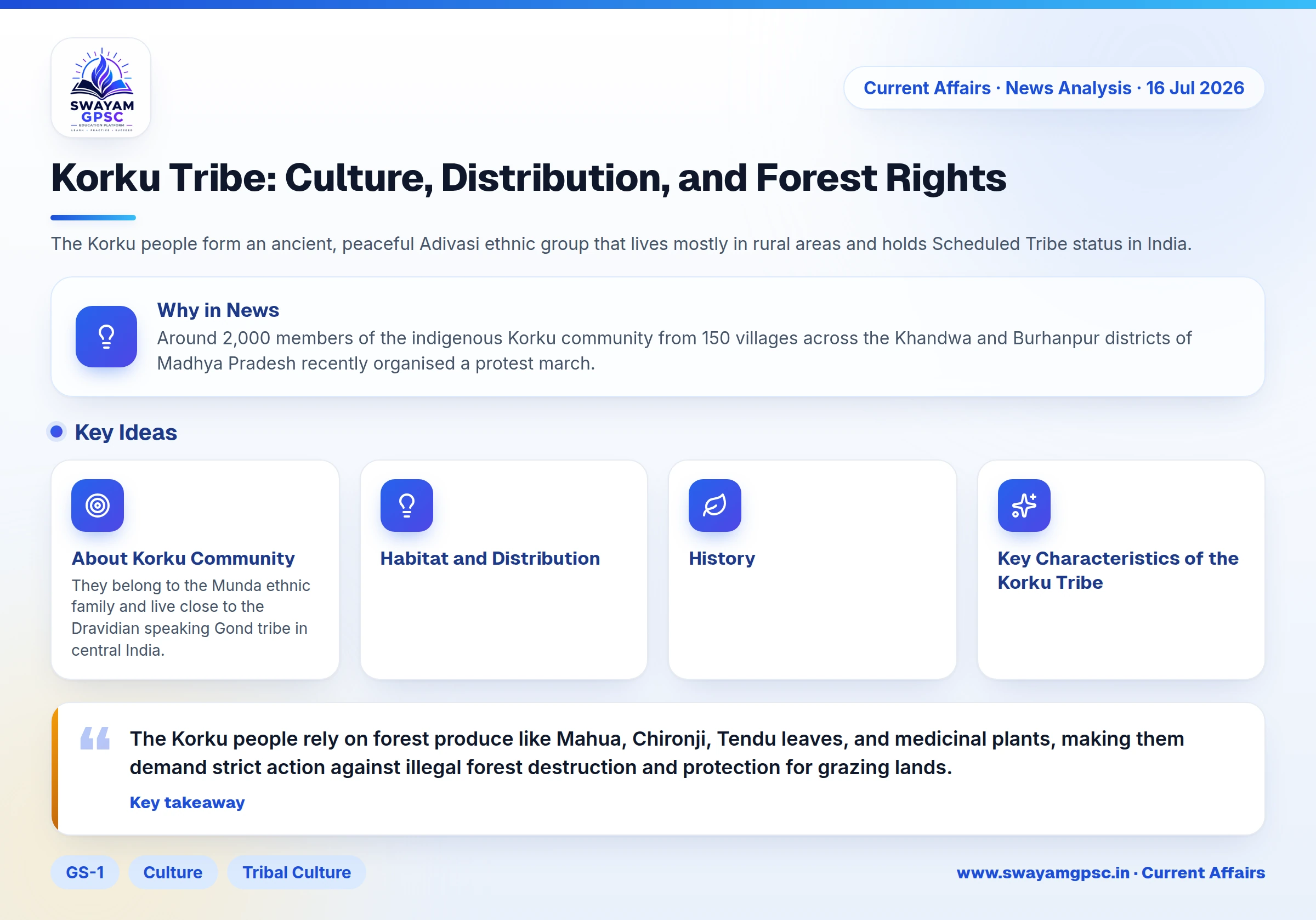
Korku Tribe: Culture, Distribution, and Forest Rights
#GS-1 #Culture #Tribal Culture #GS-2 #Indian Society #Vulnerable Sections #GS-3 #Environment #Biodiversity #Current Events #National #Scheduled Tribes #Korku Tribe
Why in News
- Around 2,000 members of the indigenous Korku community from 150 villages across the Khandwa and Burhanpur districts of Madhya Pradesh recently organised a protest march.
About Korku Community
- The Korku people form an ancient, peaceful Adivasi ethnic group that lives mostly in rural areas and holds Scheduled Tribe status in India.
- They belong to the Munda ethnic family and live close to the Dravidian speaking Gond tribe in central India.
Habitat and Distribution
- The main population of this community lives across the Khandwa, Burhanpur, Betul, and Chhindwara districts in southern Madhya Pradesh.
- They also live in the neighbouring northern areas of Maharashtra, especially around the hills near the Melghat Tiger Reserve in Amravati district.
History
- Historically, the Korku people lived as hunter-gatherers in the dense forests of the Satpura Mountain Range along the Tapti River.
- Over many centuries, they shifted away from hunting and gathering to practice settled farming as their main livelihood.
Key Characteristics of the Korku Tribe
- They speak the Korku language, an endangered Austroasiatic Munda language that people usually write using the Devanagari script.
- The Korku Panchayat manages village administration, led by a Patel with support from the Padihar, Kotwar, and community elders.
- Their villages feature neat rows of thatched huts with raised wooden platforms for storing harvested crops and cattle fodder.
- They practice seasonal double cropping of cereals, pulses, and oilseeds, with community members in Bhainsdehi starting local potato and coffee farming.
- The community divides into four sub-sects and 16 gotras based on nature elements, which guide their marriage alliances.
- During the Hari and Jitori festivals, community members plant trees to protect the environment and ensure local food security.
Significance and Forest Rights Issues
- The Korku people rely on forest produce like Mahua, Chironji, Tendu leaves, and medicinal plants, making them demand strict action against illegal forest destruction and protection for grazing lands.
- Increasing land pressure and conflicting claims over forest areas have created disputes, prompting the community to request stronger boundary protections, active Joint Forest Management (JFM) bodies, and steps to prevent re-encroachment.