The Kishau Multi-Purpose Dam Project
#GS-2 #GS-3 #Economy #Infrastructure #Environment #Water Resources #National #Current Events
Key takeaways
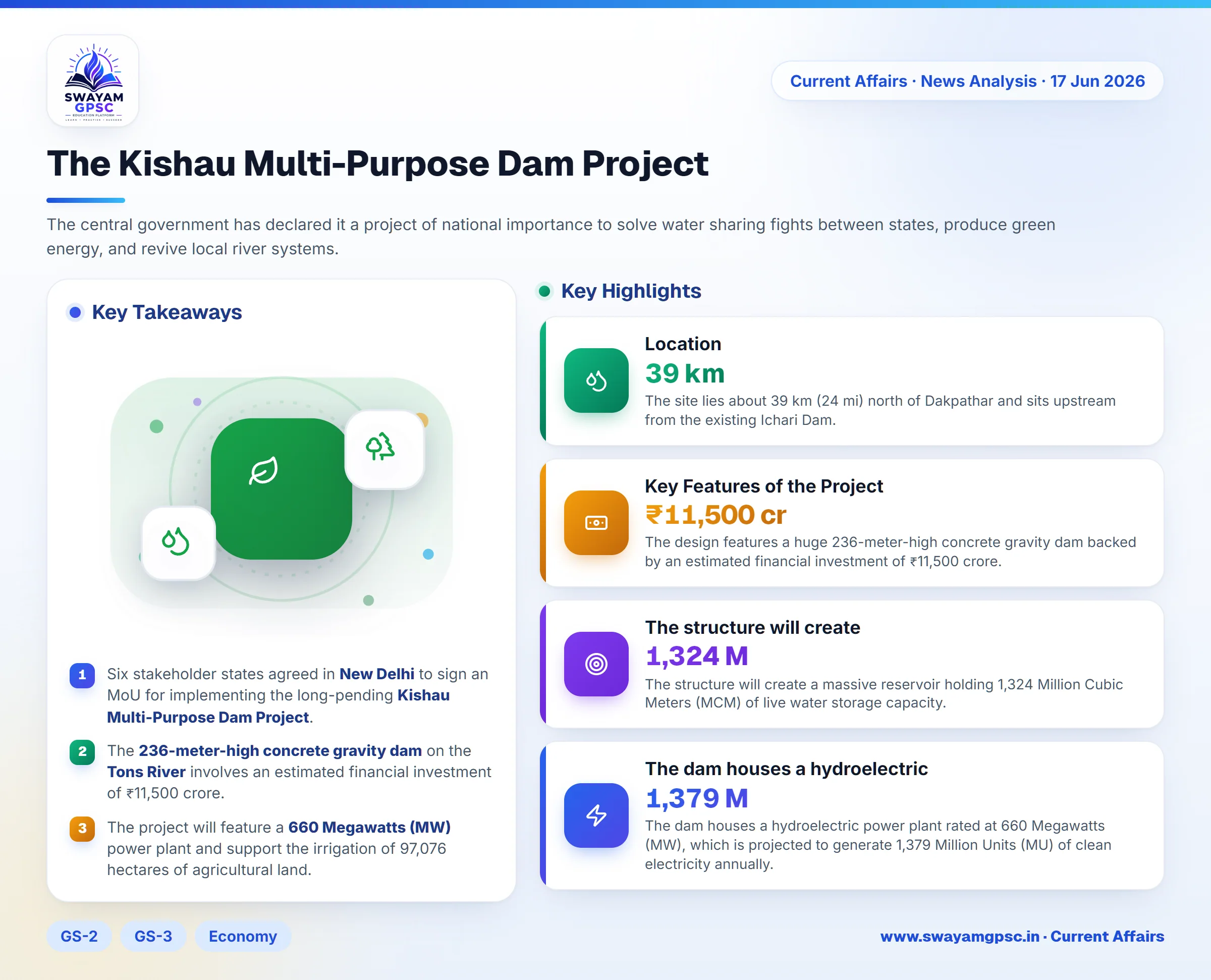
- Six stakeholder states agreed in New Delhi to sign an MoU for implementing the long-pending Kishau Multi-Purpose Dam Project.
- The 236-meter-high concrete gravity dam on the Tons River involves an estimated financial investment of ₹11,500 crore.
- The project will feature a 660 Megawatts (MW) power plant and support the irrigation of 97,076 hectares of agricultural land.
- The Central Government will fund 90 percent of the water component, with full project completion scheduled for 2028.
Why in News
- The Union Home Minister led an important meeting in New Delhi where six states reached a historic agreement to start the long-delayed Kishau Multi-Purpose Dam Project.
- The six participating states of Himachal Pradesh, Uttarakhand, Haryana, Delhi, Uttar Pradesh and Rajasthan agreed to sign a formal memorandum of understanding (MoU).
About The Kishau Multi-Purpose Dam
- The Kishau Multi-Purpose Dam Project is a massive water infrastructure and hydro-power initiative currently under development.
- The central government has declared it a project of national importance to solve water sharing fights between states, produce green energy, and revive local river systems.
Location
- Workers are building the dam across the Tons River, which is a main feeder stream of the Yamuna River.
- The site lies about 39 km (24 mi) north of Dakpathar and sits upstream from the existing Ichari Dam.
- The huge structure physically sits right across the state boundary dividing Himachal Pradesh and Uttarakhand.
Aim
- The project aims to create a broad water management system to supply safe drinking water to downstream areas.
- It seeks to expand farm irrigation across northern India and generate peak-load hydroelectric power.
- It also works to increase the low ecological flow of the Yamuna River to help heal its environment.
Key Features of the Project
- The design features a huge 236-meter-high concrete gravity dam backed by an estimated financial investment of ₹11,500 crore.
- The structure will create a massive reservoir holding 1,324 Million Cubic Meters (MCM) of live water storage capacity.
- The dam houses a hydroelectric power plant rated at 660 Megawatts (MW), which is projected to generate 1,379 Million Units (MU) of clean electricity annually.
- The storage network provides downstream water release systems capable of supporting the irrigation of 97,076 hectares (239,880 acres) of agricultural crops.
- Under the newly brokered agreement, the Central Government will fund 90 percent of the project’s water component as a national financial assistance grant, while the six stakeholder states will split the remaining 10 percent.
- To balance out initial project expenses, a unique resource swap was agreed upon: in lieu of sharing the costs of the power component, the water capacity allocated to Himachal Pradesh will be systematically supplied to fulfill the demands of Delhi and Rajasthan.
- Initially approved by the Ministry of Environment and Forests in 2018 after years of negotiation delays, the project is currently scheduled for full completion by 2028.