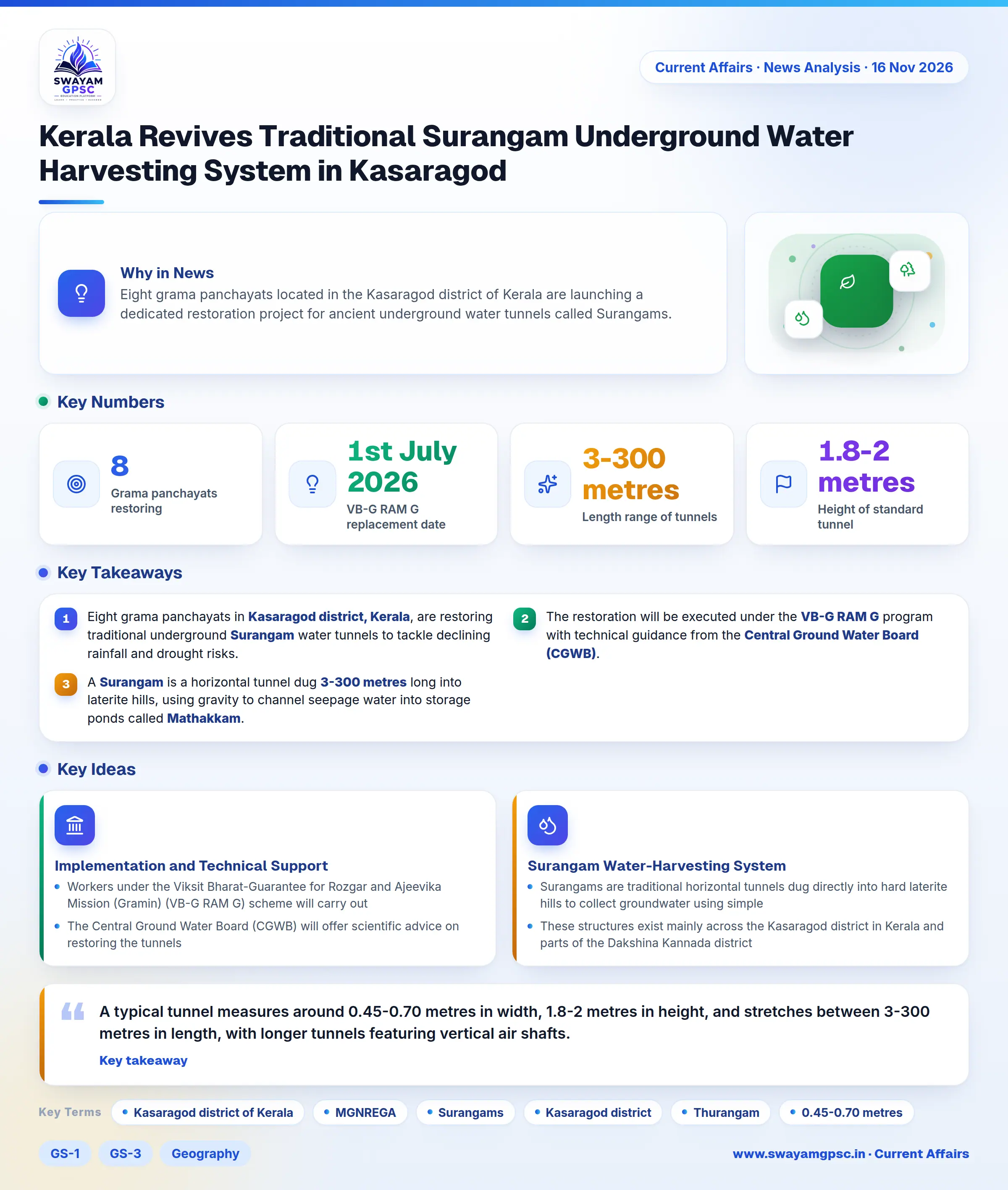
Kerala Revives Traditional Surangam Underground Water Harvesting System in Kasaragod
#GS-1 #GS-3 #Geography #Physical Geography #Environment #Water Conservation #Traditional Water Systems #Current Events #National
Key takeaways
- Eight grama panchayats in Kasaragod district, Kerala, are restoring traditional underground Surangam water tunnels to tackle declining rainfall and drought risks.
- The restoration will be executed under the VB-G RAM G program with technical guidance from the Central Ground Water Board (CGWB).
- A Surangam is a horizontal tunnel dug 3-300 metres long into laterite hills, using gravity to channel seepage water into storage ponds called Mathakkam.
Why in News
- Eight grama panchayats located in the Kasaragod district of Kerala are launching a dedicated restoration project for ancient underground water tunnels called Surangams.
- The project aims to improve groundwater recharge, save rainwater, reduce water shortages during summer, and maintain river flows despite rising drought risks and falling rainfall.
Implementation and Technical Support
- Workers under the Viksit Bharat-Guarantee for Rozgar and Ajeevika Mission (Gramin) (VB-G RAM G) scheme will carry out the restoration work, which succeeded MGNREGA on 1st July 2026.
- The Central Ground Water Board (CGWB) will offer scientific advice on restoring the tunnels, managing groundwater recharge, and maintaining sustainable water supplies.
Surangam Water-Harvesting System
- Surangams are traditional horizontal tunnels dug directly into hard laterite hills to collect groundwater using simple gravity and natural seepage.
- These structures exist mainly across the Kasaragod district in Kerala and parts of the Dakshina Kannada district in Karnataka, where the land features laterite soil and hilly terrain.
- Local communities also refer to these tunnels as Thurangam, Thorapu, and Mala, with the main name originating from the Kannada word for tunnel.
- A typical tunnel measures around 0.45-0.70 metres in width, 1.8-2 metres in height, and stretches between 3-300 metres in length, with longer tunnels featuring vertical air shafts.
- Water coming out of these tunnels flows into an open storage pool or structure known locally as a Mathakkam before residents use it for drinking, household chores, or farming.
- This traditional method provides an energy-free, gravity-driven water supply that strengthens local water security while showcasing traditional Indian engineering.