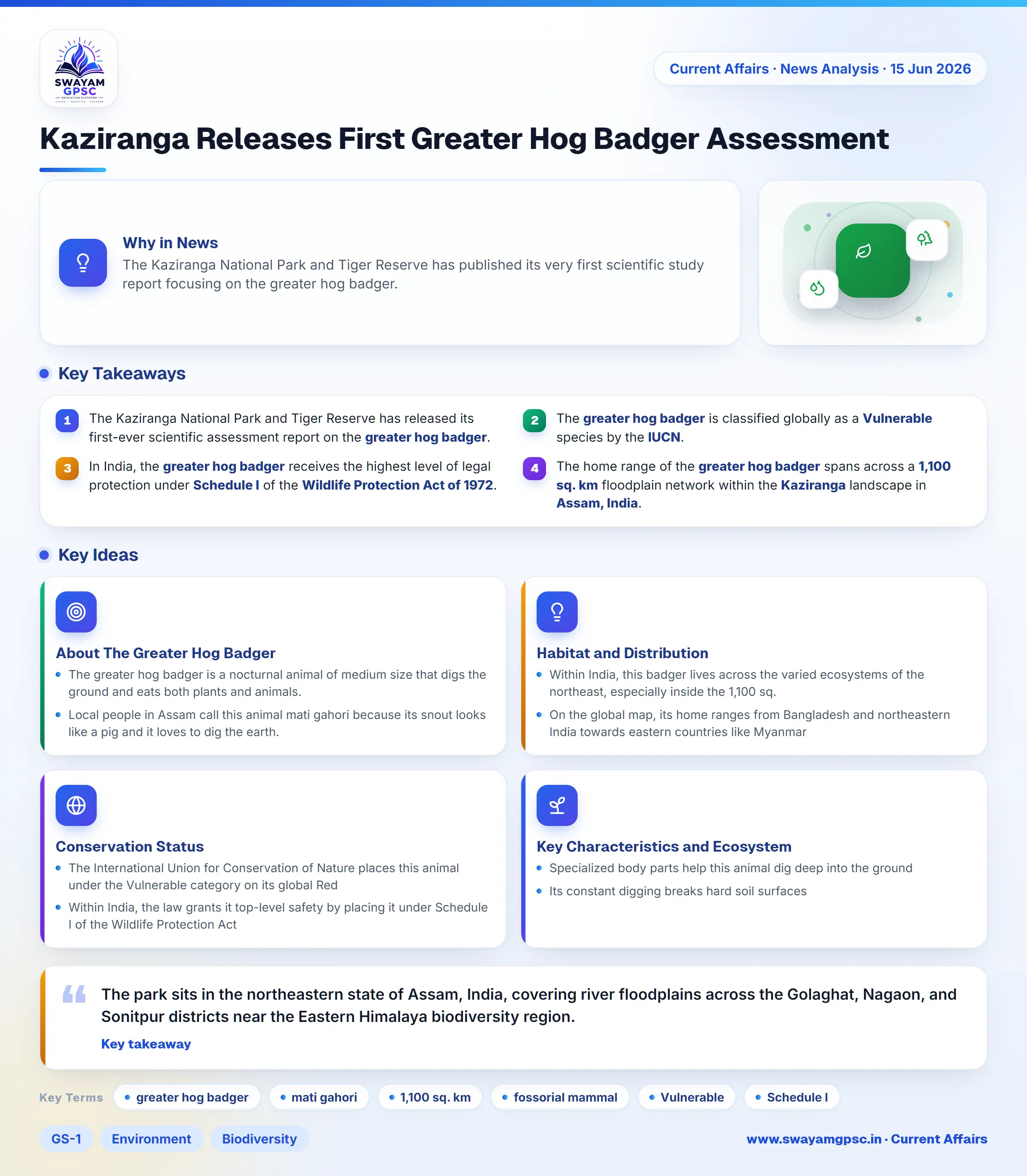
Kaziranga Releases First Greater Hog Badger Assessment
#GS-1 #Environment #Biodiversity #Wildlife #Current Events #Gujarat
Key takeaways
- The Kaziranga National Park and Tiger Reserve has released its first-ever scientific assessment report on the greater hog badger.
- The greater hog badger is classified globally as a Vulnerable species by the IUCN.
- In India, the greater hog badger receives the highest level of legal protection under Schedule I of the Wildlife Protection Act of 1972.
- The home range of the greater hog badger spans across a 1,100 sq. km floodplain network within the Kaziranga landscape in Assam, India.
Why in News
- The Kaziranga National Park and Tiger Reserve has published its very first scientific study report focusing on the greater hog badger.
About The Greater Hog Badger
- The greater hog badger is a nocturnal animal of medium size that digs the ground and eats both plants and animals.
- Local people in Assam call this animal mati gahori because its snout looks like a pig and it loves to dig the earth.
- This species stands out as the largest among the three hog badger species currently living on Earth.
Habitat and Distribution
- Within India, this badger lives across the varied ecosystems of the northeast, especially inside the 1,100 sq. km floodplain network of Kaziranga.
- On the global map, its home ranges from Bangladesh and northeastern India towards eastern countries like Myanmar, Thailand, Lao PDR, Cambodia, and Vietnam.
- As a specialized fossorial mammal, it thrives mainly on forest floors and grasslands where soft soil allows it to dig easily.
Conservation Status
- The International Union for Conservation of Nature places this animal under the Vulnerable category on its global Red List.
- Within India, the law grants it top-level safety by placing it under Schedule I of the Wildlife Protection Act of 1972.
Key Characteristics and Ecosystem Functions
- Specialized body parts help this animal dig deep into the ground, which helps redistribute soil nutrients and keeps the earth airy.
- Its constant digging breaks hard soil surfaces, helping seeds sprout and creating small living spaces for tiny animals.
- Because it comes out mostly at night, it stays hidden under thick bushes to escape predators and avoid human contact.
About Kaziranga National Park and Tiger Reserve
- The Kaziranga National Park and Tiger Reserve is a famous wildlife area recognized as a UNESCO World Heritage Site and a successful tiger reserve.
- It protects the biggest group of great Indian one-horned rhinoceroses in the world along with safe breeding homes for elephants, wild water buffalo, and swamp deer.
Location
- The park sits in the northeastern state of Assam, India, covering river floodplains across the Golaghat, Nagaon, and Sonitpur districts near the Eastern Himalaya biodiversity region.
Key Geological Features
- The large alluvial floodplains of the Brahmaputra River shape the geography of the park along its northern border.
- Numerous water bodies called beels spread across the land, acting as natural water tanks and feeding spots for animals.
- The park features four distinct plant zones that include tall elephant grasses, marshy savannas, moist semi-evergreen forests, and deciduous woods.
- Toward the southern side, flat river lands meet the rising hills of the Karbi Anglong range.