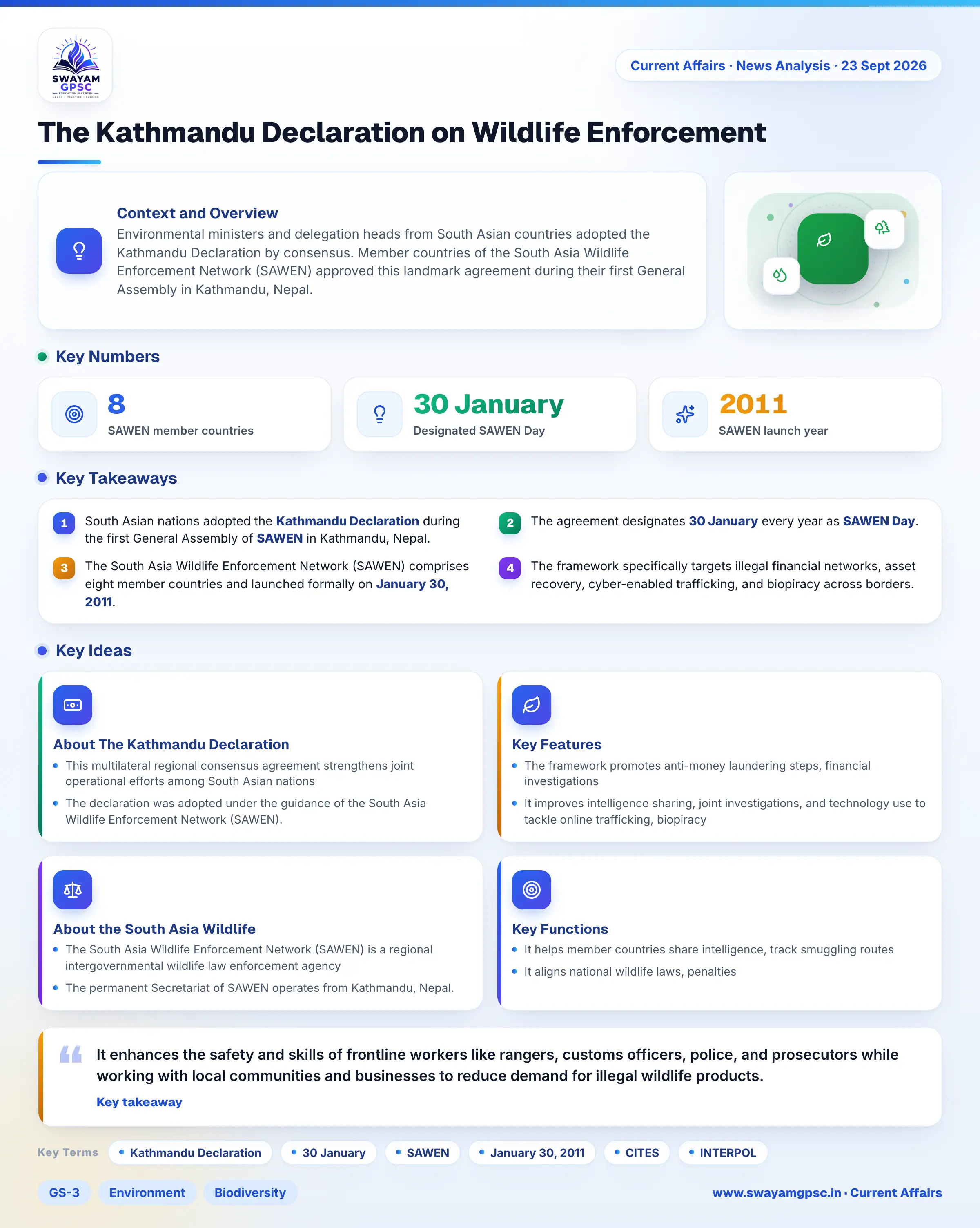
The Kathmandu Declaration on Wildlife Enforcement
#GS-3 #Environment #Biodiversity #Wildlife #Current Events #International
Key takeaways
- South Asian nations adopted the Kathmandu Declaration during the first General Assembly of SAWEN in Kathmandu, Nepal.
- The agreement designates 30 January every year as SAWEN Day.
- The South Asia Wildlife Enforcement Network (SAWEN) comprises eight member countries and launched formally on January 30, 2011.
- The framework specifically targets illegal financial networks, asset recovery, cyber-enabled trafficking, and biopiracy across borders.
Context and Overview
- Environmental ministers and delegation heads from South Asian countries adopted the Kathmandu Declaration by consensus.
- Member countries of the South Asia Wildlife Enforcement Network (SAWEN) approved this landmark agreement during their first General Assembly in Kathmandu, Nepal.
About The Kathmandu Declaration
- This multilateral regional consensus agreement strengthens joint operational efforts among South Asian nations to fight illegal wildlife trade and transnational organized crime.
- The declaration was adopted under the guidance of the South Asia Wildlife Enforcement Network (SAWEN).
- It aims to move away from isolated domestic efforts and build an intelligence-led cross-border framework that targets illegal financial networks, online trafficking, and biopiracy.
Key Features
- The framework promotes anti-money laundering steps, financial investigations, and asset recovery to disrupt the money trails behind organized wildlife trafficking.
- It improves intelligence sharing, joint investigations, and technology use to tackle online trafficking, biopiracy, and digital threats across borders.
- It enhances the safety and skills of frontline workers like rangers, customs officers, police, and prosecutors while working with local communities and businesses to reduce demand for illegal wildlife products.
- The agreement officially designates 30 January as SAWEN Day.
About the South Asia Wildlife Enforcement Network
- The South Asia Wildlife Enforcement Network (SAWEN) is a regional intergovernmental wildlife law enforcement agency that includes eight South Asian countries: Afghanistan, Bangladesh, Bhutan, India, Maldives, Nepal, Pakistan, and Sri Lanka.
- The permanent Secretariat of SAWEN operates from Kathmandu, Nepal.
- The organization was formally launched on January 30, 2011.
- Its main goal is to coordinate, strengthen, and harmonize wildlife law enforcement protocols across South Asia to stop poaching, trafficking, and habitat destruction through regional teamwork.
Key Functions
- It helps member countries share intelligence, track smuggling routes, and run joint operations against transnational wildlife crimes.
- It aligns national wildlife laws, penalties, and standards with CITES to strengthen regional enforcement against illegal trade.
- It offers specialized training for customs officers, police, judges, and wildlife staff in forensics, species identification, and anti-smuggling methods.
- It works alongside global organizations like INTERPOL, WCO, UNODC, and TRAFFIC to control the international demand and supply of illegal wildlife products.