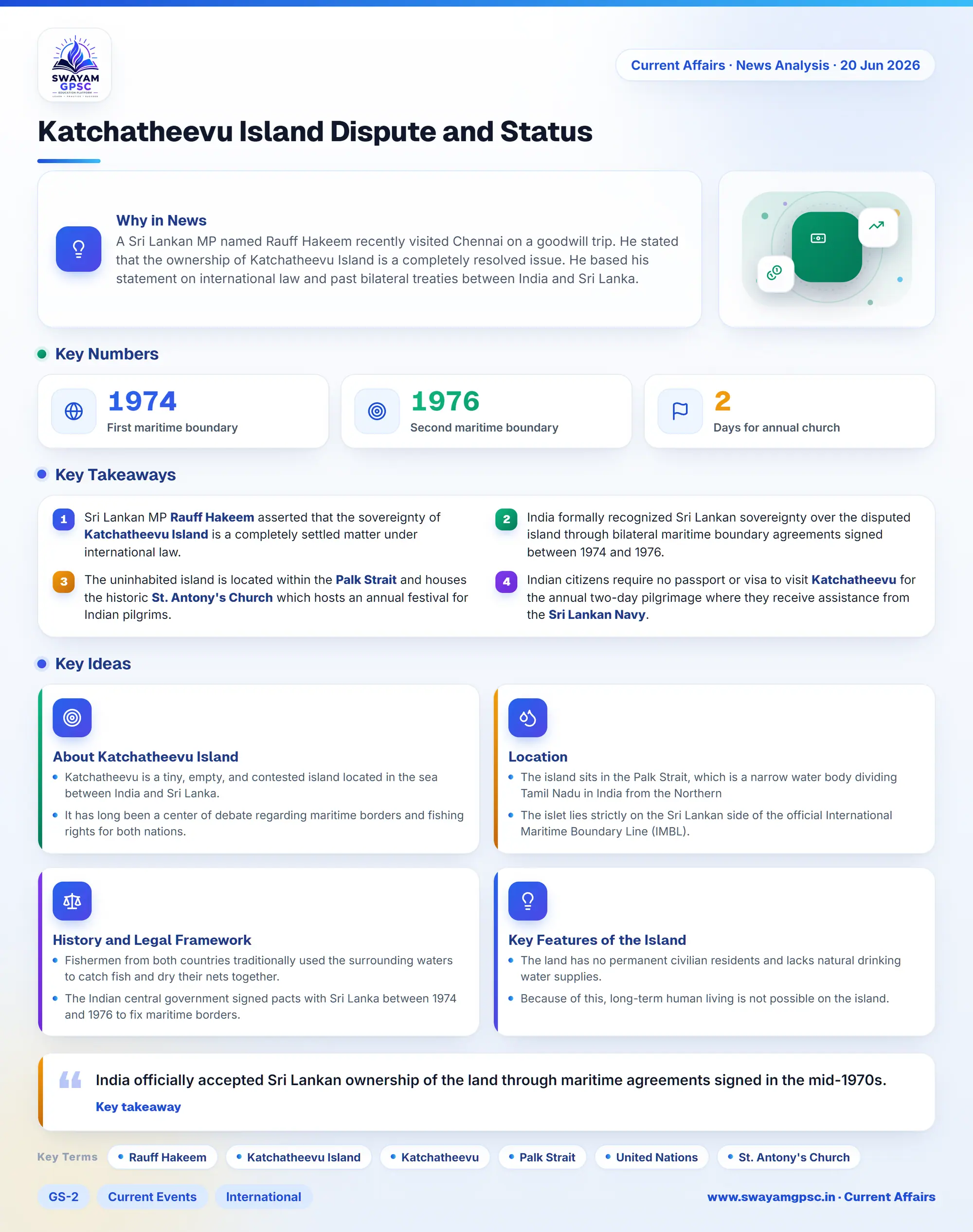
Katchatheevu Island Dispute and Status
#GS-2 #Current Events #International #Economy #Infrastructure
Key takeaways
- Sri Lankan MP Rauff Hakeem asserted that the sovereignty of Katchatheevu Island is a completely settled matter under international law.
- India formally recognized Sri Lankan sovereignty over the disputed island through bilateral maritime boundary agreements signed between 1974 and 1976.
- The uninhabited island is located within the Palk Strait and houses the historic St. Antony's Church which hosts an annual festival for Indian pilgrims.
- Indian citizens require no passport or visa to visit Katchatheevu for the annual two-day pilgrimage where they receive assistance from the Sri Lankan Navy.
Why in News
- A Sri Lankan MP named Rauff Hakeem recently visited Chennai on a goodwill trip.
- He stated that the ownership of Katchatheevu Island is a completely resolved issue.
- He based his statement on international law and past bilateral treaties between India and Sri Lanka.
About Katchatheevu Island
- Katchatheevu is a tiny, empty, and contested island located in the sea between India and Sri Lanka.
- It has long been a center of debate regarding maritime borders and fishing rights for both nations.
- Indian zamindaris and fishermen historically claimed the island for years.
- India officially accepted Sri Lankan ownership of the land through maritime agreements signed in the mid-1970s.
Location
- The island sits in the Palk Strait, which is a narrow water body dividing Tamil Nadu in India from the Northern Province of Sri Lanka.
- The islet lies strictly on the Sri Lankan side of the official International Maritime Boundary Line (IMBL).
History and Legal Framework
- Fishermen from both countries traditionally used the surrounding waters to catch fish and dry their nets together.
- The Indian central government signed pacts with Sri Lanka between 1974 and 1976 to fix maritime borders.
- These treaties formally recognized Sri Lankan control over Katchatheevu based on global legal standards.
- Modern international law states that neither nation can change the island status alone.
- Any fresh review of the situation requires taking the matter to the United Nations.
Key Features of the Island
- The land has no permanent civilian residents and lacks natural drinking water supplies.
- Because of this, long-term human living is not possible on the island.
- It features the historic St. Antony's Church, which serves as an important spiritual center.
- The church organizes a popular annual two-day festival for devotees.
- Indian citizens do not need a passport or visa to attend this yearly pilgrimage.
- The Sri Lankan Navy and local fishermen warmly greet and help Indian visitors during the event.
- The surrounding sea has a rich marine life and vibrant ecosystems.
- However, these waters suffer from ecological damage caused by illegal fishing gear and destructive trawling.