Kashmir Saffron Sees Massive Global Demand Surge
#GS-3 #Economy #Agriculture #Geography #Resources #Current Events #National #Gujarat
Key takeaways
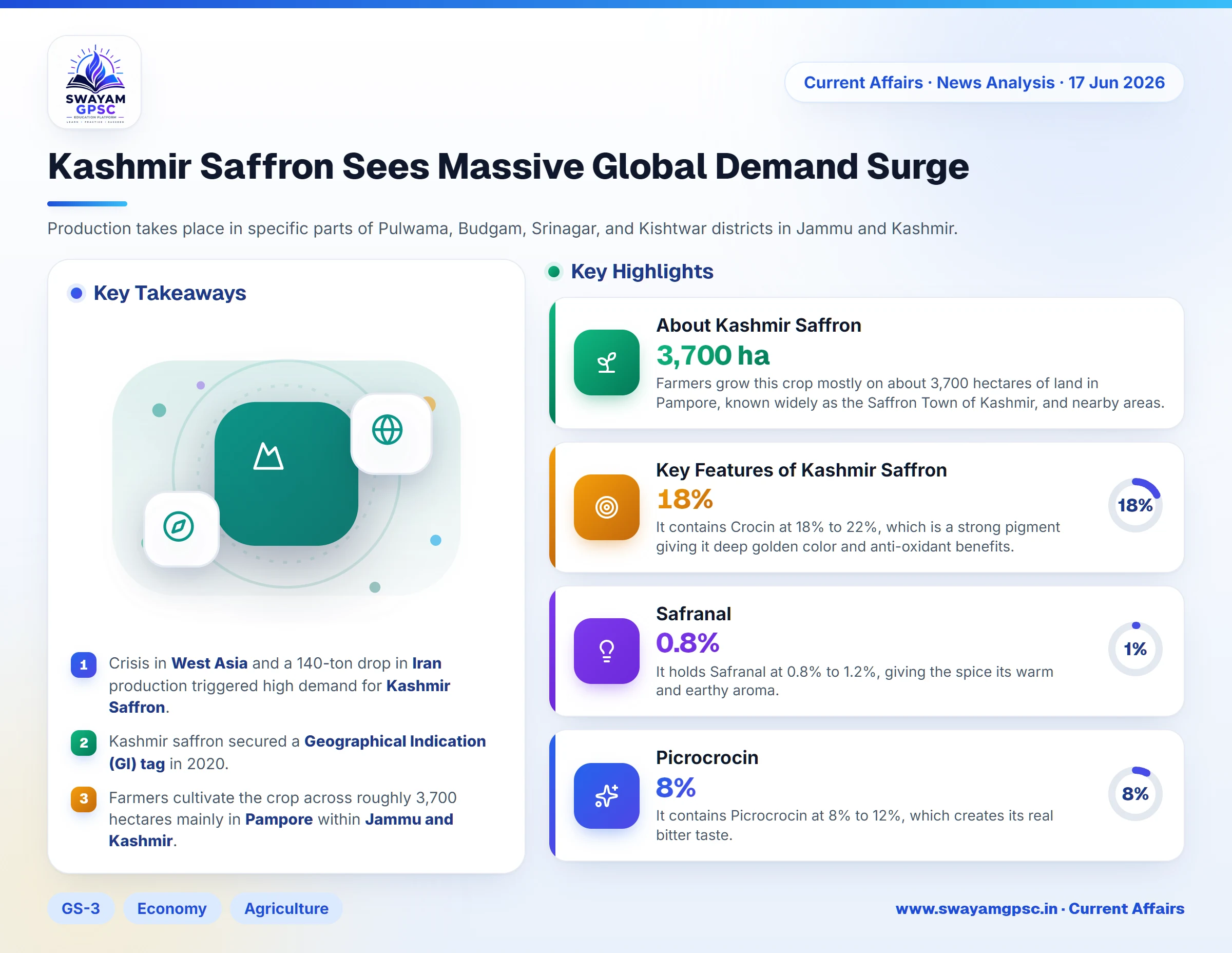
- Crisis in West Asia and a 140-ton drop in Iran production triggered high demand for Kashmir Saffron.
- Kashmir saffron secured a Geographical Indication (GI) tag in 2020.
- Farmers cultivate the crop across roughly 3,700 hectares mainly in Pampore within Jammu and Kashmir.
- The saffron grows at a high altitude of 1,600 to 1,800 meters and contains 18% to 22% Crocin.
Why in News
- The ongoing crisis in West Asia and a sharp 140-ton drop in production in Iran have caused a huge global demand jump for premium Kashmiri saffron.
About Kashmir Saffron
- Kashmir saffron was known as bahukam in old Sanskrit books and is fondly called Red Gold because it is a very costly and aromatic spice taken from dried stigmas of the Crocus sativus plant.
- It is a proud symbol of agricultural heritage in Jammu and Kashmir and received a Geographical Indication (GI) tag in 2020.
- Farmers grow this crop mostly on about 3,700 hectares of land in Pampore, known widely as the Saffron Town of Kashmir, and nearby areas.
- Production takes place in specific parts of Pulwama, Budgam, Srinagar, and Kishtwar districts in Jammu and Kashmir.
Key Features of Kashmir Saffron
- The crop grows only in *Karewas*, which are old elevated lake-bed deposits filled with minerals and organic matter that help with soil drainage.
- It is the only saffron in the world grown at a high altitude of 1,600 to 1,800 meters above sea level, making its oil content and strength much higher.
- The spice has longer and thicker stigmas with a deep crimson-maroon-purple color that is the darkest natural shade found anywhere.
- Laboratory tests show a very high amount of active chemical components compared to other foreign varieties.
- It contains Crocin at 18% to 22%, which is a strong pigment giving it deep golden color and anti-oxidant benefits.
- It holds Safranal at 0.8% to 1.2%, giving the spice its warm and earthy aroma.
- It contains Picrocrocin at 8% to 12%, which creates its real bitter taste.
- Workers process the harvest by hand and sort it into three traditional commercial grades.
- Mongra Saffron is the top A++ grade made only of hand-picked crimson tips with no yellow parts.
- Lachha Saffron consists of stigmas separated from the flower and dried right away without extra processing.
- Guchhi Saffron uses threads that are tied together into neat bundles after drying.