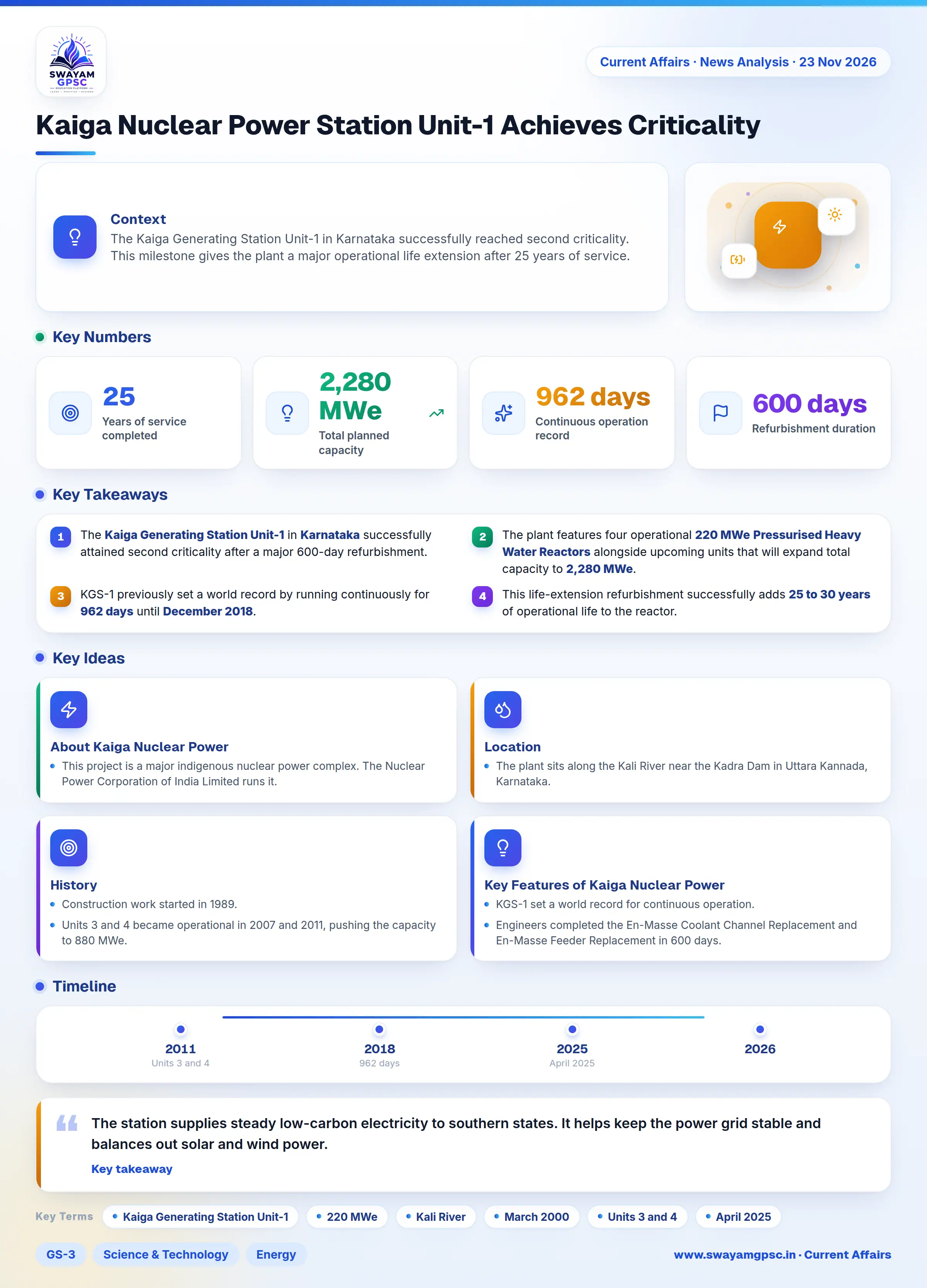
Kaiga Nuclear Power Station Unit-1 Achieves Criticality
#GS-3 #Science & Technology #Energy #Economy #Infrastructure
Key takeaways
- The Kaiga Generating Station Unit-1 in Karnataka successfully attained second criticality after a major 600-day refurbishment.
- The plant features four operational 220 MWe Pressurised Heavy Water Reactors alongside upcoming units that will expand total capacity to 2,280 MWe.
- KGS-1 previously set a world record by running continuously for 962 days until December 2018.
- This life-extension refurbishment successfully adds 25 to 30 years of operational life to the reactor.
Context
- The Kaiga Generating Station Unit-1 in Karnataka successfully reached second criticality. This milestone gives the plant a major operational life extension after 25 years of service.
About Kaiga Nuclear Power
- This project is a major indigenous nuclear power complex. The Nuclear Power Corporation of India Limited runs it. It currently has four working 220 MWe Pressurised Heavy Water Reactors that add up to 880 MWe. Two new indigenous 700 MWe PHWR units named KGS-5 and KGS-6 are under construction. These new units will raise the total capacity to 2,280 MWe.
Location
- The plant sits along the Kali River near the Kadra Dam in Uttara Kannada, Karnataka. It is located inside the ecologically sensitive Western Ghats.
History
- Construction work started in 1989. Unit-2 started commercial operations in March 2000, and Unit-1 followed in November 2000.
- Units 3 and 4 became operational in 2007 and 2011, pushing the capacity to 880 MWe. Plans for Units 5 and 6 will add another 1,400 MWe.
- KGS-1 was shut down in April 2025 after completing 25 years. It achieved second criticality on November 22, 2026, after a 600-day refurbishment process.
Key Features of Kaiga Nuclear Power Plant
- KGS-1 set a world record for continuous operation. It ran without a break for 962 days until December 2018, beating the older record of 940 days and proving its high reliability.
- Engineers completed the En-Masse Coolant Channel Replacement and En-Masse Feeder Replacement in 600 days. This work extends the reactor life by 25 to 30 years.
- The plant uses India-made Pressurised Heavy Water Reactor technology. It runs on natural uranium fuel and uses heavy water as a moderator and coolant.
- The upcoming Units 5 and 6 feature double containment and Passive Decay Heat Removal Systems to make the reactors safer during power cuts.
- The plant works inside the Western Ghats following ISO 14001 environmental rules. It uses strict radiological monitoring and controlled cooling water systems.
Significance
- The station supplies steady low-carbon electricity to southern states. It helps keep the power grid stable and balances out solar and wind power.
- This success shows the NPCIL capability in upgrading and expanding reactors. It supports India's goal of reaching 100 GWe nuclear capacity by 2047.