The June 3rd Declaration and the Mountbatten Plan
#GS-1 #Modern India #Freedom Struggle #Indian Polity & Constitution #Current Events #National
Key takeaways
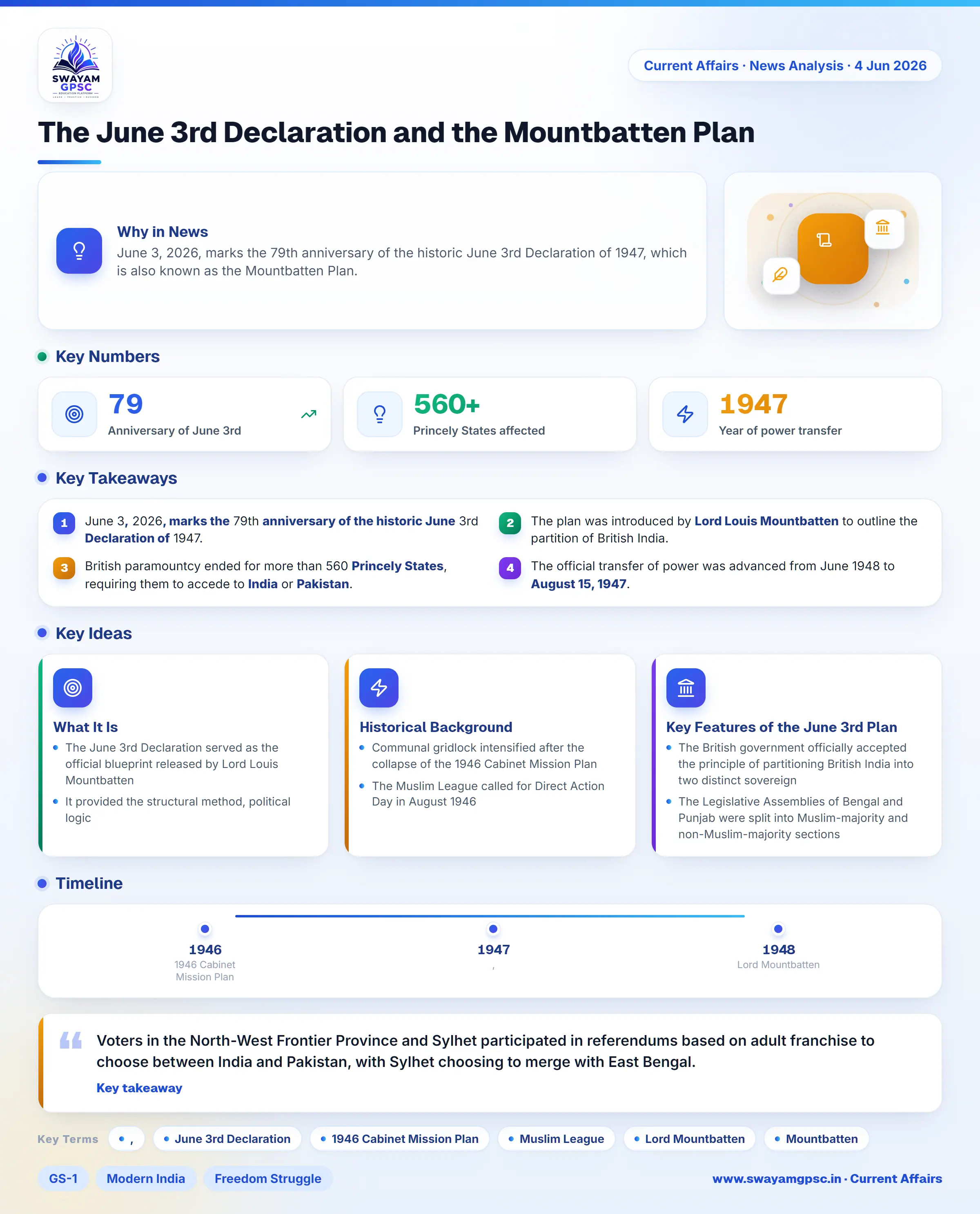
- June 3, 2026, marks the 79th anniversary of the historic June 3rd Declaration of 1947.
- The plan was introduced by Lord Louis Mountbatten to outline the partition of British India.
- British paramountcy ended for more than 560 Princely States, requiring them to accede to India or Pakistan.
- The official transfer of power was advanced from June 1948 to August 15, 1947.
Why in News
- June 3, 2026, marks the 79th anniversary of the historic June 3rd Declaration of 1947, which is also known as the Mountbatten Plan.
What It Is
- The June 3rd Declaration served as the official blueprint released by Lord Louis Mountbatten, who was the last Viceroy of India.
- It provided the structural method, political logic, and accelerated timeline for the partition of British India and the transfer of political power to Indian hands.
Historical Background
- Communal gridlock intensified after the collapse of the 1946 Cabinet Mission Plan, causing relations between the Indian National Congress and the Muslim League to break down completely.
- The Muslim League called for Direct Action Day in August 1946, which triggered the Great Calcutta Killings and widespread communal violence across Noakhali, Bihar, and the Punjab districts like Amritsar and Rawalpindi.
- When Lord Mountbatten took office in March 1947, British Prime Minister Clement Attlee gave him a strict deadline to transfer power no later than June 30, 1948.
- Mountbatten originally drafted Plan Balkan to let individual provinces choose their own paths, but Jawaharlal Nehru fiercely rejected it because it threatened to completely fragment India.
Key Features of the June 3rd Plan
- The British government officially accepted the principle of partitioning British India into two distinct sovereign dominions named the Dominion of India and the Dominion of Pakistan.
- The Legislative Assemblies of Bengal and Punjab were split into Muslim-majority and non-Muslim-majority sections to vote separately on whether to partition the province.
- The Sindh Legislative Assembly received the mandate to vote directly on which Constituent Assembly to join.
- Voters in the North-West Frontier Province and Sylhet participated in referendums based on adult franchise to choose between India and Pakistan, with Sylhet choosing to merge with East Bengal.
- The plan mandated creating an independent Boundary Commission headed by Sir Cyril Radcliffe to draw precise international borders for the splitting provinces.
- The plan ended British paramountcy over more than 560 Princely States, removing their option to remain independent and requiring them to join either India or Pakistan based on geography.
- To prevent administrative collapse amid rising violence, Mountbatten advanced the official transfer of power from June 1948 to August 15, 1947.