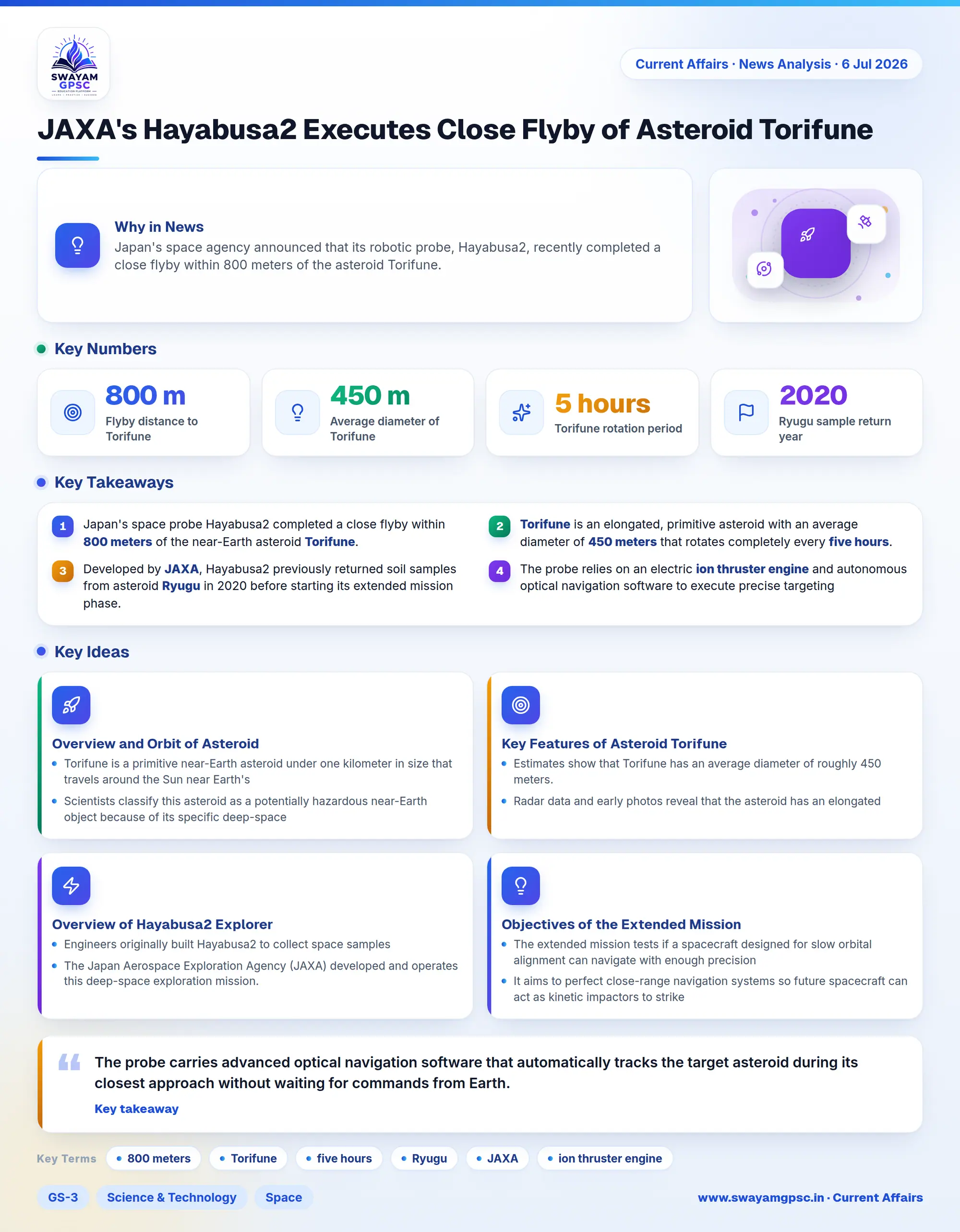
JAXA's Hayabusa2 Executes Close Flyby of Asteroid Torifune
#GS-3 #Science & Technology #Space #Current Events #International #JAXA #Hayabusa2 #Asteroid Torifune
Why in News
- Japan's space agency announced that its robotic probe, **Hayabusa2**, recently completed a close flyby within **800 meters** of the asteroid **Torifune**.
Overview and Orbit of Asteroid Torifune
- **Torifune** is a primitive near-Earth asteroid under one kilometer in size that travels around the Sun near Earth's orbital path, making it ideal for space research and asteroid defense tests.
- Scientists classify this asteroid as a potentially hazardous near-Earth object because of its specific deep-space orbital path.
Key Features of Asteroid Torifune
- Estimates show that **Torifune** has an average diameter of roughly **450 meters**.
- Radar data and early photos reveal that the asteroid has an elongated, irregular shape instead of a round spherical form.
- The asteroid spins quickly on its axis, completing one full rotation every **five hours**, which changes how it looks to passing spacecraft cameras.
Overview of Hayabusa2 Explorer
- Engineers originally built **Hayabusa2** to collect space samples, and after it successfully brought soil from asteroid **Ryugu** in **2020**, it began an extended mission phase called **Hayabusa2#** to perform complex solar system flybys.
- The **Japan Aerospace Exploration Agency (JAXA)** developed and operates this deep-space exploration mission.
Objectives of the Extended Mission
- The extended mission tests if a spacecraft designed for slow orbital alignment can navigate with enough precision to target a fast-moving space object.
- It aims to perfect close-range navigation systems so future spacecraft can act as kinetic impactors to strike and deflect dangerous asteroids away from Earth.
Key Technical Features of Hayabusa2
- Scientists designed the probe as a compact, refrigerator-sized cube structured for long journeys across deep space.
- Since the spacecraft lacks movable camera lenses, operators must rotate the entire body of the probe to keep the asteroid within its field of view.
- The spacecraft uses an electric **ion thruster engine** to make tiny, highly precise path adjustments during its years of travel.
- The probe carries advanced optical navigation software that automatically tracks the target asteroid during its closest approach without waiting for commands from Earth.