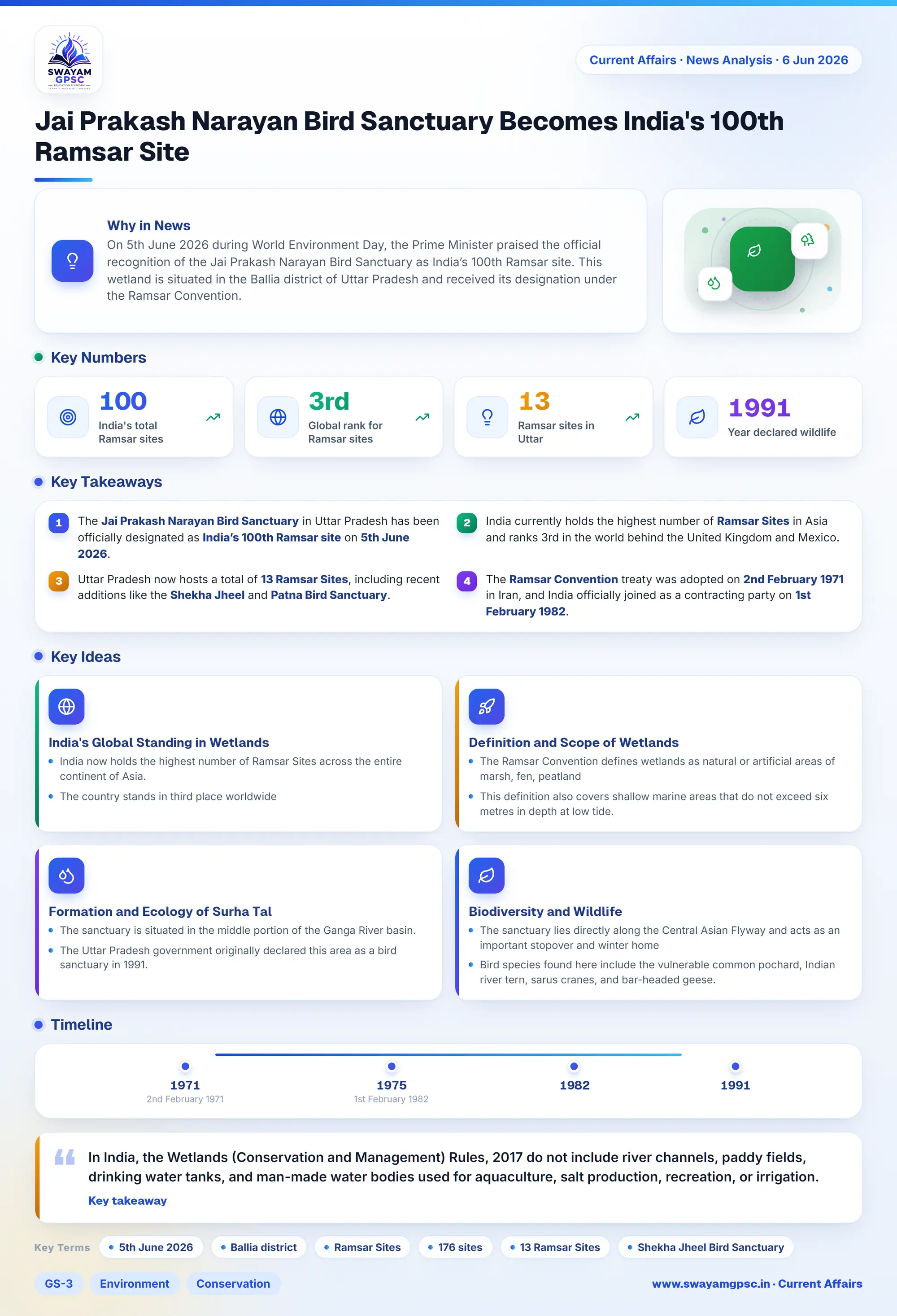
Jai Prakash Narayan Bird Sanctuary Becomes India's 100th Ramsar Site
#GS-3 #Environment #Conservation #Biodiversity #Wetlands #Rapid Fire CA
Key takeaways
- The Jai Prakash Narayan Bird Sanctuary in Uttar Pradesh has been officially designated as India’s 100th Ramsar site on 5th June 2026.
- India currently holds the highest number of Ramsar Sites in Asia and ranks 3rd in the world behind the United Kingdom and Mexico.
- Uttar Pradesh now hosts a total of 13 Ramsar Sites, including recent additions like the Shekha Jheel and Patna Bird Sanctuary.
- The Ramsar Convention treaty was adopted on 2nd February 1971 in Iran, and India officially joined as a contracting party on 1st February 1982.
Why in News
- On 5th June 2026 during World Environment Day, the Prime Minister praised the official recognition of the Jai Prakash Narayan Bird Sanctuary as India’s 100th Ramsar site.
- This wetland is situated in the Ballia district of Uttar Pradesh and received its designation under the Ramsar Convention.
India's Global Standing in Wetlands
- India now holds the highest number of Ramsar Sites across the entire continent of Asia.
- The country stands in third place worldwide, coming right behind the United Kingdom which has 176 sites and Mexico which has 144 sites.
- With this addition, Uttar Pradesh now has a total of 13 Ramsar Sites within its borders.
- Earlier in 2026, other wetlands in Uttar Pradesh like the Shekha Jheel Bird Sanctuary in Aligarh and the Patna Bird Sanctuary in Etah also joined this prestigious international list.
Definition and Scope of Wetlands
- The Ramsar Convention defines wetlands as natural or artificial areas of marsh, fen, peatland, or water that hold permanent or temporary fresh, brackish, or saline water.
- This definition also covers shallow marine areas that do not exceed six metres in depth at low tide.
- In India, the Wetlands (Conservation and Management) Rules, 2017 do not include river channels, paddy fields, drinking water tanks, and man-made water bodies used for aquaculture, salt production, recreation, or irrigation.
Formation and Ecology of Surha Tal
- The sanctuary is situated in the middle portion of the Ganga River basin.
- The Uttar Pradesh government originally declared this area as a bird sanctuary in 1991.
- Geologically, it is a large natural oxbow lake created by the changing path of the Ganga River.
- It gets fresh water through three primary channels and expands massively over surrounding floodplains during the monsoon season.
Biodiversity and Wildlife
- The sanctuary lies directly along the Central Asian Flyway and acts as an important stopover and winter home for thousands of migratory birds coming from Siberia and Central Asia.
- Bird species found here include the vulnerable common pochard, Indian river tern, sarus cranes, and bar-headed geese.
- The wetland supports more than 221 plant species and 66 fish species, including vulnerable ones like Wallago attu and Bagarius bagarius.
- The large fish population attracts the vulnerable fishing cat, which uses the area for feeding and breeding.
- Surha Taal also holds deep cultural and religious importance for the local people in eastern Uttar Pradesh.
About the Ramsar Convention
- A Ramsar site is a wetland area recognized globally for its ecological value under the rules of the Ramsar Convention.
- Once a wetland gets this status, the country promises to protect it from harmful commercial use, pollution, and structural damage.
- The treaty was adopted on 2nd February 1971 in the Iranian city of Ramsar on the shores of the Caspian Sea.
- The international treaty officially came into force in 1975, and India joined as a member on 1st February 1982.
- The main goal of the framework is to stop the continuous loss of wetlands around the world through local and international cooperation.
Prelims in Focus: Ramsar Framework Features
- To qualify as a Ramsar site, a wetland must meet at least one of nine international criteria, such as supporting large groups of waterbirds or threatened ecosystems.
- The framework promotes the wise use principle for sustainable activities like eco-tourism, traditional fishing, and organic farming without harming nature.
- The Montreux Record is a special list that tracks Ramsar sites facing ecological dangers to provide them with focused help and protection.
- The convention encourages global teamwork to manage shared river basins, cross-border wetlands, and migratory bird routes.