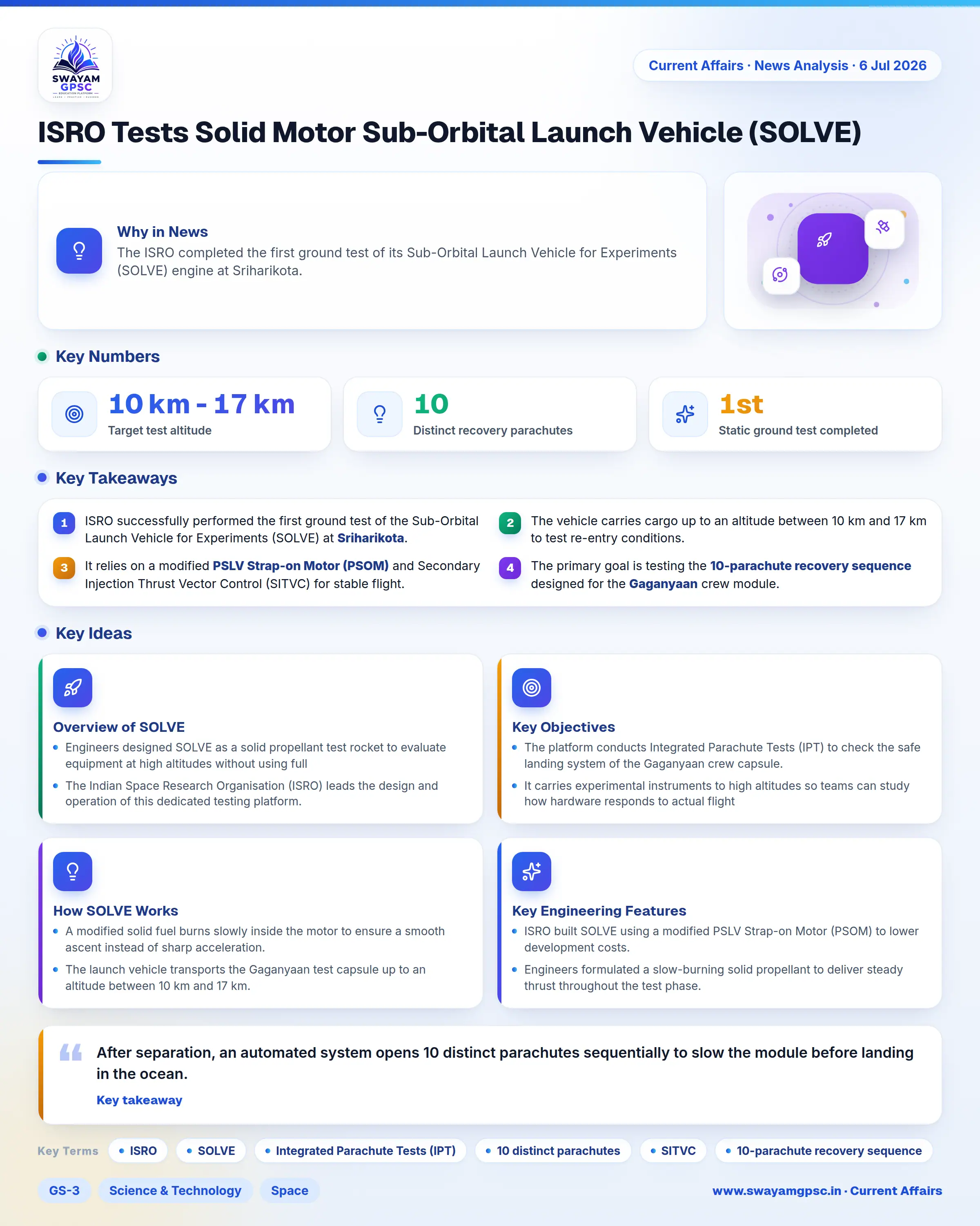
ISRO Tests Solid Motor Sub-Orbital Launch Vehicle (SOLVE)
#GS-3 #Science & Technology #Space #Current Events #National #ISRO #SOLVE #Gaganyaan Mission
Why in News
- The **ISRO** completed the first ground test of its **Sub-Orbital Launch Vehicle for Experiments (SOLVE)** engine at **Sriharikota**.
Overview of SOLVE
- Engineers designed **SOLVE** as a solid propellant test rocket to evaluate equipment at high altitudes without using full orbital vehicles.
- The **Indian Space Research Organisation (ISRO)** leads the design and operation of this dedicated testing platform.
Key Objectives
- The platform conducts **Integrated Parachute Tests (IPT)** to check the safe landing system of the **Gaganyaan** crew capsule.
- It carries experimental instruments to high altitudes so teams can study how hardware responds to actual flight conditions.
How SOLVE Works
- A modified solid fuel burns slowly inside the motor to ensure a smooth ascent instead of sharp acceleration.
- The launch vehicle transports the **Gaganyaan** test capsule up to an altitude between **10 km and 17 km**.
- At peak height, the vehicle releases the capsule to expose it directly to heavy atmospheric friction and forces.
- After separation, an automated system opens **10 distinct parachutes** sequentially to slow the module before landing in the ocean.
Key Engineering Features
- ISRO built **SOLVE** using a modified **PSLV Strap-on Motor (PSOM)** to lower development costs.
- Engineers formulated a slow-burning solid propellant to deliver steady thrust throughout the test phase.
- A straight nozzle paired with **Secondary Injection Thrust Vector Control (SITVC)** guides the vehicle along its path.
- The structure recreates realistic aerodynamic speeds and pressures to mirror actual re-entry profiles.
Uses and Applications
- The system verifies the **10-parachute recovery sequence** required to return Indian astronauts safely from space.
- It lowers testing costs by avoiding the expense of full-scale multi-stage rocket launches.
- The rocket aids domestic space research in hypersonic flight, atmospheric science, and microgravity experiments.