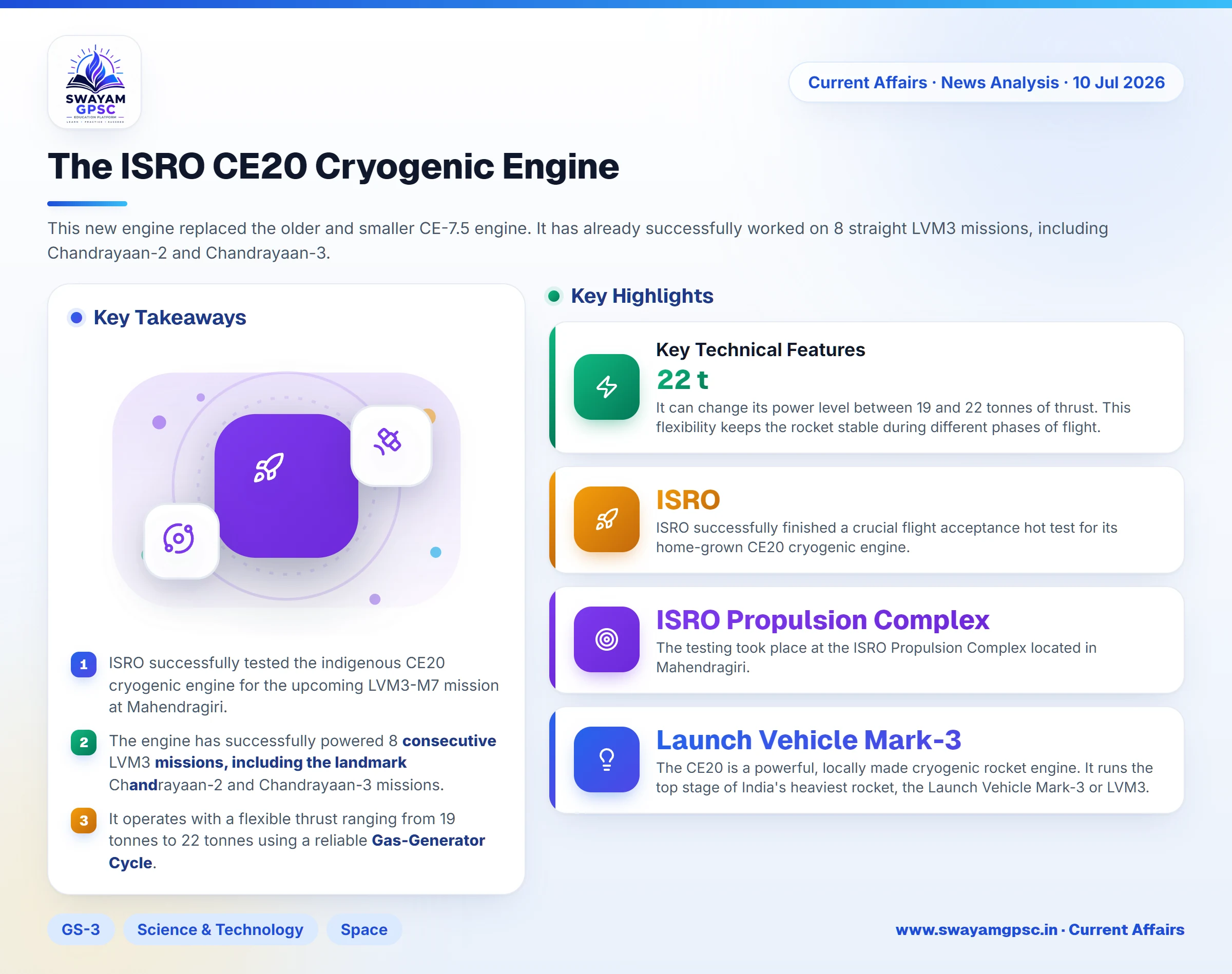
The ISRO CE20 Cryogenic Engine
#GS-3 #Science & Technology #Space #Current Events #National #ISRO #Space Technology
Key takeaways
- ISRO successfully tested the indigenous CE20 cryogenic engine for the upcoming LVM3-M7 mission at Mahendragiri.
- The engine has successfully powered 8 consecutive LVM3 missions, including the landmark Chandrayaan-2 and Chandrayaan-3 missions.
- It operates with a flexible thrust ranging from 19 tonnes to 22 tonnes using a reliable Gas-Generator Cycle.
- The human-rated engine is designed to meet strict safety standards to power the upcoming Gaganyaan manned space mission.
Why in News
- ISRO successfully finished a crucial flight acceptance hot test for its home-grown CE20 cryogenic engine.
- This engine will power the upcoming LVM3-M7 space mission.
- The testing took place at the ISRO Propulsion Complex located in Mahendragiri.
About the CE20 Cryogenic Engine
- The CE20 is a powerful, locally made cryogenic rocket engine. It runs the top stage of India's heaviest rocket, the Launch Vehicle Mark-3 or LVM3.
- This engine burns extremely cold liquid fuels. This process creates the high speed required to send heavy satellites into deep space and high orbits.
Development and Background
- The Liquid Propulsion Systems Centre of ISRO designed this engine. Engineers then tested and approved it at the propulsion complex.
- This new engine replaced the older and smaller CE-7.5 engine. It has already successfully worked on 8 straight LVM3 missions, including Chandrayaan-2 and Chandrayaan-3.
Core Aim
- The main goal is to have a highly dependable Indian engine for heavy satellites. This engine will also help launch internet satellites and support manned space missions like Gaganyaan.
Key Technical Features
- It uses a simple system called the Gas-Generator Cycle. This design makes the engine more reliable, easier to start, and simple to control while in space.
- The engine burns liquid hydrogen and liquid oxygen as fuel. This mixture gives the rocket high efficiency for carrying heavy loads.
- It can change its power level between 19 and 22 tonnes of thrust. This flexibility keeps the rocket stable during different phases of flight.
- The Nozzle Protection System allows scientists to test the large engine safely on the ground. This system saves money because India does not need expensive vacuum test facilities.
- The engine has extra safety backups and a health monitoring system. These features ensure it meets the strict safety standards required for the Gaganyaan human space mission.
Applications
- The CE20 acts as the final engine for the LVM3 rocket. It gives the last push to place heavy communication satellites into their exact orbits.
- It will serve as the main engine for the Gaganyaan mission. It will safely carry Indian astronauts into space and place them in low-Earth orbit.