Iranian Drone Attacks on Kuwait: Key Details and Strategic Significance
#GS-2 #Current Events #International #GS-3 #Geography #Resources #Iran-Kuwait Conflict #Persian Gulf
Key takeaways
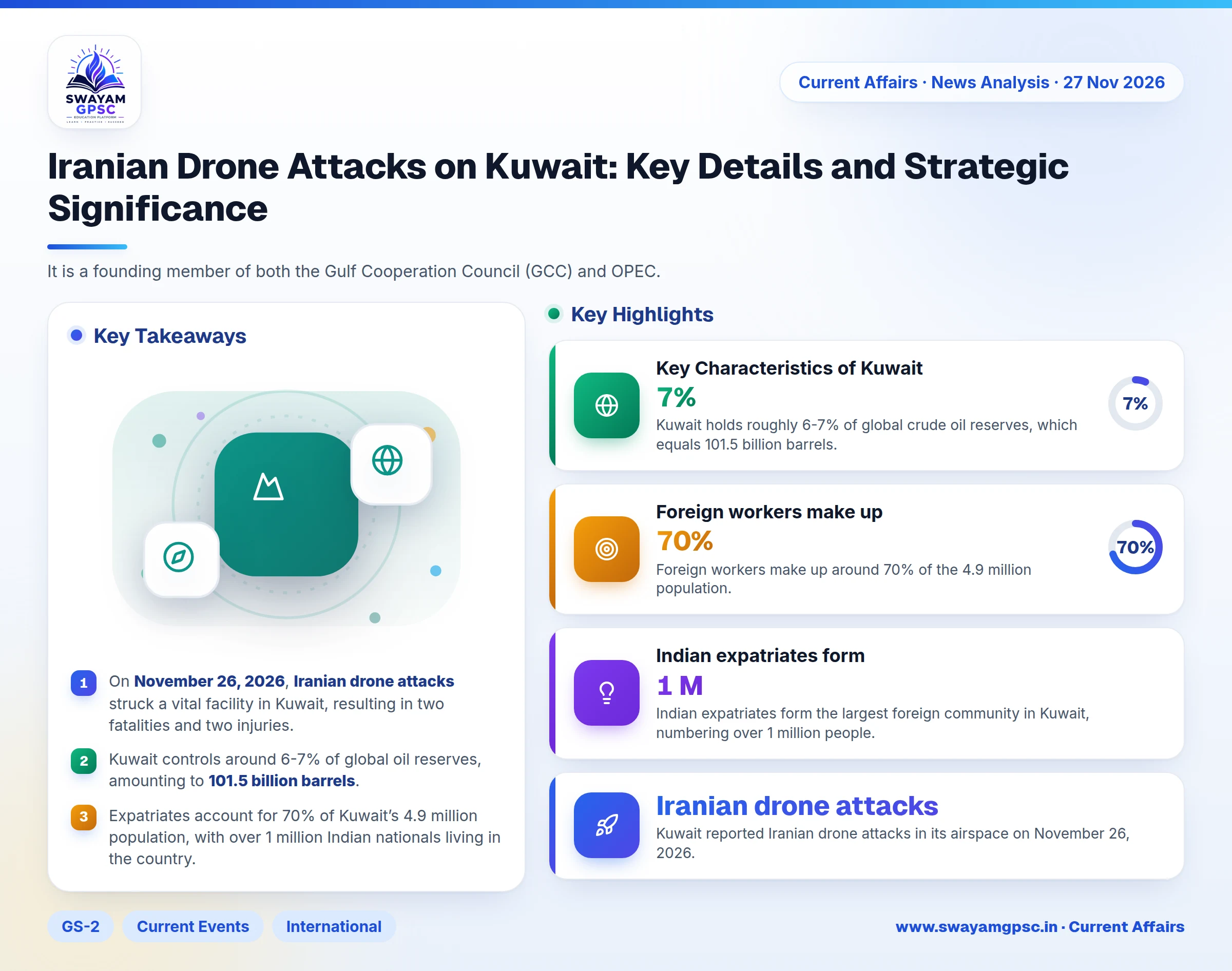
- On November 26, 2026, Iranian drone attacks struck a vital facility in Kuwait, resulting in two fatalities and two injuries.
- Kuwait controls around 6-7% of global oil reserves, amounting to 101.5 billion barrels.
- Expatriates account for 70% of Kuwait’s 4.9 million population, with over 1 million Indian nationals living in the country.
- The official currency of Kuwait is the Kuwaiti Dinar (KWD), which holds the highest value among all global currencies.
Why in News
- Kuwait reported Iranian drone attacks in its airspace on November 26, 2026.
- The attack targeted a vital installation in the country.
- The strike killed two Italian technicians and injured two others.
About Kuwait
- Kuwait is an oil-rich constitutional monarchy located in West Asia.
- It is a founding member of both the Gulf Cooperation Council (GCC) and OPEC.
- The capital of the country is Kuwait City, which sits on the southern shore of Kuwait Bay.
- The nation is situated at the northwestern tip of the Persian Gulf and covers about 17,818 sq. km.
- Kuwait shares land borders with Iraq to the north and west, and Saudi Arabia to the south and southwest, while facing Iran across the Persian Gulf to the east.
Key Characteristics of Kuwait
- Kuwait holds roughly 6-7% of global crude oil reserves, which equals 101.5 billion barrels.
- Petroleum exports generate most of the government revenue and export earnings for the country.
- The official currency is the Kuwaiti Dinar (KWD), which is the highest-valued currency unit in the world.
- The country manages the Kuwait Investment Authority, a major sovereign wealth fund set up in 1953.
- The terrain consists of flat, hyper-arid desert without any permanent rivers or lakes.
- Kuwait includes nine offshore islands, with Bubiyan and Failaka being notable ones.
- The country follows a semi-democratic system ruled by the Al-Sabah dynasty, though its elected National Assembly is currently suspended due to political gridlock.
- Foreign workers make up around 70% of the 4.9 million population.
- Indian expatriates form the largest foreign community in Kuwait, numbering over 1 million people.
Significance
- Kuwait sits at a strategic location at the head of the Persian Gulf, making its oil ports vulnerable to conflicts around the Strait of Hormuz.
- The country is a vital supplier of crude oil and liquefied petroleum gas (LPG) to India.
- India relies on regional peace to ensure the safety and financial remittances of over 1 million Indian citizens living in Kuwait.