International Sickle Cell Day 2026
#GS-2 #Health #Vulnerable Sections #National #Economy
Key takeaways
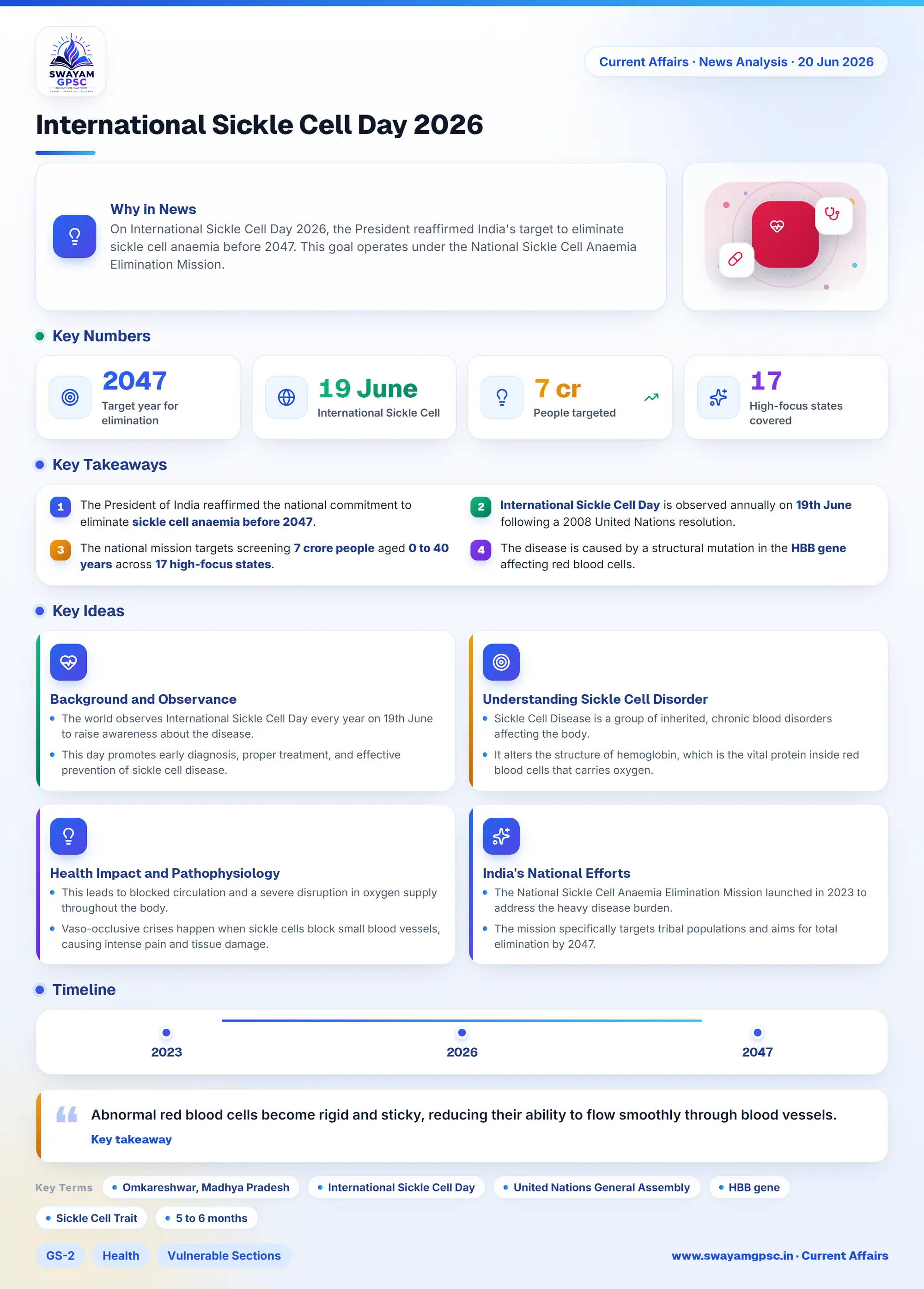
- The President of India reaffirmed the national commitment to eliminate sickle cell anaemia before 2047.
- International Sickle Cell Day is observed annually on 19th June following a 2008 United Nations resolution.
- The national mission targets screening 7 crore people aged 0 to 40 years across 17 high-focus states.
- The disease is caused by a structural mutation in the HBB gene affecting red blood cells.
Why in News
- On International Sickle Cell Day 2026, the President reaffirmed India's target to eliminate sickle cell anaemia before 2047.
- This goal operates under the National Sickle Cell Anaemia Elimination Mission.
- The President marked this commemoration at Omkareshwar, Madhya Pradesh, celebrating a significant health milestone.
Background and Observance
- The world observes International Sickle Cell Day every year on 19th June to raise awareness about the disease.
- This day promotes early diagnosis, proper treatment, and effective prevention of sickle cell disease.
- The United Nations General Assembly officially recognized this day through a resolution adopted on 22nd December 2008.
- The resolution described sickle cell disease as a major public health problem and a vital global genetic disease.
- The theme for 2026 is Closing the Survival Gap: Equity in Sickle Cell Disease.
- This theme emphasizes bridging existing disparities and uniting local and global communities to support patients.
Understanding Sickle Cell Disorder
- Sickle Cell Disease is a group of inherited, chronic blood disorders affecting the body.
- It alters the structure of hemoglobin, which is the vital protein inside red blood cells that carries oxygen.
- Instead of remaining flexible and round, affected red blood cells mutate into rigid, crescent, or sickle shapes.
- It is caused by a structural mutation in the HBB gene, which gives instructions for making beta-globin.
- The disease follows an autosomal recessive inheritance pattern.
- A person develops the disease only if they inherit two abnormal hemoglobin genes from both parents.
- Individuals inheriting only one mutated gene copy are called carriers or possess the Sickle Cell Trait.
- Carriers generally live healthy lives without symptoms but can pass the mutated gene to their biological children.
Health Impact and Pathophysiology
- Abnormal red blood cells become rigid and sticky, reducing their ability to flow smoothly through blood vessels.
- This leads to blocked circulation and a severe disruption in oxygen supply throughout the body.
- Vaso-occlusive crises happen when sickle cells block small blood vessels, causing intense pain and tissue damage.
- Rapid destruction of sickle cells results in chronic anaemia, persistent fatigue, breathlessness, and weakness.
- Repeated spleen injury reduces overall immunity, making patients vulnerable to serious infections.
- Long-term oxygen deprivation causes progressive damage to the brain, lungs, kidneys, and other vital organs.
- Symptoms usually appear around 5 to 6 months of age as fetal hemoglobin levels decline.
India's National Efforts
- The National Sickle Cell Anaemia Elimination Mission launched in 2023 to address the heavy disease burden.
- The mission specifically targets tribal populations and aims for total elimination by 2047.
- The government implements this mission under the National Health Mission across 17 high-focus states.
- It focuses heavily on early detection, proper treatment, public awareness, and disease prevention.
- The mission adopts a mission-mode approach combining large-scale screening and community awareness.
- It targets approximately 7 crore people aged 0 to 40 years over a span of three years from 2023 to 2026.
- The Ministry of Health and Family Welfare and the Ministry of Tribal Affairs jointly implement this mission.
Treatment and Management
- Pain management uses analgesics, anti-inflammatory drugs, and proper hydration to control severe crises.
- Hydroxyurea therapy increases fetal hemoglobin production to reduce cell sickling and pain episodes.
- Regular antibiotics and vaccination prevent severe infections, particularly in infants and young children.
- Doctors use blood transfusions to reduce dangerous complications such as stroke and severe anaemia.
Prelims in Focus
- International Sickle Cell Day falls annually on 19th June.
- The United Nations General Assembly recognized the day in 2008.
- The HBB gene mutation causes this hereditary blood disorder.
- The national mission targets 7 crore people across 17 high-focus states.
- The target year for complete elimination in India is 2047.