International Day of Yoga 2026
#GS-1 #Indian Art Forms #GS-4 #Contribution of Moral Thinkers and Philosophers #International Day of Yoga #Schools of Indian Philosophy #Lord Mahavira #Eight-Fold Path (Astanga Yoga) #Culture #Heritage #Health #Current Events #International
Key takeaways
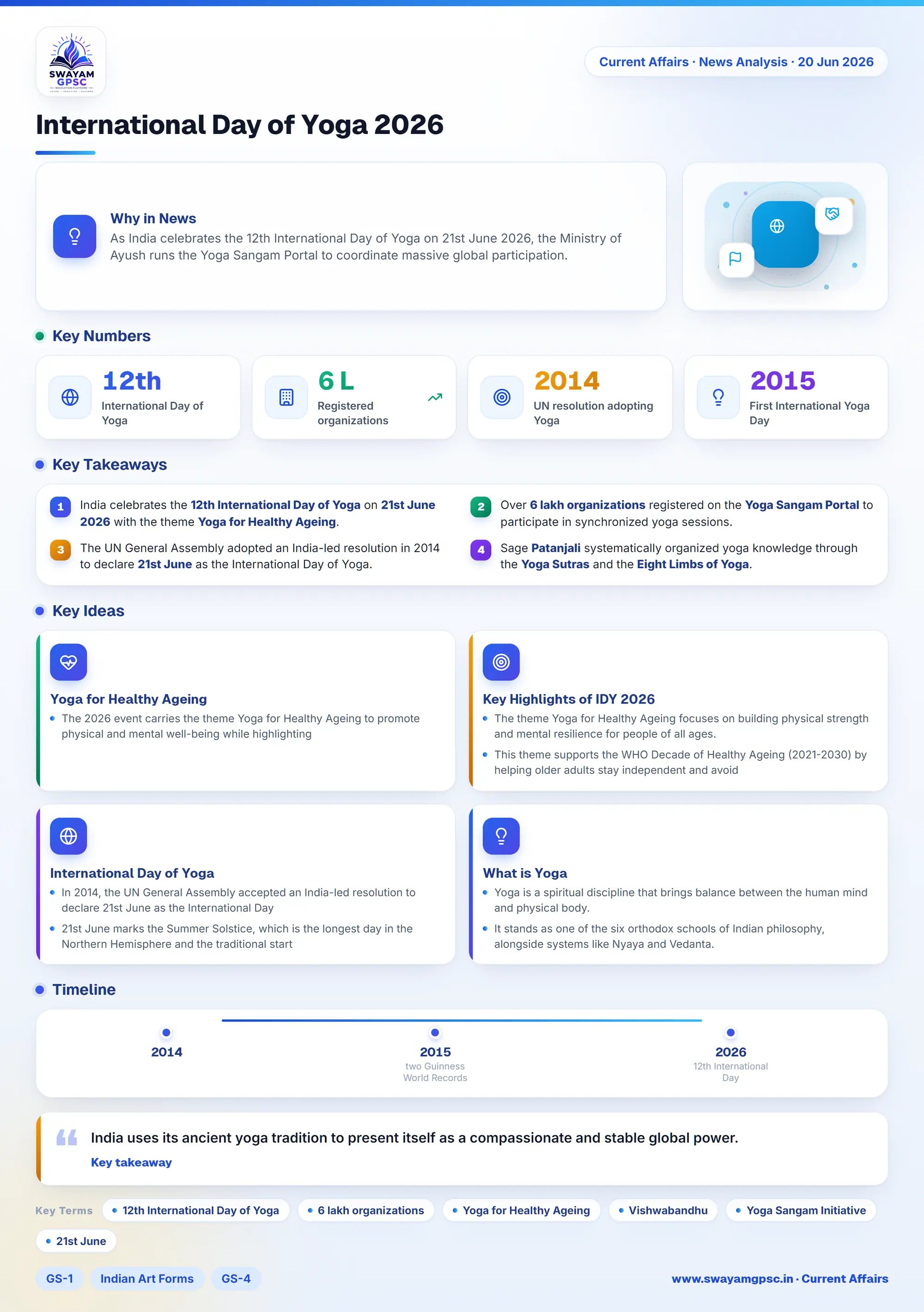
- India celebrates the 12th International Day of Yoga on 21st June 2026 with the theme Yoga for Healthy Ageing.
- Over 6 lakh organizations registered on the Yoga Sangam Portal to participate in synchronized yoga sessions.
- The UN General Assembly adopted an India-led resolution in 2014 to declare 21st June as the International Day of Yoga.
- Sage Patanjali systematically organized yoga knowledge through the Yoga Sutras and the Eight Limbs of Yoga.
Why in News
- As India celebrates the 12th International Day of Yoga on 21st June 2026, the Ministry of Ayush runs the Yoga Sangam Portal to coordinate massive global participation.
- Over 6 lakh organizations have registered to join this nationwide yoga event and perform yoga simultaneously with the Prime Minister of India.
Summary
- The 2026 event carries the theme Yoga for Healthy Ageing to promote physical and mental well-being while highlighting yoga as an ancient philosophy turned global wellness practice.
- India uses yoga as a powerful soft power tool through wellness tourism and digital outreach to project its image as a Vishwabandhu.
Key Highlights of IDY 2026
- The theme Yoga for Healthy Ageing focuses on building physical strength and mental resilience for people of all ages.
- This theme supports the WHO Decade of Healthy Ageing (2021-2030) by helping older adults stay independent and avoid fall-related health risks.
- The Yoga Sangam Initiative connects institutions across the country to perform group sessions using the Common Yoga Protocol (CYP).
- Organizations can host these sessions at their own local spaces while remaining connected to the main national celebration.
International Day of Yoga
- In 2014, the UN General Assembly accepted an India-led resolution to declare 21st June as the International Day of Yoga under global health policies.
- 21st June marks the Summer Solstice, which is the longest day in the Northern Hemisphere and the traditional start of yogic science.
- The UN supports yoga because it builds resistance against non-communicable diseases and helps people manage modern life stress.
- The first IDY celebration in 2015 at Rajpath in New Delhi set two Guinness World Records for attendance and nationality count.
- The official logo features folded hands representing the union of consciousness alongside elements of nature like the sun and earth.
- The Ministry of Ayush serves as the central agency for organizing all yoga celebrations in the country.
What is Yoga
- Yoga is a spiritual discipline that brings balance between the human mind and physical body.
- It stands as one of the six orthodox schools of Indian philosophy, alongside systems like Nyaya and Vedanta.
- The name Yoga comes from the Sanskrit root Yuj, meaning to join or unite.
- Its core teaching is to merge individual human consciousness with the Universal Consciousness.
- The ultimate goal of yoga is Self-realization, which helps a person escape suffering and attain Moksha or Kaivalya.
- Shiva is revered as the first yogi or Adiyogi, who shared this profound wisdom with the Saptarishis at Lake Kantisarovar in the Himalayas.
- Traditional forms include Jnana Yoga, Bhakti Yoga, Karma Yoga, and Hatha Yoga.
Chronological Evolution of Yoga
- During the Indus Valley Civilization, seals like the Pashupati Seal showed figures sitting in traditional yogic meditation postures.
- The Vedic era integrated yoga into daily worship practices, including early versions of Surya Namaskara and Pranayama.
- The classical period saw the rise of Lord Mahavira’s Five Great Vows and Lord Buddha’s Eightfold Path as foundations of disciplined practice.
- Sage Patanjali wrote the Yoga Sutras and introduced the Eight Limbs of Yoga to guide ethical living and meditation.
- During the medieval period, Yogi Swatmarama wrote the Hatha Yoga Pradipika in the 15th Century CE, focusing heavily on physical body mastery.
- Modern thinkers like Swami Vivekananda and Paramhansa Yogananda introduced Hindu philosophy and yoga practices to Western audiences.
- In the 20th century, masters like Tirumalai Krishnamacharya developed rigorous physical styles such as Iyengar Yoga.
Yoga Philosophy
- Yoga philosophy offers a practical method to control the physical body, senses, mind, and ego to find spiritual truth.
- Sage Patanjali created the Yoga Sutras, which are divided into four parts: Samadhipada, Sadhanapada, Vibhutipada, and Kaivalyapada.
- Yoga is closely linked to Samkhya philosophy, where Samkhya provides the theory and Yoga provides the practical steps.
- While Samkhya believes in many individual souls, yoga teaches the existence of one supreme self.
God and Liberation
- In yoga philosophy, God or Iswara is the supreme being who remains free from karma and worldly pain.
- An individual soul must seek liberation to escape the endless cycle of rebirth and suffering.
- This ultimate state of freedom is known as kaivalya, and a person who achieves it is called a kevali.
How India is Operationalizing Yoga Diplomacy
- India promotes yoga alongside Ayurveda to counter China's push for Traditional Chinese Medicine (TCM).
- The WHO Global Centre for Traditional Medicine in Jamnagar helps India set global health standards and protect its intellectual property.
- By promoting yoga worldwide, India shifts its global image from a regional conflict player to a global benefactor known as Vishwabandhu.
- Countries in the Middle East like Saudi Arabia now officially recognize yoga as a sports activity, improving diplomatic ties.
- The Ministry of Home Affairs has introduced special E-Tourist Visas to help foreign visitors join short-term wellness programs.
- The Ministry of AYUSH runs the Heal in India program to build medical tourism markets around traditional healing.
- India turns regional hubs like Rishikesh and Kerala into global spiritual capitals to boost foreign exchange earnings.
- Government missions abroad use digital tools like the Namaste Yoga app to teach authentic yoga methods worldwide.
Conclusion
- India uses its ancient yoga tradition to present itself as a compassionate and stable global power.
- This cultural strength helps India build stronger international friendships and act as a true Vishwabandhu.