International Day for the Elimination of Violence against Women 2026
#GS-1 #GS-2 #Issues Related to Women #Government Policies & Interventions #Economy #Governance & Social Justice #Current Events #National #Vulnerable Sections #Good Governance
Key takeaways
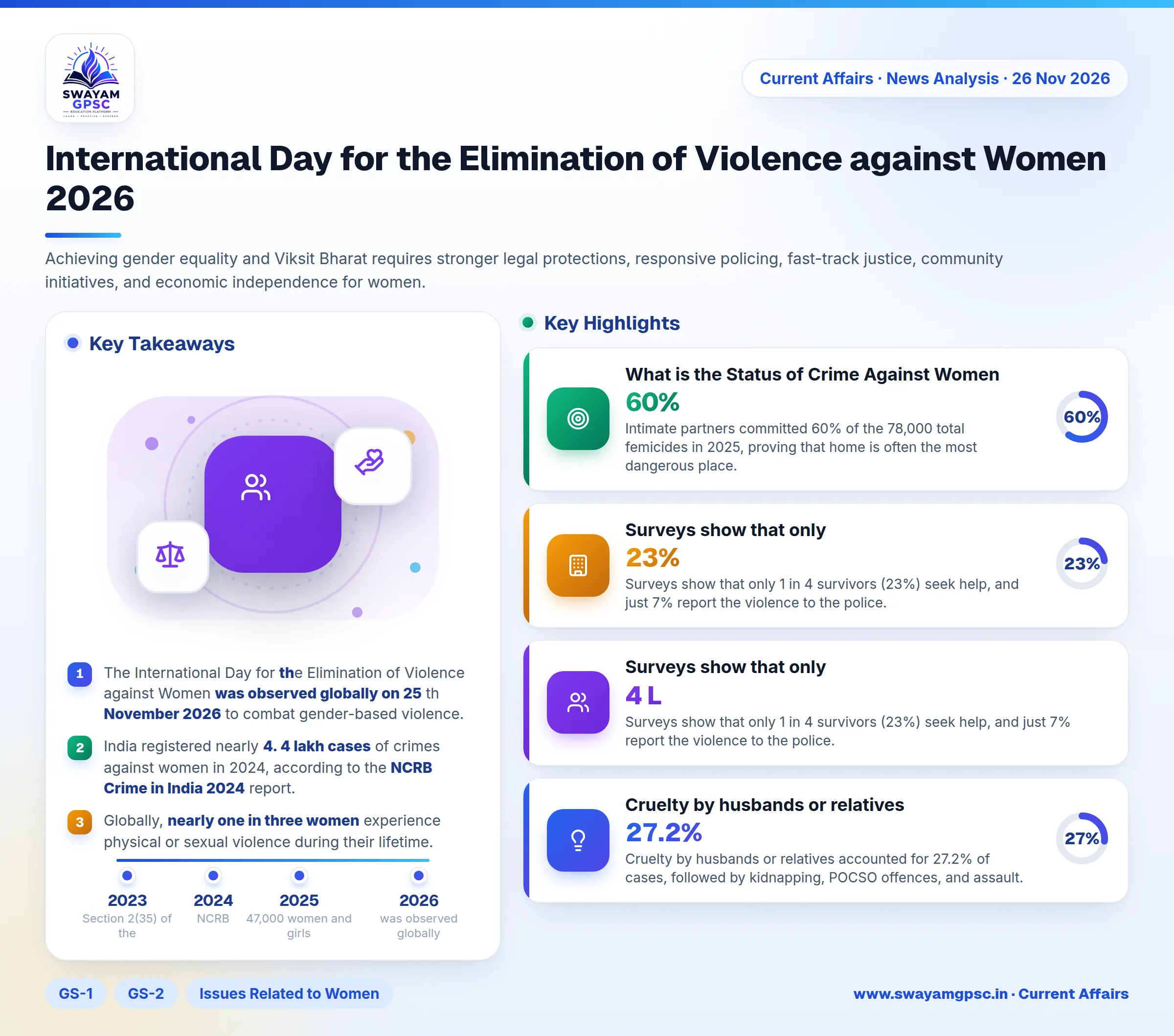
- The International Day for the Elimination of Violence against Women was observed globally on 25 th November 2026 to combat gender-based violence.
- India registered nearly 4. 4 lakh cases of crimes against women in 2024, according to the NCRB *Crime in India 2024* report.
- Globally, nearly one in three women experience physical or sexual violence during their lifetime.
- Only 1 in 4 survivors (23%) seek help globally, and just 7% report the violence to the police.
- Spousal violence in India stands at 22.3% according to the NFHS-6 survey, remaining higher in rural areas.
Why in News
- The International Day for the Elimination of Violence against Women was observed globally on 25 th November 2026 to raise awareness and promote preventive action.
- To mark this occasion, India unveiled Nayi Chetna 5.0 and launched the #NumberSaveKiya? emergency helpline awareness campaign.
- Additionally, the government signed a Quadripartite MoU on the Violence-Free Village Initiative to strengthen grassroots coordination.
Summary
- Violence against women remains widespread despite strict laws due to under-reporting, patriarchal mindsets, delayed justice, weak enforcement, and new digital threats like AI deepfakes.
- Achieving gender equality and Viksit Bharat requires stronger legal protections, responsive policing, fast-track justice, community initiatives, and economic independence for women.
What is the International Day for the Elimination of Violence against Women
- This global day mobilises governments, international agencies, and civil society to prevent and eliminate violence against women and girls across all spaces.
- The date honours the Mirabal sisters, who were political activists brutally assassinated in the Dominican Republic on 25th November 1960.
- The UN General Assembly adopted a landmark declaration in 1993 and officially designated 25 th November in the year 2000.
- The observance begins the 16 Days of Activism against Gender-Based Violence, which concludes on 10 th December for Human Rights Day, using orange as the official campaign colour.
- The 2026 Global Campaign led by the UN focuses on survivor-centred services, safe reporting mechanisms, and institutional accountability.
India's Initiatives on International Day for the Elimination of Violence against Women (2026)
- The Ministry of Rural Development launched Nayi Chetna 5.0 as a month-long national campaign under the Deendayal Antyodaya Yojana-National Rural Livelihoods Mission (DAY-NRLM).
- The campaign focuses on four areas: recognizing women as economic contributors, improving financial access, promoting safe mobility, and redistributing unpaid care work.
- The Quadripartite MoU on the Violence-Free Village Initiative was signed by four key ministries and legal authorities to build village-level institutional support.
- The #NumberSaveKiya? campaign urges women to save the Women Helpline (181) and the Emergency Response Support System (112) on their phones.
What is the Status of Crime Against Women
- Globally, nearly one in three women experience physical or sexual violence during their lifetime.
- The UNODC-UN Women Femicides in 2025 report states that 47,000 women and girls were intentionally killed by family members in 2025.
- Intimate partners committed 60% of the 78,000 total femicides in 2025, proving that home is often the most dangerous place.
- Surveys show that only 1 in 4 survivors (23%) seek help, and just 7% report the violence to the police.
- The NCRB *Crime in India 2024* report recorded nearly 4. 4 lakh cases of crimes against women, averaging 1,210 FIRs per day.
- Cruelty by husbands or relatives accounted for 27.2% of cases, followed by kidnapping, POCSO offences, and assault.
- Uttar Pradesh recorded the highest total cases, while Delhi and Telangana reported the highest crime rates per lakh women.
- The NFHS-6 survey shows spousal violence fell to 22.3%, yet more than 1 in 5 married women still face abuse at home.
- Spousal violence remains higher in rural India (24.4%) compared to urban India (17.5%).
- Judicial pendency remains high, with the rape conviction rate at 24.4% and nearly 1. 85 lakh rape cases pending at the end of 2024.
What are the Key Challenges in Eliminating Violence Against Women
- Section 2(35) of the Bharatiya Nyaya Sanhita (BNS), 2023 defines a woman without clarifying if transgender women qualify, creating a major legal protection vacuum.
- Divergent court rulings have led to state-wise inequalities, with some courts including transgender women and others excluding them even after gender-affirming surgery.
- Excluding transgender women leaves them reliant on the Transgender Persons (Protection of Rights) Act, 2019, which carries a maximum punishment of just 2 years instead of life imprisonment.
- Only 5.6% of survivors in India report violence to the police due to stigma, fear, and slow trials.
- As noted in the NHRC Advisory on Women's Safety (Oct 2026), harassment persists due to low legal awareness and inadequate police sensitisation.
- Women in the informal sector remain largely outside the oversight of Internal Committee (IC) mechanisms.
- The rise of AI-enabled abuse, deepfakes, and cyberstalking has outpaced current cyber laws.
- Deep-rooted patriarchal attitudes, financial dependence, and a lack of real-time data hinder prevention efforts.
- Trauma bonding and emotional manipulation create psychological dependence, making it hard for survivors to leave abusive relationships.
What Measures are Needed to Eliminate Violence Against Women
- Courts and Parliament should ensure inclusive legal definitions so that transgender women receive full criminal law protection.
- The government should expedite building one girls' hostel in every district using Viability Gap Funding (VGF) from the Union Budget 2026-27.
- Working women's hostels like Sakhi Niwas and creches under Mission Shakti should be integrated with transport safety models.
- The Self-Help Entrepreneur (SHE) Marts announced in the Union Budget 2026-27 should be operationalised to boost women's economic independence.
- Successful regional models like SHE Teams and Bharosa Centres should be integrated into village-level initiatives.
- Surveillance infrastructure must include privacy safeguards, while dedicated cyber-forensic cells must tackle AI deepfakes.
- Police, prosecutors, and judges must receive trauma-informed training to improve conviction rates and prevent secondary victimisation.
Conclusion
- Eliminating violence against women is a constitutional duty under Articles 14, 15 and 21 and is vital for building an inclusive Viksit Bharat.
- Bridging the gap between laws and ground-level justice requires inclusive legislation, responsive policing, and strong economic empowerment.