INSA Proposes Unified National Energy Framework for India
#GS-1 #Geography #Resources #GS-2 #Governance & Social Justice #Government Policies & Interventions #GS-3 #Economy #Infrastructure #Science & Technology #Energy #Environment #Climate Change #Current Events #National
Why in News
- In May 2026, the Indian National Science Academy (INSA) released a policy brief through its Centre for Science, Technology, Innovation, and Policy (CSTIP) that recommends establishing a Unified National Energy Policy Framework. This framework aims to speed up India's clean energy transition while helping the nation achieve energy self-reliance by 2047 and net-zero emissions by 2070.
Summary
- The INSA framework proposes bringing together India's separate energy policies to boost energy security, modernize the power grid, and fulfill the national goals for 2047 and 2070.
- It highlights key areas such as grid integration, energy storage, Green Hydrogen, CCUS, circular economy practices, power distribution company (DISCOM) reforms, and region-specific planning for a fair energy transition.
What is a Unified National Energy Policy Framework?
- A Unified National Energy Policy Framework is an integrated governance model that aligns rules across fossil fuels like coal and gas, renewable sources like solar and wind, power distribution networks, green hydrogen, and climate targets.
- Instead of forcing different energy sources to compete with each other as separate markets, this framework treats the national power grid and fuel supply chain as one single interconnected system.
Need for a Unified Policy Architecture for India's Clean Energy Future
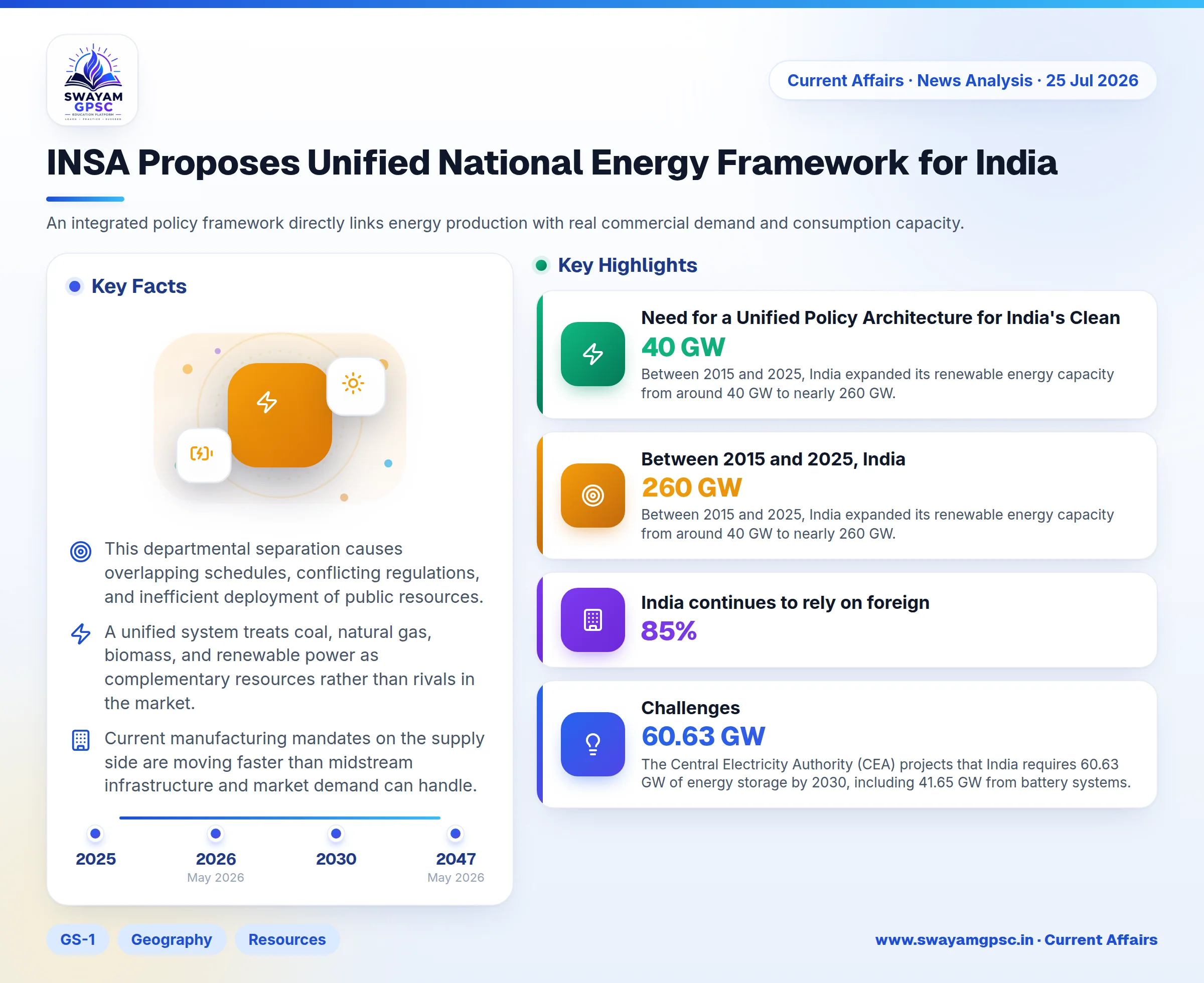
- Between 2015 and 2025, India expanded its renewable energy capacity from around 40 GW to nearly 260 GW.
- Managing this variable 260 GW of green power requires smooth real-time integration with coal power plants, Pumped Storage Hydropower, and Battery Energy Storage Systems (BESS) to keep the power grid stable.
- India's energy governance currently operates in separate ministerial silos, with the Ministry of Coal, Ministry of Power, Ministry of Petroleum and Natural Gas (MoPNG), Ministry of New and Renewable Energy (MNRE), and the Department of Atomic Energy (DAE) acting independently.
- This departmental separation causes overlapping schedules, conflicting regulations, and inefficient deployment of public resources.
- A unified system treats coal, natural gas, biomass, and renewable power as complementary resources rather than rivals in the market.
- Current manufacturing mandates on the supply side are moving faster than midstream infrastructure and market demand can handle.
- Major government schemes such as the National Green Hydrogen Mission and SATAT for compressed biogas face bottlenecks due to missing local pipelines, evacuation constraints, and uneven pricing.
- An integrated policy framework directly links energy production with real commercial demand and consumption capacity.
- Electricity data stays fragmented across multiple government agencies in incompatible formats, which severely limits accurate real-time planning and investment.
- To fix this, the draft National Electricity Data Sharing Framework, 2026 recommends building a National Electricity Data Centre (NEDC) to standardise data across the sector for artificial intelligence grid management and demand forecasting.
- India continues to rely on foreign imports for more than 85% of its crude oil needs, while direct energy subsidies account for about 2.3% of national gross domestic product.
- Fragmented schemes waste financial resources through uncoordinated subsidies, whereas a unified policy connects solar initiatives like PM Surya Ghar and PM-KUSUM directly to DISCOM reforms and CCUS deployment in heavy industries.
Challenges
- Setting up an overarching coordinating authority such as a Department of Energy Resources conflicts with existing bureaucratic boundaries across individual ministries.
- This organizational breakdown creates a resource impetus mismatch, where coal and renewable sectors operate under conflicting policy timelines.
- Renewable power projects take 12 to 18 months to build, whereas constructing interstate power transmission lines requires 18 to 30 months.
- This infrastructure timeline gap leads to grid congestion and clean energy curtailment, especially when solar power fluctuates within the narrow national grid frequency band of 49.90 Hz to 50.05 Hz.
- The Central Electricity Authority (CEA) projects that India requires 60.63 GW of energy storage by 2030, including 41.65 GW from battery systems.
- As of early 2024, India operates only a tiny fraction of this required capacity due to high upfront costs and foreign dependence on critical minerals.
- Modernising grid distribution networks with smart meters requires huge financial investment that state electricity distribution companies cannot afford.
- State DISCOMs remain burdened with heavy financial debts and aggregate technical and commercial losses, restricting their ability to purchase flexible clean power.
- A top-down national policy clashes with regional economic conditions across different state governments.
- Under India's system of competitive federalism, creating state-level reskilling programs without hurting local revenues remains a tough political challenge.
Key Highlights of the Proposed INSA Framework
- Adequacy: The framework focuses on securing reliable energy through conventional and modern power sources supported by grid-scale storage and digital technologies.
- Access: It prioritizes delivering stable power to every citizen by improving local power lines and expanding decentralized off-grid systems in remote regions.
- Affordability: It ensures that clean energy stays affordable for homes, businesses, and manufacturing plants through competitive market mechanisms and financial safeguards.
- Appropriate Sustainability: It avoids rigid solutions by promoting climate strategies that fit India's specific social, economic, and regional conditions.
Strategic Enablers and Emerging Technologies Highlighted
- Cross-Cutting Technical Levers: The proposed framework mandates circular economy practices and Carbon Capture, Utilisation, and Storage (CCUS) to lower emissions in heavy industrial sectors.
- Green Hydrogen and Clean Tech: It gives high priority to building market infrastructure and commercial scale for green hydrogen and advanced bio-energy resources.
- Resource Optimization: The strategy treats coal, renewables, gas, biomass, and waste-to-energy as interdependent parts of one national energy asset.
Way Forward
- In the short term, India must break ministerial silos, fast-track interstate power transmission lines to prevent clean energy wastage, and deploy affordable grid-scale energy storage.
- Over the long term, India should deeply integrate low-carbon technologies like Green Hydrogen, expand bio-resources, and commercialise CCUS to bridge regional economic gaps while meeting its net-zero goals.