Infrastructure-Led Nation Building and Development in India
#GS-3 #Economy #Infrastructure #Governance & Social Justice #Good Governance #Science & Technology #ICT #Current Events #National #Gujarat
Key takeaways
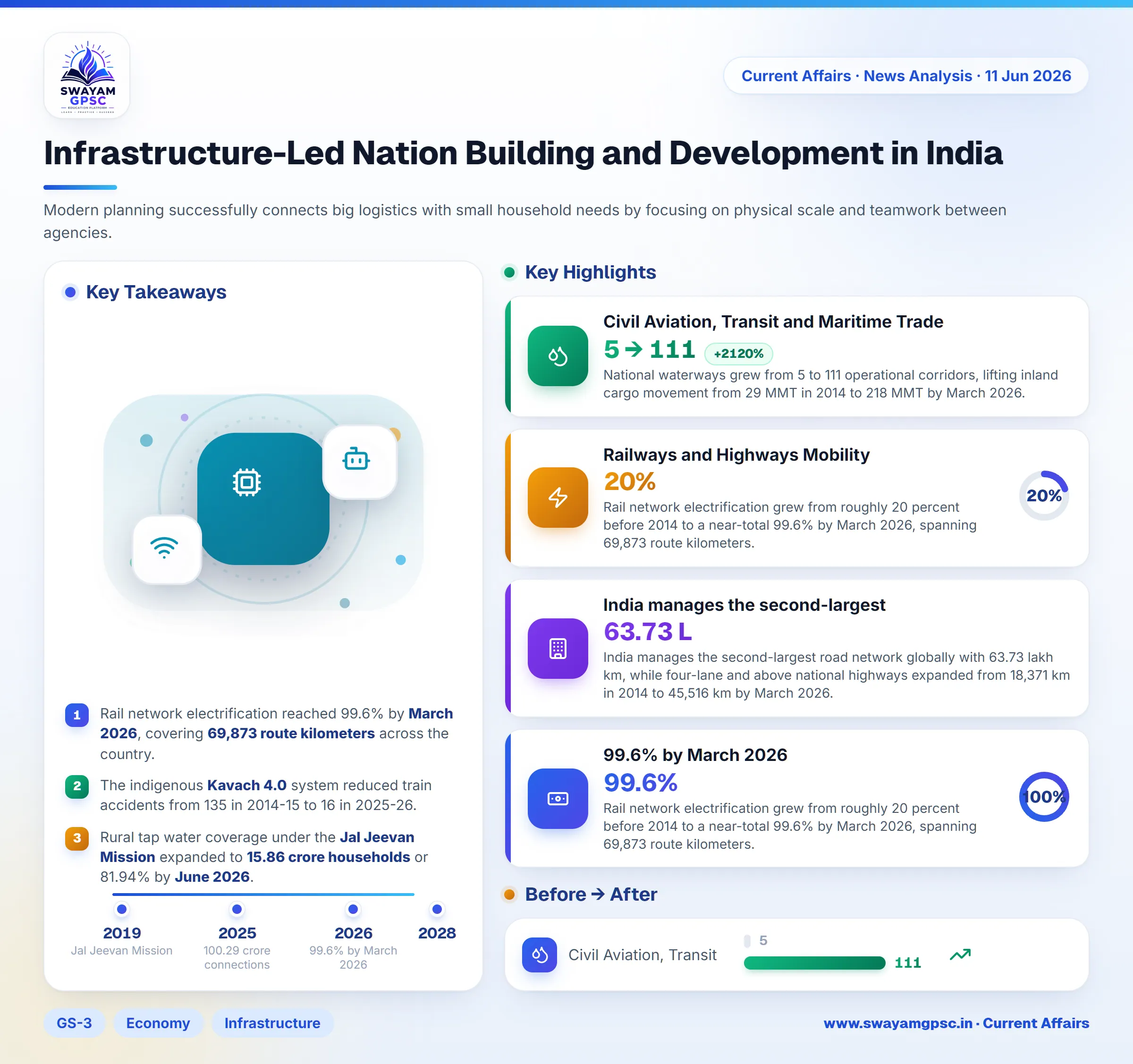
- Rail network electrification reached 99.6% by March 2026, covering 69,873 route kilometers across the country.
- The indigenous Kavach 4.0 system reduced train accidents from 135 in 2014-15 to 16 in 2025-26.
- Rural tap water coverage under the Jal Jeevan Mission expanded to 15.86 crore households or 81.94% by June 2026.
- The Unified Payments Interface (UPI) processed 2,264 crore digital transactions worth ₹29.53 lakh crore in March 2026 alone.
- National LPG coverage grew from 55.9% in 2014 to 107.2% in 2026, touching 33.39 crore active consumers.
Context
- The Press Information Bureau (PIB) recently published a detailed progress report tracking the massive transformation of India over the past twelve years.
- This report highlights growth across physical, financial, and digital public infrastructure.
About Infrastructure-Led Nation Building
- Building infrastructure in India has turned into a powerful tool for economic unity and social welfare.
- Modern planning successfully connects big logistics with small household needs by focusing on physical scale and teamwork between agencies.
Railways and Highways Mobility
- Rail network electrification grew from roughly 20 percent before 2014 to a near-total 99.6% by March 2026, spanning 69,873 route kilometers.
- A total of 162 indigenous Vande Bharat services and 60 affordable Amrit Bharat Express lines are now working across the nation.
- The Kavach (Version 4.0) automatic train protection system is deployed across 3,103 route km and 4,277 locomotives, reducing train accidents from 135 in 2014-15 to 16 in 2025-26.
- India manages the second-largest road network globally with 63.73 lakh km, while four-lane and above national highways expanded from 18,371 km in 2014 to 45,516 km by March 2026.
- Under the Pradhan Mantri Gram Sadak Yojana (PMGSY), road budgets scaled from ₹386 crore in 2014-15 to ₹19,000 crore in 2026-27, connecting 99.6% of eligible rural habitations.
Civil Aviation, Transit and Maritime Trade
- Total operational airports doubled from 74 in 2014 to 165 in 2026, helped by the UDAN scheme which served 1.64 crore passengers across 665 routes.
- Over 9.3 crore flyers used the Digi Yatra facial recognition system across 38 airports.
- Metro transit lines expanded from 248 km in 2014 to over 1,155 km in 2026 across 26 cities, making India the third-largest metro network globally.
- Major port capacity nearly doubled from 873 MMTPA in 2014 to 1,726 MMTPA in 2026, dropping cargo turnaround times from 94 hours to 48.8 hours while earning a yearly financial surplus of ₹10,910 crore.
- National waterways grew from 5 to 111 operational corridors, lifting inland cargo movement from 29 MMT in 2014 to 218 MMT by March 2026.
Water Security, Affordable Housing and Clean Energy
- Rural tap water connections under the Jal Jeevan Mission surged from 3.23 crore households or 17% coverage in 2019 to 15.86 crore households in June 2026, reaching 81.94% coverage.
- Under PMAY-Urban, 98.10 lakh homes were completed out of 125.31 lakh sanctioned units, with 96% of properties registered under women's ownership.
- Under PMAY-Gramin, 3.06 crore rural homes have been completed.
- The power supply deficit dropped from 4.2% in 2014 to 0.03% in 2025-26, while total installed capacity reached 532.74 GW, hitting COP21 clean energy goals nearly ten years early.
- National LPG coverage grew from 55.9% in 2014 to 107.2% in 2026, with active consumer databases touching 33.39 crore citizens.
Public Digital Infrastructure and Logistics
- Internet connections expanded nearly fourfold to 100.29 crore connections, while average monthly data usage per user jumped from 61.66 MB in 2014 to 24.01 GB in 2025.
- Aadhaar identity generation crossed 144 crore identifiers, and Jan Dhan financial inclusion bank accounts reached 57.71 crore.
- The Unified Payments Interface (UPI) processed 2,264 crore digital transactions worth ₹29.53 lakh crore in March 2026 alone, working across eight international countries.
- The PRAGATI governance platform evaluated 382 delayed projects worth over ₹85 lakh crore, solving 2,958 cross-departmental blockages since 2015.
Challenges
- Central digital portals clear permits quickly, but execution hits delays when dealing with local municipal corporations and state revenue offices.
- Laying transport links across landslide-prone Himalayan areas requires expensive reinforcement and constant checks on the environment.
- Cheap mobile data packs make consumers underutilize public physical networks despite the deployment of over 4.10 lakh public Wi-Fi hotspots under PM-WANI.
- Complex legal disputes over compensation values can hold up high-speed freight alignments and expressways at the district level.
Way Forward
- Complete the rollout of the 100 new industrial smart hubs under the BHAVYA scheme to attract global manufacturing supply chains.
- Fast-track the ongoing installation of Kavach 4.0 across the remaining 24,427 sanctioned route kilometers to ensure total rail safety.
- Maintain high capital spending through the extended 2028 timeline to bridge the remaining 18% rural tap water gap.
- Monetize operational highways and power grids through transparent investment trusts like InvITs to raise non-fiscal capital for new construction.
- Scale up the international reach of UPI and DigiLocker in emerging markets to strengthen cross-border trade.
Conclusion
- India has shifted successfully from slow construction to multi-modal and technology-driven infrastructure planning.
- By backing mega transport links like the Chenab Bridge with digital networks, the nation has connected industrial efficiency with household welfare.