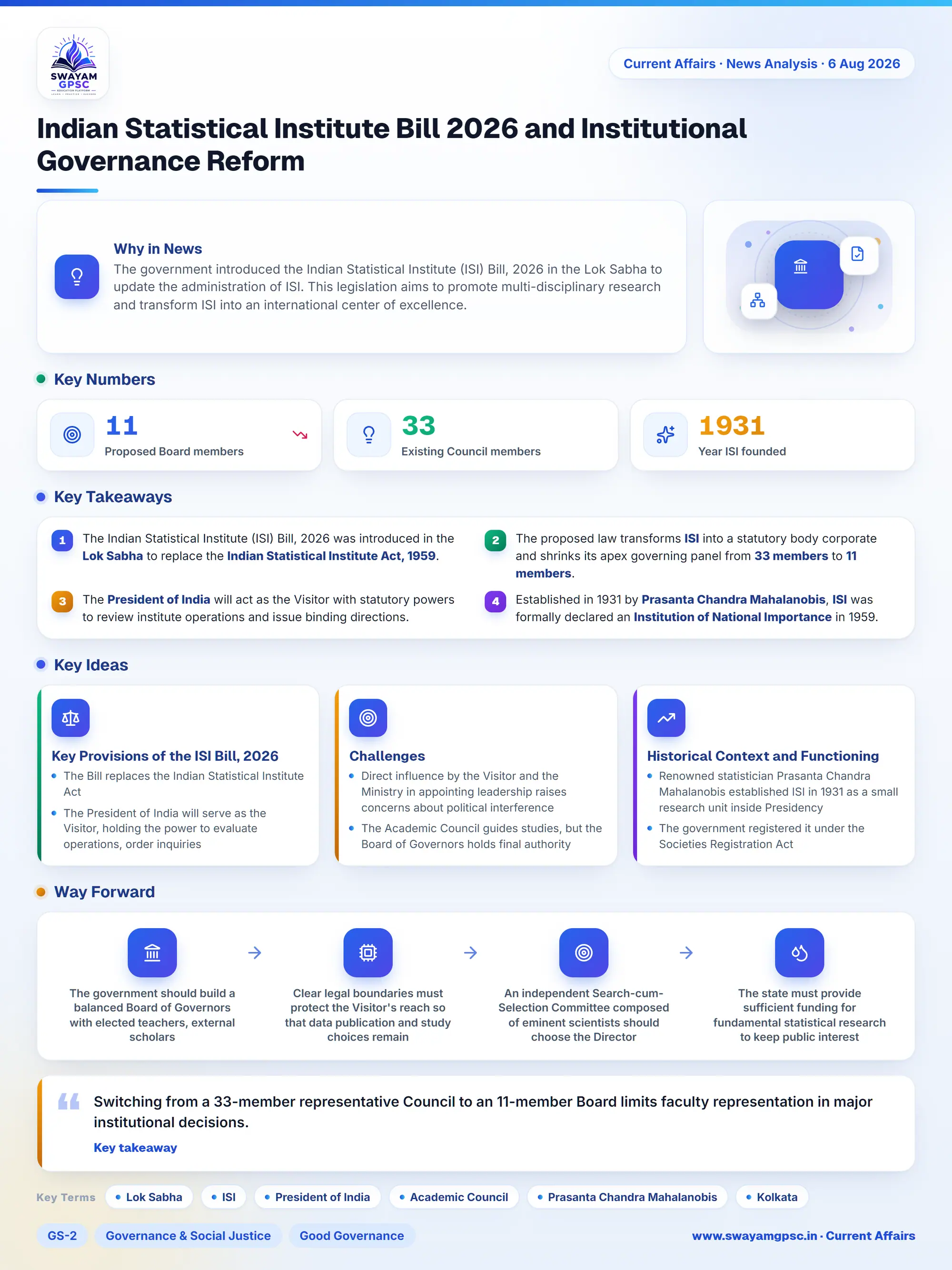
Indian Statistical Institute Bill 2026 and Institutional Governance Reform
#GS-2 #Governance & Social Justice #Good Governance #Regulatory Bodies #Government Policies #National
Key takeaways
- The Indian Statistical Institute (ISI) Bill, 2026 was introduced in the Lok Sabha to replace the Indian Statistical Institute Act, 1959.
- The proposed law transforms ISI into a statutory body corporate and shrinks its apex governing panel from 33 members to 11 members.
- The President of India will act as the Visitor with statutory powers to review institute operations and issue binding directions.
- Established in 1931 by Prasanta Chandra Mahalanobis, ISI was formally declared an Institution of National Importance in 1959.
Why in News
- The government introduced the Indian Statistical Institute (ISI) Bill, 2026 in the Lok Sabha to update the administration of ISI.
- This legislation aims to promote multi-disciplinary research and transform ISI into an international center of excellence.
- Critics argue that the proposed changes give the Central Government excessive authority and reduce institutional independence.
Key Provisions of the ISI Bill, 2026
- The Bill replaces the Indian Statistical Institute Act, 1959 and turns ISI from a registered society into a non-profit statutory body corporate.
- The President of India will serve as the Visitor, holding the power to evaluate operations, order inquiries, and issue binding directives.
- A new 11-member Board of Governors will replace the current 33-member Council to make decision-making faster and simpler.
- The Board of Governors will handle budgeting, open new departments, award degrees, make internal regulations, and review institute performance.
- The structure creates an Academic Council for courses, a Finance Committee for money matters, and Management Councils for individual regional centers.
- The Board will select the Director as the Chief Executive Officer after getting prior approval from the Visitor.
- Future regulation changes will no longer need government permission after the initial set of rules gets central approval.
Challenges
- Switching from a 33-member representative Council to an 11-member Board limits faculty representation in major institutional decisions.
- Direct influence by the Visitor and the Ministry in appointing leadership raises concerns about political interference in scientific work.
- The Academic Council guides studies, but the Board of Governors holds final authority, which might restrict pure academic freedom.
- Pushing for corporate partnerships and self-generated revenue could shift focus away from foundational statistical research.
Historical Context and Functioning of ISI
- Renowned statistician Prasanta Chandra Mahalanobis established ISI in 1931 as a small research unit inside Presidency College.
- The government registered it under the Societies Registration Act, 1860 and named it an Institution of National Importance in 1959.
- Headquartered in Kolkata, the institute operates major active regional centers in Delhi, Bengaluru, Chennai, and Tezpur.
- A broad 33-member Council currently governs the institute, including elected scholars and representatives from MoSPI, Ministry of Finance, and the RBI.
- Under the present framework, this independent representative Council selects the Director without seeking prior government confirmation.
Way Forward
- The government should build a balanced Board of Governors with elected teachers, external scholars, and official nominees to preserve administrative democracy.
- Clear legal boundaries must protect the Visitor's reach so that data publication and study choices remain completely independent.
- An independent Search-cum-Selection Committee composed of eminent scientists should choose the Director to secure professional credibility.
- The state must provide sufficient funding for fundamental statistical research to keep public interest priorities above pure market demands.