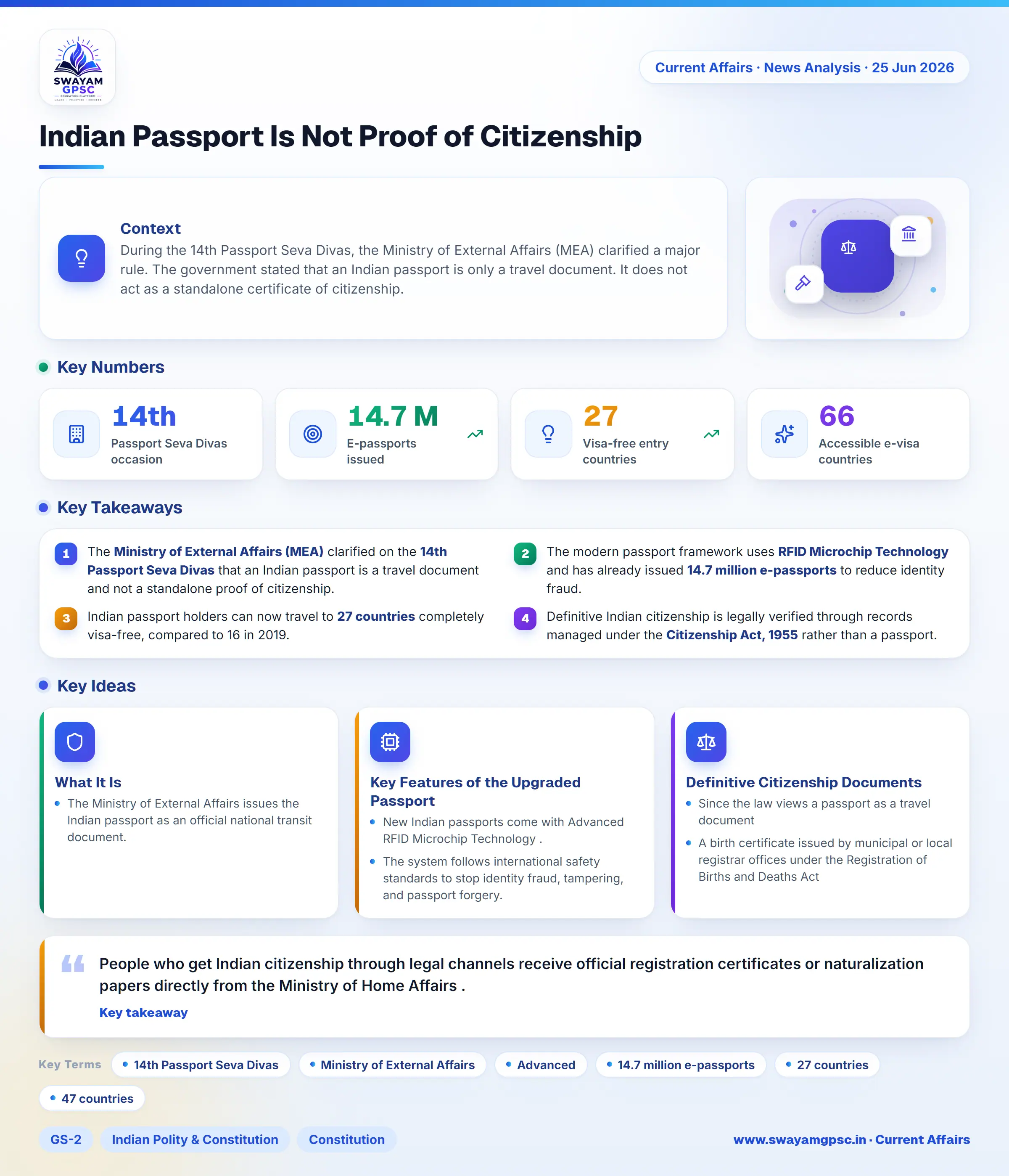
Indian Passport Is Not Proof of Citizenship
#GS-2 #Indian Polity & Constitution #Constitution #Economy #Infrastructure #Current Events #National
Key takeaways
- The Ministry of External Affairs (MEA) clarified on the 14th Passport Seva Divas that an Indian passport is a travel document and not a standalone proof of citizenship.
- The modern passport framework uses RFID Microchip Technology and has already issued 14.7 million e-passports to reduce identity fraud.
- Indian passport holders can now travel to 27 countries completely visa-free, compared to 16 in 2019.
- Definitive Indian citizenship is legally verified through records managed under the Citizenship Act, 1955 rather than a passport.
Context
- During the 14th Passport Seva Divas, the Ministry of External Affairs (MEA) clarified a major rule. The government stated that an Indian passport is only a travel document. It does not act as a standalone certificate of citizenship.
What It Is
- The Ministry of External Affairs issues the Indian passport as an official national transit document. Security agencies run strict background checks and verification before granting it to confirm a person has Indian nationality. Even with this verification, the main legal purpose is to help people travel abroad and receive consular protection. It does not work as a final, standalone proof of citizenship.
Key Features of the Upgraded Passport System
- New Indian passports come with Advanced RFID Microchip Technology . These e-passports have built-in radio frequency chips and secure digital biometric storage.
- The system follows international safety standards to stop identity fraud, tampering, and passport forgery.
- Automated chips help people clear immigration at international borders much faster. The government has already issued 14.7 million e-passports using this modern setup.
- New migration and mobility partnerships give Indian passport holders better global travel options.
- Now, 27 countries allow completely visa-free entry, which is an increase from 16 in 2019.
- Another 47 countries offer convenient visa-on-arrival options for Indian travelers.
- Travelers can also use e-visa entry channels to visit 66 countries easily.
Definitive Citizenship Documents in India
- Since the law views a passport as a travel document, authorities check different civil records to prove Indian citizenship under the Citizenship Act, 1955 .
- A birth certificate issued by municipal or local registrar offices under the Registration of Births and Deaths Act, 1969 acts as a natural citizenship proof. This works especially well for people whose parents meet basic Indian descent rules.
- Finding a name inside the National Register of Citizens (NRC) serves as clear proof of official citizenship status.
- People who get Indian citizenship through legal channels receive official registration certificates or naturalization papers directly from the Ministry of Home Affairs .