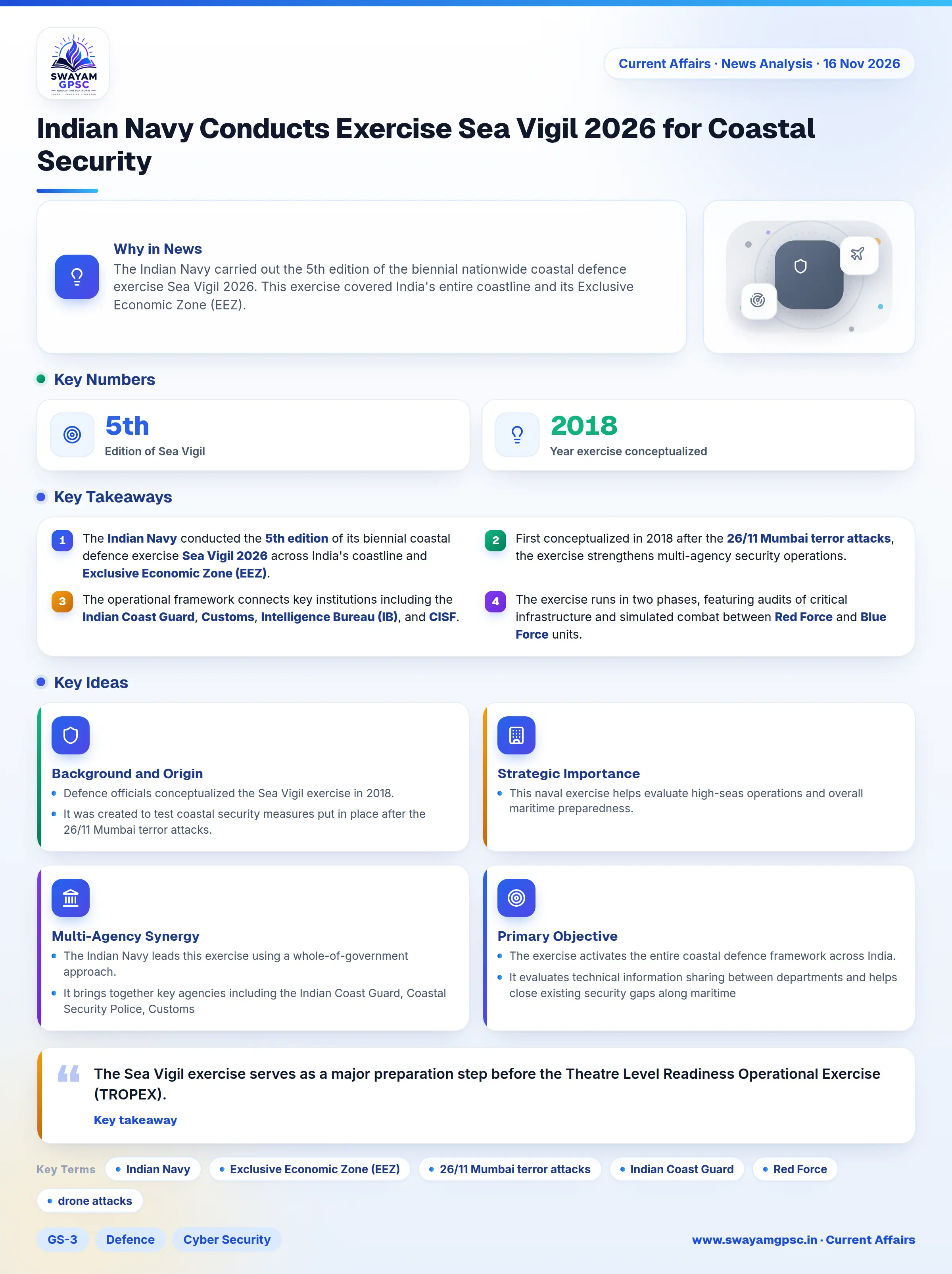
Indian Navy Conducts Exercise Sea Vigil 2026 for Coastal Security
#GS-3 #Defence #Cyber Security #Current Events #National #Coastal Security #Rapid Fire CA
Key takeaways
- The Indian Navy conducted the 5th edition of its biennial coastal defence exercise Sea Vigil 2026 across India's coastline and Exclusive Economic Zone (EEZ).
- First conceptualized in 2018 after the 26/11 Mumbai terror attacks, the exercise strengthens multi-agency security operations.
- The operational framework connects key institutions including the Indian Coast Guard, Customs, Intelligence Bureau (IB), and CISF.
- The exercise runs in two phases, featuring audits of critical infrastructure and simulated combat between Red Force and Blue Force units.
- It acts as a build-up phase for the Theatre Level Readiness Operational Exercise (TROPEX) to address modern threats like drone attacks and ship hijackings.
Why in News
- The Indian Navy carried out the 5th edition of the biennial nationwide coastal defence exercise Sea Vigil 2026.
- This exercise covered India's entire coastline and its Exclusive Economic Zone (EEZ).
- The main purpose was to check maritime security readiness and improve coordination between different government agencies.
Background and Origin
- Defence officials conceptualized the Sea Vigil exercise in 2018.
- It was created to test coastal security measures put in place after the 26/11 Mumbai terror attacks.
Strategic Importance
- The Sea Vigil exercise serves as a major preparation step before the Theatre Level Readiness Operational Exercise (TROPEX).
- This naval exercise helps evaluate high-seas operations and overall maritime preparedness.
Multi-Agency Synergy
- The Indian Navy leads this exercise using a whole-of-government approach.
- It brings together key agencies including the Indian Coast Guard, Coastal Security Police, Customs, Intelligence Bureau (IB), and the Central Industrial Security Force (CISF).
Primary Objective
- The exercise activates the entire coastal defence framework across India.
- It evaluates technical information sharing between departments and helps close existing security gaps along maritime borders.
Two-Phased Execution
- Phase 1 focuses on the Coastal Defence and Security Readiness Evaluation through Joint Audit Teams.
- These audit teams inspect critical maritime infrastructure, including major ports, minor ports, fish landing centres, and Vulnerable Areas and Vulnerable Points (VAs/VPs).
- Phase 2 involves tactical deployment where forces split into simulated Red Force attackers and Blue Force defenders to test real-time operational response.
Contemporary Threat Mitigation
- The exercise tests security readiness against modern asymmetric threats.
- These threats include drone attacks, merchant vessel hijackings, and covert strikes on key coastal facilities.