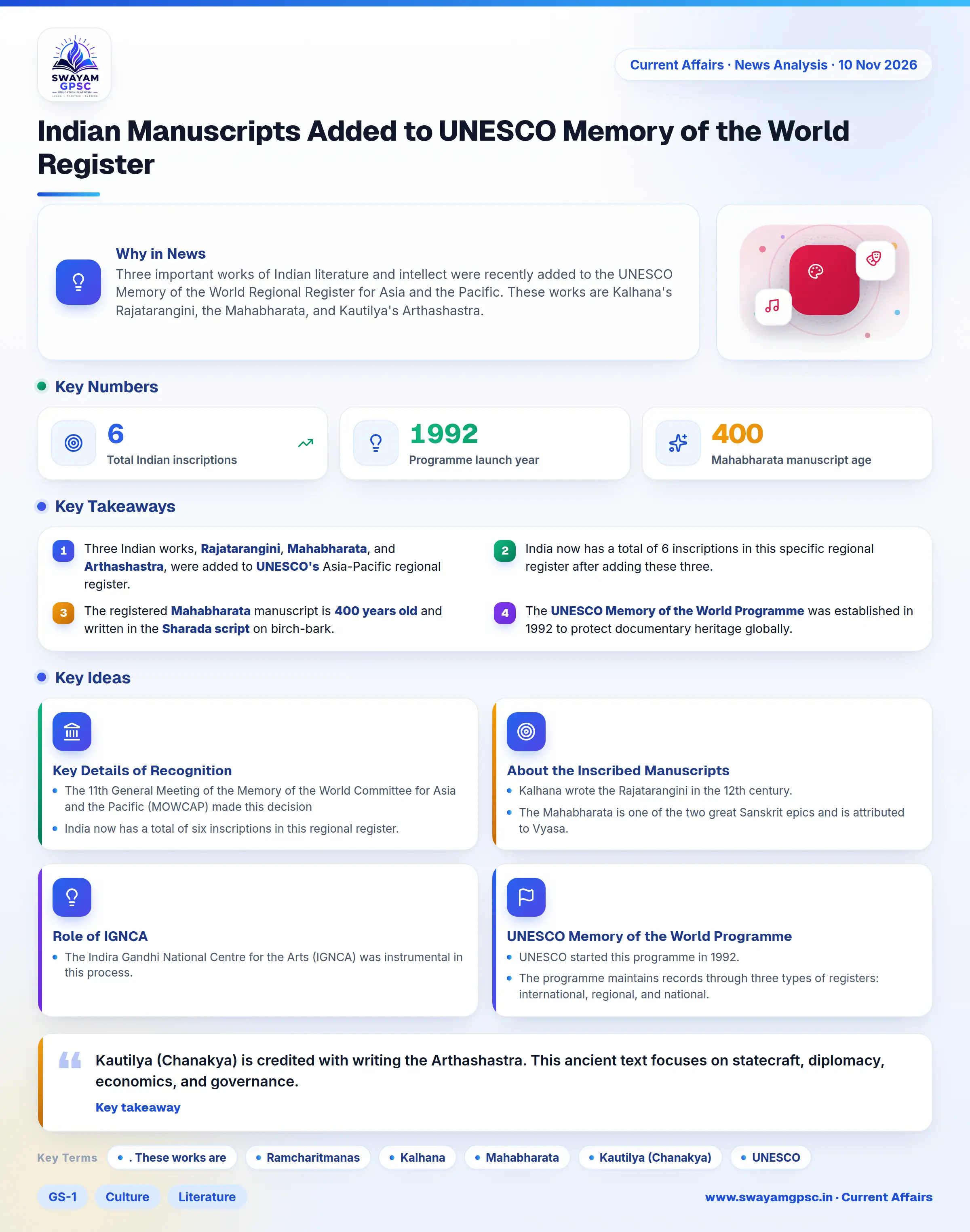
Indian Manuscripts Added to UNESCO Memory of the World Register
#GS-1 #Culture #Literature #UNESCO #National
Key takeaways
- Three Indian works, Rajatarangini, Mahabharata, and Arthashastra, were added to UNESCO's Asia-Pacific regional register.
- India now has a total of 6 inscriptions in this specific regional register after adding these three.
- The registered Mahabharata manuscript is 400 years old and written in the Sharada script on birch-bark.
- The UNESCO Memory of the World Programme was established in 1992 to protect documentary heritage globally.
Why in News
- Three important works of Indian literature and intellect were recently added to the UNESCO Memory of the World Regional Register for Asia and the Pacific. These works are Kalhana's Rajatarangini, the Mahabharata, and Kautilya's Arthashastra.
Key Details of Recognition
- The 11th General Meeting of the Memory of the World Committee for Asia and the Pacific (MOWCAP) made this decision during its meeting in Jakarta, Indonesia.
- India now has a total of six inscriptions in this regional register.
- Before this, three other works were added in 2024. These were the Ramcharitmanas, Panchatantra, and Sahrdayaloka-Locana.
About the Inscribed Manuscripts
- Kalhana wrote the Rajatarangini in the 12th century. It is a historical record of Kashmir written in Sanskrit that describes its kings and politics. The Oriental Research Library, Srinagar keeps this manuscript.
- The Mahabharata is one of the two great Sanskrit epics and is attributed to Vyasa. It teaches about Dharma, duty, and morality. The registered version is a 400-year-old birch-bark manuscript written in the Sharada script. It is kept at the Bhandarkar Oriental Research Institute, Pune.
- Kautilya (Chanakya) is credited with writing the Arthashastra. This ancient text focuses on statecraft, diplomacy, economics, and governance. The registered version is a 16th-century palm-leaf manuscript kept at the Oriental Research Institute, Mysuru.
Role of IGNCA
- The Indira Gandhi National Centre for the Arts (IGNCA) was instrumental in this process. They prepared the detailed nomination files for all three manuscripts.
UNESCO Memory of the World Programme
- UNESCO started this programme in 1992. Its goal is to protect documentary heritage that might be lost due to natural disasters or wars. It also wants to make these records available to everyone and raise public awareness.
- The programme maintains records through three types of registers: international, regional, and national. These include archives, manuscripts, and audio-visual records.
- The UNESCO/Jikji Memory of the World Prize was started in 2004. It rewards people or groups that help preserve and provide access to documentary heritage.
- The prize is named after the Buljo Jikji Simche Yojeol (Jikji). This is the oldest known book in the world printed with movable metal type.