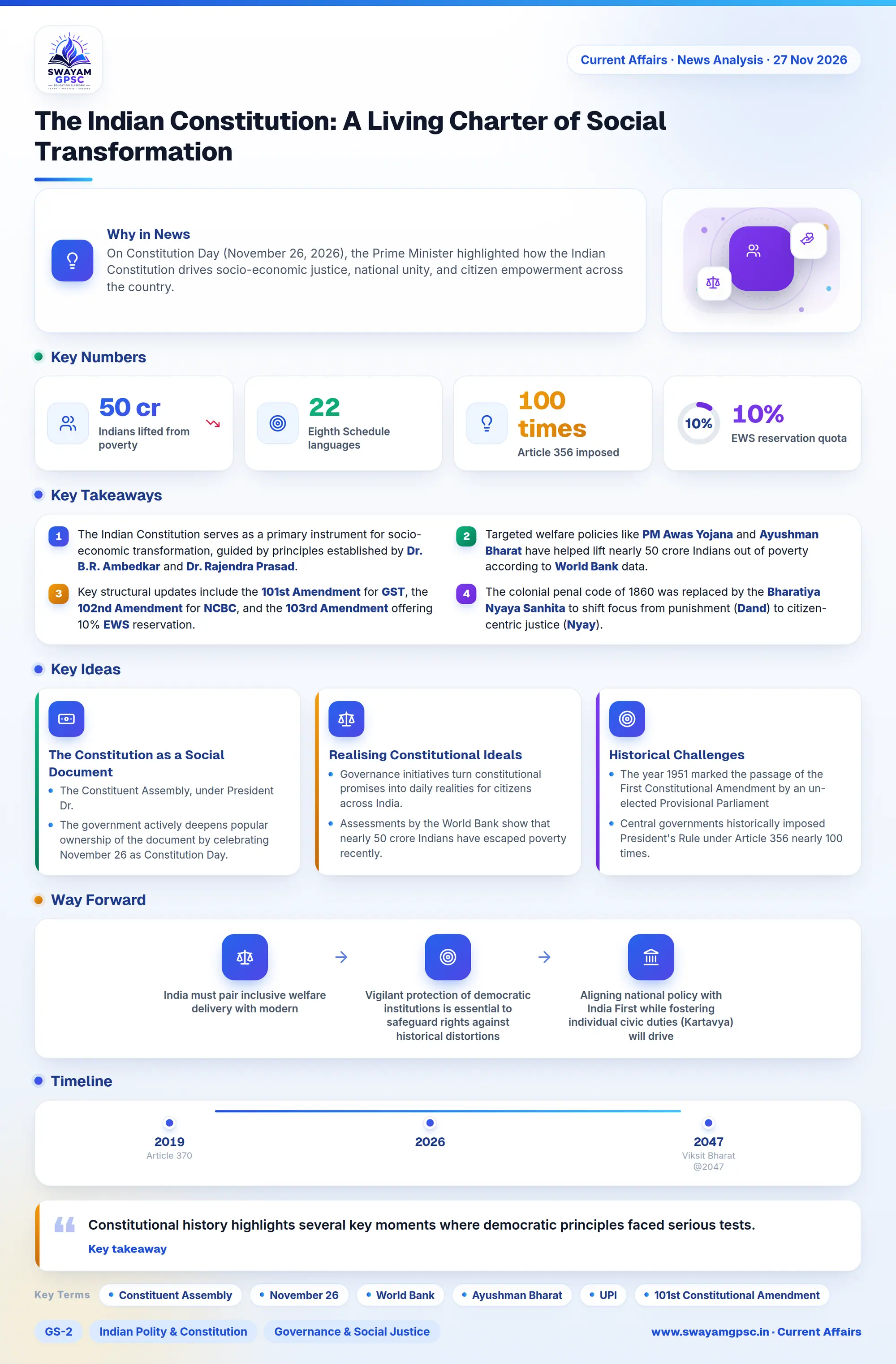
The Indian Constitution: A Living Charter of Social Transformation
#GS-2 #Indian Polity & Constitution #Governance & Social Justice #Constitution #Good Governance #Social Justice #Women
Key takeaways
- The Indian Constitution serves as a primary instrument for socio-economic transformation, guided by principles established by Dr. B.R. Ambedkar and Dr. Rajendra Prasad.
- Targeted welfare policies like PM Awas Yojana and Ayushman Bharat have helped lift nearly 50 crore Indians out of poverty according to World Bank data.
- Key structural updates include the 101st Amendment for GST, the 102nd Amendment for NCBC, and the 103rd Amendment offering 10% EWS reservation.
- The colonial penal code of 1860 was replaced by the Bharatiya Nyaya Sanhita to shift focus from punishment (Dand) to citizen-centric justice (Nyay).
- Achieving Viksit Bharat @2047 requires balancing fundamental rights with fundamental duties (Kartavya) under an India First approach.
Why in News
- On Constitution Day (November 26, 2026), the Prime Minister highlighted how the Indian Constitution drives socio-economic justice, national unity, and citizen empowerment across the country.
The Constitution as a Social Document of Justice
- The Constituent Assembly, under President Dr. Rajendra Prasad and Drafting Committee Chairman Dr. B.R. Ambedkar, framed the Constitution as a foundational social document. Scholar Granville Austin famously described it as first and foremost a instrument of social reform. It merges ancient Indian wisdom with modern democratic values to eliminate birth-based privileges and guarantee social, economic, and political justice.
- The government actively deepens popular ownership of the document by celebrating November 26 as Constitution Day. It publishes updated constitutional editions in all 22 Eighth Schedule languages to bring legal literacy directly to youth and citizens outside courtrooms.
Realising Constitutional Ideals through Governance
- Governance initiatives turn constitutional promises into daily realities for citizens across India.
- Assessments by the World Bank show that nearly 50 crore Indians have escaped poverty recently. Targeted welfare programs like PM Awas Yojana for permanent housing and Ujjwala Yojana for clean cooking gas uphold human dignity.
- Health insurance under Ayushman Bharat shields vulnerable families from catastrophic medical expenses. At the same time, MUDRA and PM-SVANidhi provide collateral-free loans to small business owners and street vendors.
- Open platforms like UPI democratize financial access for all socio-economic groups. This digital infrastructure makes equal opportunity a reality for everyday transactions.
- Parliament enacted major structural and legal updates to strengthen constitutional mandates.
- The 101st Constitutional Amendment created the GST framework for national economic integration. The 102nd Amendment gave constitutional status to the National Commission for Backward Classes (NCBC). Additionally, the 103rd Amendment secured a 10% reservation for Economically Weaker Sections (EWS).
- India updated its legal framework by replacing the colonial penal code of 1860 with the Bharatiya Nyaya Sanhita. This legislative overhaul moves the legal system away from punitive measures (Dand) toward citizen-centric justice (Nyay).
Historical Challenges to Constitutional Democracy
- Constitutional history highlights several key moments where democratic principles faced serious tests.
- The year 1951 marked the passage of the First Constitutional Amendment by an un-elected Provisional Parliament to place restrictions on fundamental freedoms. Decades later, the 42nd Amendment (1976), alongside the 38th and 39th Amendments passed during the Emergency, severely restricted judicial review and eroded checks and balances.
- Central governments historically imposed President's Rule under Article 356 nearly 100 times. This frequent misuse destabilized federalism and undermined democratically elected state leadership.
- Temporary arrangements like Article 370 and Article 35A denied full constitutional rights to SC, ST, OBC communities, and women in Jammu and Kashmir until their abrogation in 2019. Meanwhile, left-wing extremism long deprived tribal citizens of basic rights through violent actions.
- Efforts to introduce religion-based reservations contradict the principles advocated by Dr. B.R. Ambedkar in the Constituent Assembly. Continuous legislative disruptions (Avrodh Paksh) further risk weakening national constitutional consensus.
Women's Empowerment and Constitutional Justice
- The nation recognizes the crucial contributions of women members of the Constituent Assembly. Grassroots welfare schemes in housing, energy, and finance continue to empower women directly.
- Passage of the Nari Shakti Vandan Adhiniyam advances legislative seat reservations for women. This reform reinforces India's commitment to gender justice despite past legislative delays.
Constitutional Duties in Building Viksit Bharat @2047
- Fundamental duties (Kartavya) provide the necessary balance to fundamental rights. Active civic responsibility turns citizens into key partners for national development.
- Citizens channel their fundamental duties through large-scale public movements (Jan Andolan). Examples include Swachh Bharat Mission for sanitation, Jal Shakti for water conservation, and Ek Ped Maa Ke Naam for tree planting.
- The roadmap for Viksit Bharat @2047 relies on two central pillars: prioritizing an India First mindset in national decisions and practicing Kartavya in daily life.
Way Forward
- India must pair inclusive welfare delivery with modern, citizen-centric legal systems to uphold constitutional promises.
- Vigilant protection of democratic institutions is essential to safeguard rights against historical distortions and legislative deadlocks.
- Aligning national policy with India First while fostering individual civic duties (Kartavya) will drive progress toward Viksit Bharat @2047.