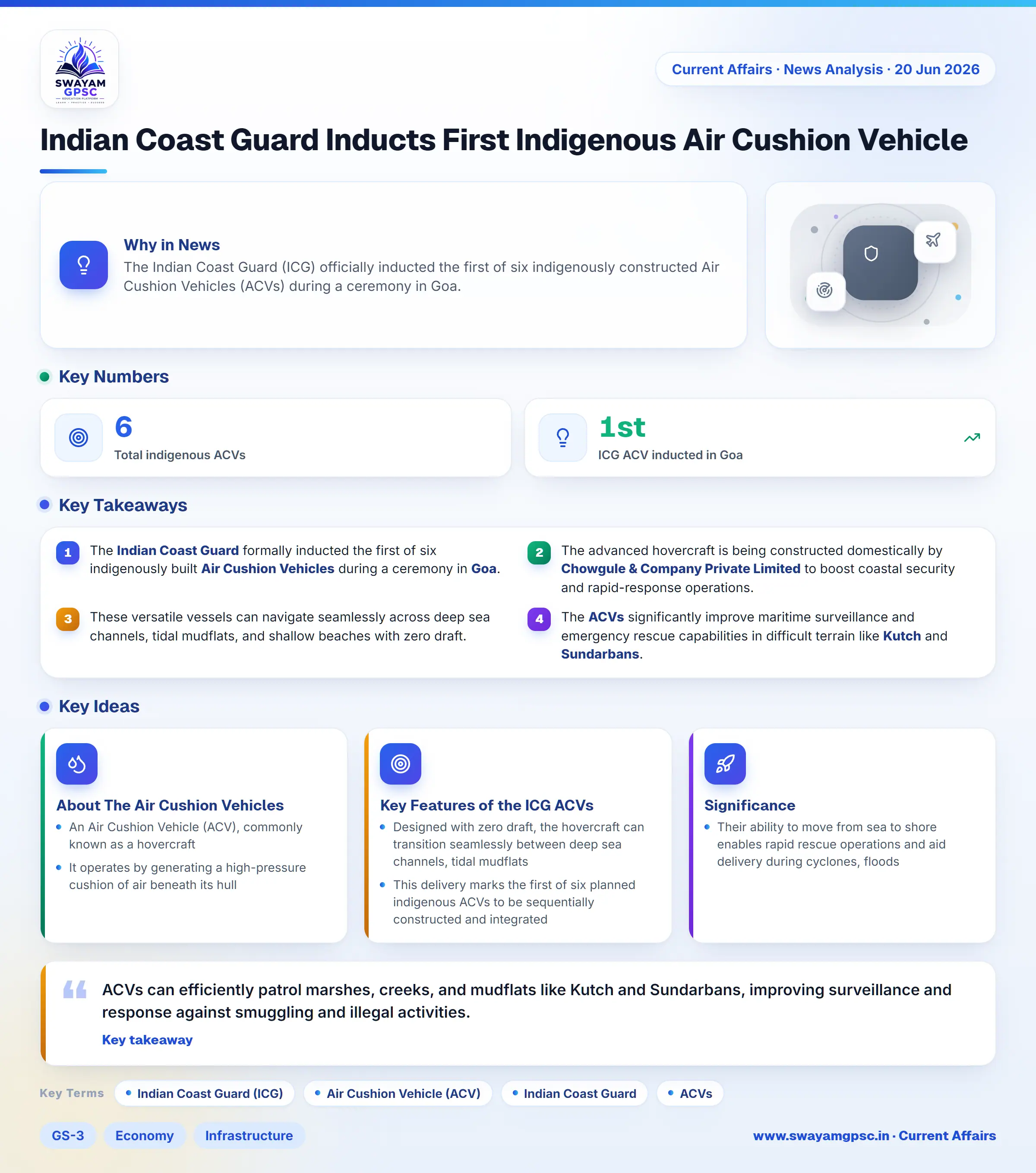
Indian Coast Guard Inducts First Indigenous Air Cushion Vehicle
#GS-3 #Economy #Infrastructure #Science & Technology #Defence #National #Current Events
Key takeaways
- The Indian Coast Guard formally inducted the first of six indigenously built Air Cushion Vehicles during a ceremony in Goa.
- The advanced hovercraft is being constructed domestically by Chowgule & Company Private Limited to boost coastal security and rapid-response operations.
- These versatile vessels can navigate seamlessly across deep sea channels, tidal mudflats, and shallow beaches with zero draft.
- The ACVs significantly improve maritime surveillance and emergency rescue capabilities in difficult terrain like Kutch and Sundarbans.
Why in News
- The Indian Coast Guard (ICG) officially inducted the first of six indigenously constructed Air Cushion Vehicles (ACVs) during a ceremony in Goa.
About The Air Cushion Vehicles
- An Air Cushion Vehicle (ACV), commonly known as a hovercraft, is an amphibious craft designed to travel smoothly over multiple surfaces including water, mudflats, sandbars, and shallow beaches.
- It operates by generating a high-pressure cushion of air beneath its hull, which is contained by a flexible rubber skirt, allowing the vessel to float completely above the surface and eliminate water resistance.
- The high-tech vessel is being constructed indigenously by Chowgule & Company Private Limited.
- The induction of these ACVs aims to enhance the Indian Coast Guard’s rapid-response capability for coastal security, shallow-water surveillance, search and rescue, and maritime law enforcement operations.
Key Features of the ICG ACVs
- Designed with zero draft, the hovercraft can transition seamlessly between deep sea channels, tidal mudflats, and sandy shores where traditional hulls would run aground.
- This delivery marks the first of six planned indigenous ACVs to be sequentially constructed and integrated into the ICG fleet.
- It is built using lightweight, marine-grade materials paired with a durable rubber skirt system to preserve structural integrity while skimming over debris or rough coastal terrain.
- It is equipped with specialized marine radars, night-vision thermal imaging, and secure communication systems to enable round-the-clock operations in dense fog or zero-visibility conditions.
- It is engineered with a versatile deck layout capable of carrying armed boarding parties, medical response teams, or rapid-intervention equipment.
Significance
- ACVs can efficiently patrol marshes, creeks, and mudflats like Kutch and Sundarbans, improving surveillance and response against smuggling and illegal activities.
- Their ability to move from sea to shore enables rapid rescue operations and aid delivery during cyclones, floods, and maritime emergencies.