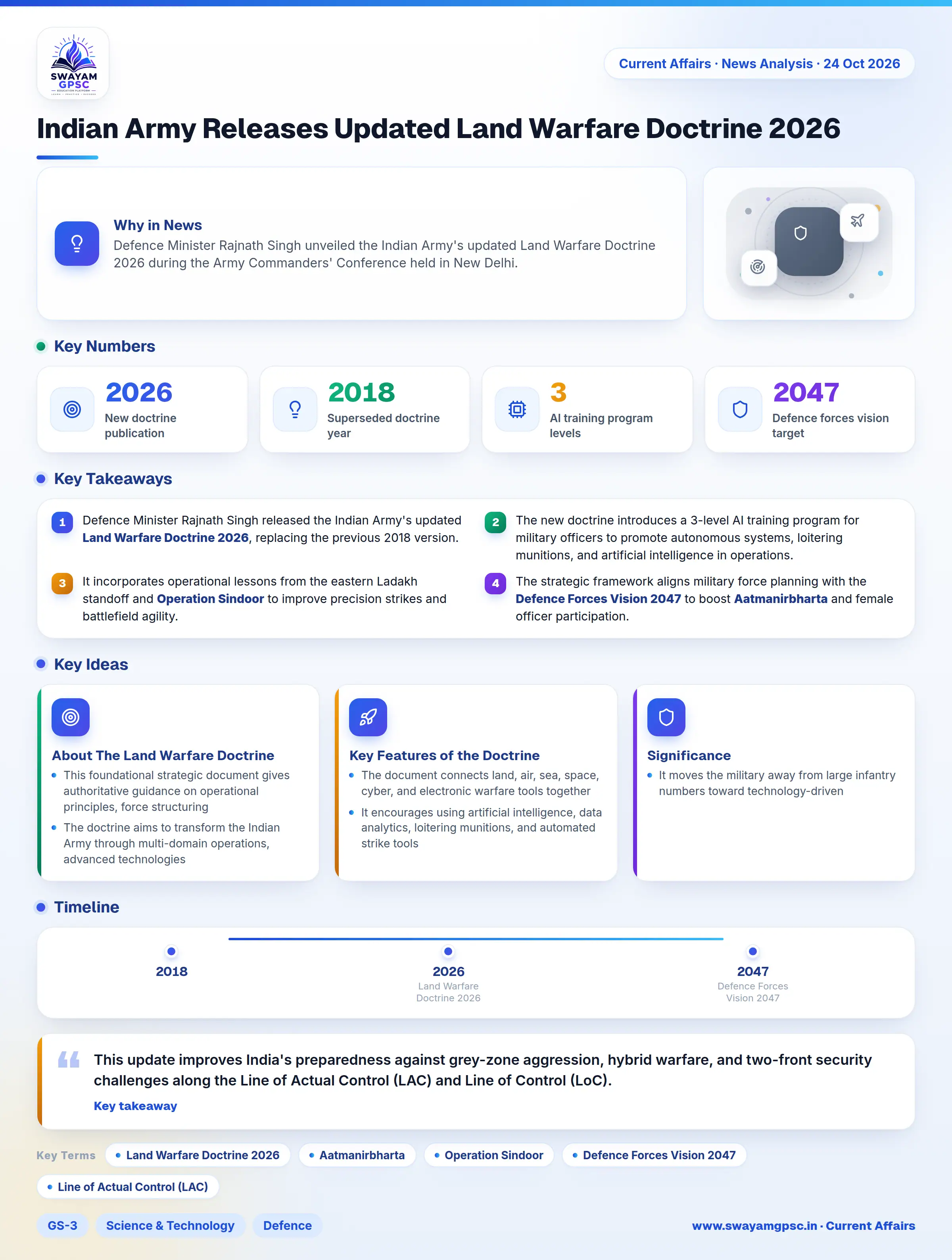
Indian Army Releases Updated Land Warfare Doctrine 2026
#GS-3 #Science & Technology #Defence #Current Events #National #Land Warfare Doctrine 2026 #Military Modernisation
Key takeaways
- Defence Minister Rajnath Singh released the Indian Army's updated Land Warfare Doctrine 2026, replacing the previous 2018 version.
- The new doctrine introduces a 3-level AI training program for military officers to promote autonomous systems, loitering munitions, and artificial intelligence in operations.
- It incorporates operational lessons from the eastern Ladakh standoff and Operation Sindoor to improve precision strikes and battlefield agility.
- The strategic framework aligns military force planning with the Defence Forces Vision 2047 to boost Aatmanirbharta and female officer participation.
Why in News
- Defence Minister Rajnath Singh unveiled the Indian Army's updated Land Warfare Doctrine 2026 during the Army Commanders' Conference held in New Delhi.
About The Land Warfare Doctrine
- This foundational strategic document gives authoritative guidance on operational principles, force structuring, and warfare concepts across modern conflict scenarios, officially replacing the earlier 2018 doctrine.
- The doctrine aims to transform the Indian Army through multi-domain operations, advanced technologies, recent conflict lessons, and Aatmanirbharta to boost operational readiness.
Key Features of the Doctrine
- The document connects land, air, sea, space, cyber, and electronic warfare tools together, while keeping land forces central to securing territory.
- It encourages using artificial intelligence, data analytics, loitering munitions, and automated strike tools, backed by a 3-level AI training course for military officers.
- The plan makes drone flying and counter-drone systems basic soldier skills, while combining automated systems with human troops to keep soldier casualties low.
- It includes practical lessons learned from the eastern Ladakh standoff and Operation Sindoor, focusing on quick tactical movement, accurate missile strikes, and flexible local command.
- The strategy gives field commanders full authority to change tactics across mountains, forests, and deserts, even when electronic jamming breaks regular communication.
- It focuses on domestic defence manufacturing and links civilian infrastructure, local factories, and research institutions to army operational needs.
- The framework matches long-term plans with Defence Forces Vision 2047, emphasizing sustained self-reliance, smart manpower deployment, increased roles for female officers, and steady capability growth.
Significance
- This update improves India's preparedness against grey-zone aggression, hybrid warfare, and two-front security challenges along the Line of Actual Control (LAC) and Line of Control (LoC).
- It moves the military away from large infantry numbers toward technology-driven, connected network systems for stronger national defense.