IndiaAI Mission Launches Three Indigenous Foundation Language Models
#GS-3 #Science & Technology #Artificial Intelligence #GS-2 #Governance & Social Justice #Government Policies & Interventions #Quick Facts For Prelims
Key takeaways
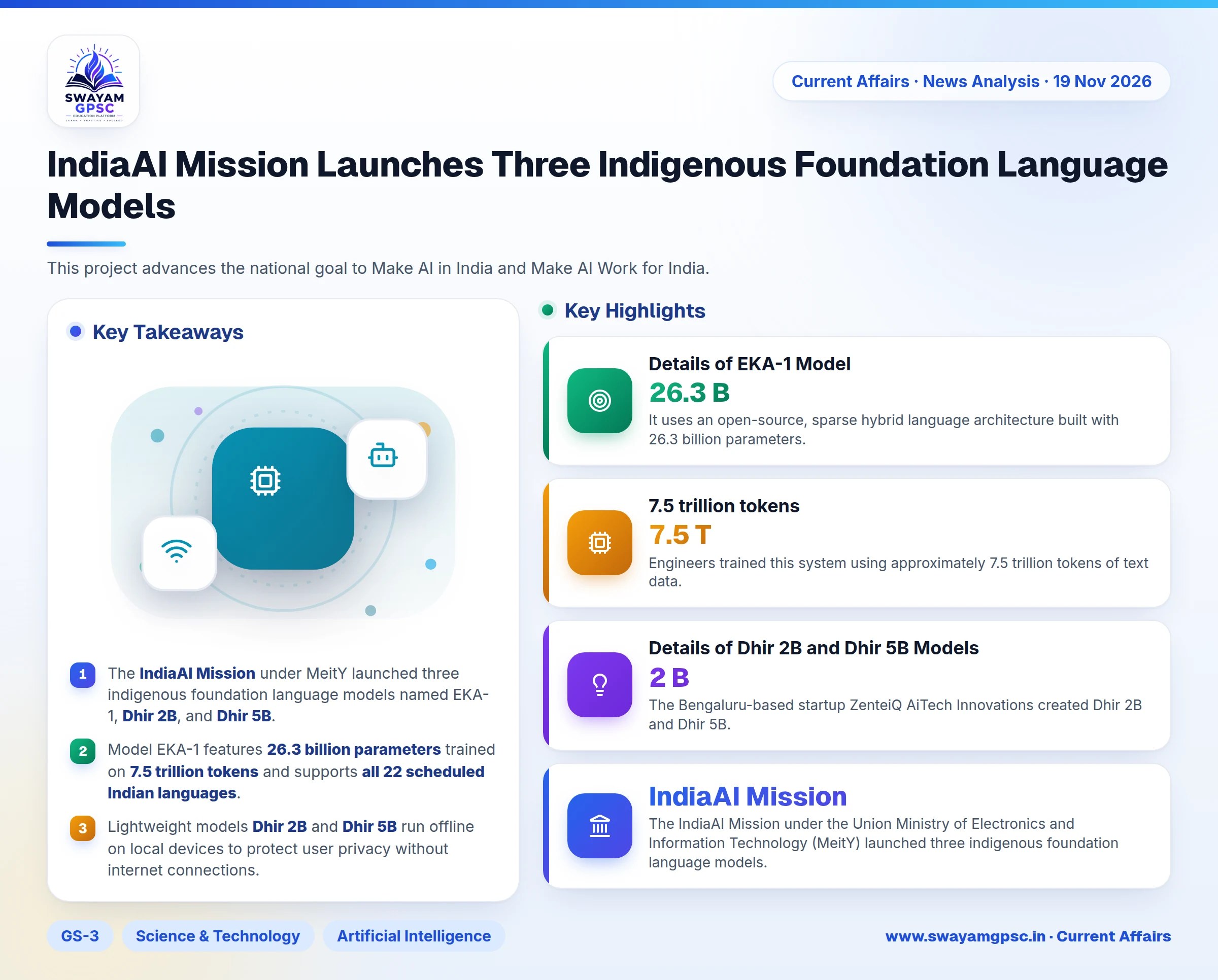
- The IndiaAI Mission under MeitY launched three indigenous foundation language models named EKA-1, Dhir 2B, and Dhir 5B.
- Model EKA-1 features 26.3 billion parameters trained on 7.5 trillion tokens and supports all 22 scheduled Indian languages.
- Lightweight models Dhir 2B and Dhir 5B run offline on local devices to protect user privacy without internet connections.
- Native Indic tokenizers eliminate the token tax where standard AI consumes 35 to 140 tokens for Indian languages compared to 10 tokens in English.
Why in News
- The IndiaAI Mission under the Union Ministry of Electronics and Information Technology (MeitY) launched three indigenous foundation language models.
- These new language models are named EKA-1, Dhir 2B, and Dhir 5B.
- Indian startups developed these systems under the IndiaAI Innovation Centre (Foundation Models) initiative.
- The creators received subsidized access to national AI computing resources to build these technologies.
- This project advances the national goal to Make AI in India and Make AI Work for India.
Details of EKA-1 Model
- The Soket Labs Technology and Research Private Limited (Soket AI Labs) created EKA-1 under Project EKA.
- It uses an open-source, sparse hybrid language architecture built with 26.3 billion parameters.
- Engineers trained this system using approximately 7.5 trillion tokens of text data.
- The sparse design activates only specific parts of the network during tasks to save processing energy.
- It processes text across all 22 scheduled Indian languages alongside English.
- The software manages advanced workloads including mathematics, computer programming, reasoning, and agentic AI.
- Its primary deployment focuses on BFSI (Banking, Financial Services, and Insurance) and cybersecurity operations.
Details of Dhir 2B and Dhir 5B Models
- The Bengaluru-based startup ZenteiQ AiTech Innovations created Dhir 2B and Dhir 5B.
- These systems are open-source, lightweight Small Language Models (SLMs) containing 2 billion and 5 billion parameters.
- They process text in English and 10 Indian languages.
- The programs run directly on individual devices without needing active cloud internet links.
- Local execution ensures that confidential user information remains stored safely inside private hardware.
- These models assist with document searching, information retrieval, and government services.
- They operate reliably in high-security locations like border zones where internet access is limited.
Need for Indigenous Foundation Language Models
- Local models give India digital independence and protect national interest in key sectors like defence.
- On-device computing keeps private citizen details safe inside local database systems.
- Native language tools allow non-English speakers to use digital platforms like BHASHINI with ease.
- Standard English-focused AI systems process Indian languages using extra processing fragments called tokens.
- An English sentence using 10 tokens can jump to 35 to 140 tokens in Indian languages.
- This difference creates a token tax that makes regional language AI slower and more expensive.
- Developing local language tokenizers removes this extra cost and speeds up digital processing.
- Small, offline-capable systems ensure digital services remain functional in distant rural villages.
- Creating regional datasets improves local language representation across public AI platforms.
- Connecting regional datasets to AIKosh helps researchers share development resources easily.
India's Other Key Indigenous AI Models
- The IIT Bombay consortium developed BharatGen (Param 2 - 17B) to assist public administration and research across 22 scheduled languages.
- Startup Sarvam AI released open-source models like Sarvam 30B, Bulbul, and Sarvam Vision aligned with the DPDP Act, 2023.
- The Gnani.ai platform offers voice processing tools designed for direct conversational speech in Indian regional languages.
- Company Ola AI introduced Krutrim, a cloud-based language model covering 22 Indian languages for transport and consumer apps.
- Developer Avataar AI launched Varya AI in June 2026 as a dedicated indigenous video generation tool.
- Tech Mahindra built Project Indus as a business-focused language platform centered around vernacular language communication.