India's Wage Stagnation Amid Rising Corporate Profits
#GS-3 #Economy #Growth #Employment #Infrastructure #Industrial Policy
Key takeaways
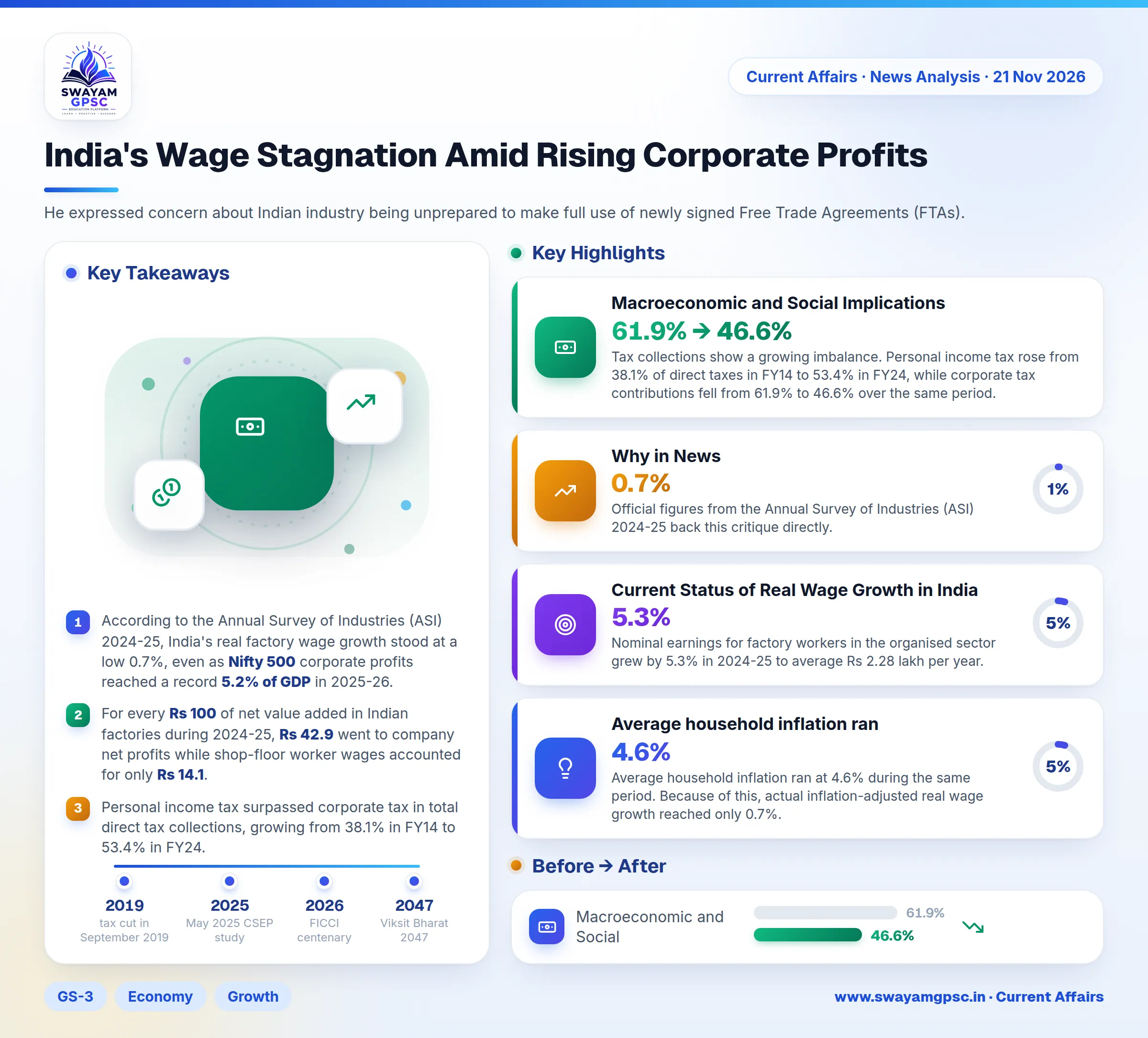
- According to the Annual Survey of Industries (ASI) 2024-25, India's real factory wage growth stood at a low 0.7%, even as Nifty 500 corporate profits reached a record 5.2% of GDP in 2025-26.
- For every Rs 100 of net value added in Indian factories during 2024-25, Rs 42.9 went to company net profits while shop-floor worker wages accounted for only Rs 14.1.
- Personal income tax surpassed corporate tax in total direct tax collections, growing from 38.1% in FY14 to 53.4% in FY24.
- To address wage stagnation, the government is rolling out the Employment Linked Incentive (ELI) Scheme with an outlay of Rs 1 lakh crore to support 3.5 crore formal jobs.
Why in News
- The Prime Minister addressed business leaders at the FICCI centenary celebrations in November 2026. He raised strong concerns about the growing disconnect between business profits and worker salaries.
- He highlighted that recent reforms in ease of doing business and cuts in corporate tax rates did not convert into better worker pay or strong employment growth.
- Official figures from the Annual Survey of Industries (ASI) 2024-25 back this critique directly. The survey reveals that real factory wages grew by only 0.7%, even as company earnings hit record highs.
- The Prime Minister also pointed to weak growth in the manufacturing sector and low quality standards in domestic products.
- He expressed concern about Indian industry being unprepared to make full use of newly signed Free Trade Agreements (FTAs).
Summary of the Situation
- Corporate earnings are expanding quickly, but real factory wage growth in India stays stuck near 0.7%.
- This slow wage growth widens inequality across society and weakens spending by ordinary households.
- India must improve worker output, build stronger small businesses, expand formal jobs, and enforce proper minimum pay rules.
- Taking these steps will help pass company gains to workers, supporting the broader goal of Viksit Bharat 2047.
Current Status of Real Wage Growth in India
- Nominal earnings for factory workers in the organised sector grew by 5.3% in 2024-25 to average Rs 2.28 lakh per year.
- Average household inflation ran at 4.6% during the same period. Because of this, actual inflation-adjusted real wage growth reached only 0.7%.
- This 0.7% figure represents the best performance in three years, following a minimal 0.1% increase in 2023-24 and a 1.1% drop in 2022-23.
- Annual real wage growth in factories stayed below 1% in five of the past six years. The single exception was 2021-22, when wages rose 4.5% due to a low mathematical base after a 5.3% drop during the 2020-21 pandemic.
- Real earnings in rural locations grew by just 0.1-0.6% yearly between 2015-16 and 2023-24, while urban workers saw a 0.8% rise, showing that wage stagnation affects the entire country.
- Income gaps between staff roles are widening fast. Supervisory and management staff earned an average of Rs 14.5 lakh in 2024-25, which is 6.36 times the pay of an ordinary worker. This ratio stood at 5.87 times in 2008-09.
- This flat pay growth for workers contrasts sharply with corporate results. Listed businesses logged record high earnings, with Nifty 500 corporate profits reaching 5.2% of GDP in 2025-26.
- During the second quarter of FY26, listed companies reported yearly profit gains of 26-30%, while average salary increases lagged behind at around 9%.
- Data from the Economic Survey 2025-26 shows that nearly 40% of gig economy workers earn under Rs 15,000 per month, showing low pay and high earnings uncertainty.
- The Economic Survey 2024-25 noted that between 2017-18 and 2023-24, inflation-adjusted monthly pay fell by 6.4% for regular salaried men and by 12.5% for salaried women.
Factors Responsible for Low Wage Growth in India
- Factory value created in India favours company profits over worker pay. ASI 2024-25 details show that for every Rs 100 of added value, companies kept Rs 42.9 as net profit while paying shop-floor workers only Rs 14.1 in wages.
- Per-worker productivity growth remains very slow. While overall manufacturing Gross Value Added (GVA) grew by 9.59% in 2024-25, productivity per worker grew by just 2.25%.
- Because long-term real wages depend directly on worker productivity, low individual output gains keep employee wages flat.
- The manufacturing structure suffers from a major missing middle, where capital concentrates heavily in a few places. Large factories make up only 15.84% of all units, but they hold 87.42% of fixed capital and generate 78.07% of Net Value Added (NVA).
- Micro-factories account for 18.34% of manufacturing units but generate a tiny 0.08% of output and a negative -0.10% of NVA, leaving small businesses without the cash to raise worker pay.
- Industrial growth remains concentrated in very few places. Over 54% of total manufacturing GVA and 56% of factory jobs sit inside just five states: Maharashtra, Gujarat, Tamil Nadu, Karnataka or Haryana, and Uttar Pradesh.
- Large supplies of unused labor in eastern and central states reduce worker bargaining power across the whole country.
- Tax relief failed to boost corporate spending on payrolls. Despite receiving a major tax cut in September 2019, companies chose to build cash reserves rather than expand capacity or pay higher wages, blaming complex rules, international trade issues, and soft consumer spending.
- Steady household inflation continuously reduces nominal salary gains in both structured and informal jobs, leaving actual buying power stagnant for almost ten years.
Macroeconomic and Social Implications
- Record corporate profits running alongside flat wages create a K-shaped recovery, widening wealth disparities and concentrating economic gains.
- The Economic Survey 2024-25 and Chief Economic Advisor V. Anantha Nageswaran pointed out that India faces an underlying income problem rather than a simple job availability issue.
- Stagnant wages harm overall economic growth by weakening Private Final Consumption Expenditure (PFCE).
- When market demand stays soft, companies hold back on new greenfield private capital expenditure (capex), locking the economy into a cycle of strong corporate profits paired with weak investments.
- Tax collections show a growing imbalance. Personal income tax rose from 38.1% of direct taxes in FY14 to 53.4% in FY24, while corporate tax contributions fell from 61.9% to 46.6% over the same period.
- Stagnant real pay forces families to take on debt, reduce spending, and delay investments in education and health.
- A May 2025 CSEP study showed that long-lasting wage stagnation limits human capital formation, slows down middle-class growth, and holds back social mobility across generations.
Measures Needed to Boost Real Wage Growth in India
- Deploy the Employment Linked Incentive (ELI) Scheme effectively. The policy targets 3.5 crore formal jobs using an outlay of Rs 1 lakh crore, giving up to Rs 15,000 to new employees and up to Rs 3,000 per month to employers for up to 4 years.
- Strictly enforce the Code on Wages (Central) Rules, 2026 to establish a legally binding national wage floor based on essential living standards across states.
- Close the gap between statutory minimum pay and actual living costs by using research-backed frameworks like the Anker Methodology from the Global Living Wage Coalition.
- Strengthen mandatory wage reviews, perform regular workplace checks, and ensure fair pay for informal workers.
- Apply the findings of the Anoop Satpathy Committee (2019) to set regional, inflation-adjusted minimum wages based on food needs and basic living costs.
- Uphold the landmark Supreme Court decision in *Crown Aluminium Works (1957)*, which ruled that a business has no right to operate if it cannot pay basic minimum pay.
- Link future payouts under the Production Linked Incentive (PLI) program directly to net job creation and domestic value addition.
- Follow recommendations from the Economic Survey 2024-25 by cutting state-level regulations, helping small businesses scale up and pay better rates.
- Provide broader social safety nets and income support for gig workers and informal employees, complementing targeted state welfare schemes like Maharashtra's Ladki Bahin Yojana and Odisha's Subhadra Scheme.
- Accelerate the Ministry of Statistics and Programme Implementation's (MoSPI) upcoming household income survey to gather clear data for wage policies.
- Study successful international models like Singapore's Progressive Wage Model (PWM), which links clear wage increases directly to worker training and productivity.
- Adopt processes like Japan's Shunto, an annual tripartite wage discussion between government leaders, business owners, and worker unions to align salary growth with profits and inflation.
- Learn from Germany's Dual Vocational Training system, combining classroom study with paid factory apprenticeships to boost practical skills and worker output.
Conclusion
- Reaching the goal of Viksit Bharat 2047 requires bridging the current divide between high national growth figures and household purchasing power.
- While lower taxes and simpler rules create favorable business conditions, long-term national strength depends on sharing corporate success with factory workers.
- Moving away from profit-led accumulation toward sustainable wage-driven consumption will make economic progress inclusive for all Indian families.