India and Urban Fire Accidents: Malviya Nagar Incident
#GS-2 #GS-3 #Governance & Social Justice #Good Governance #Infrastructure #Urban Fire Accidents #Safety Standards
Key takeaways
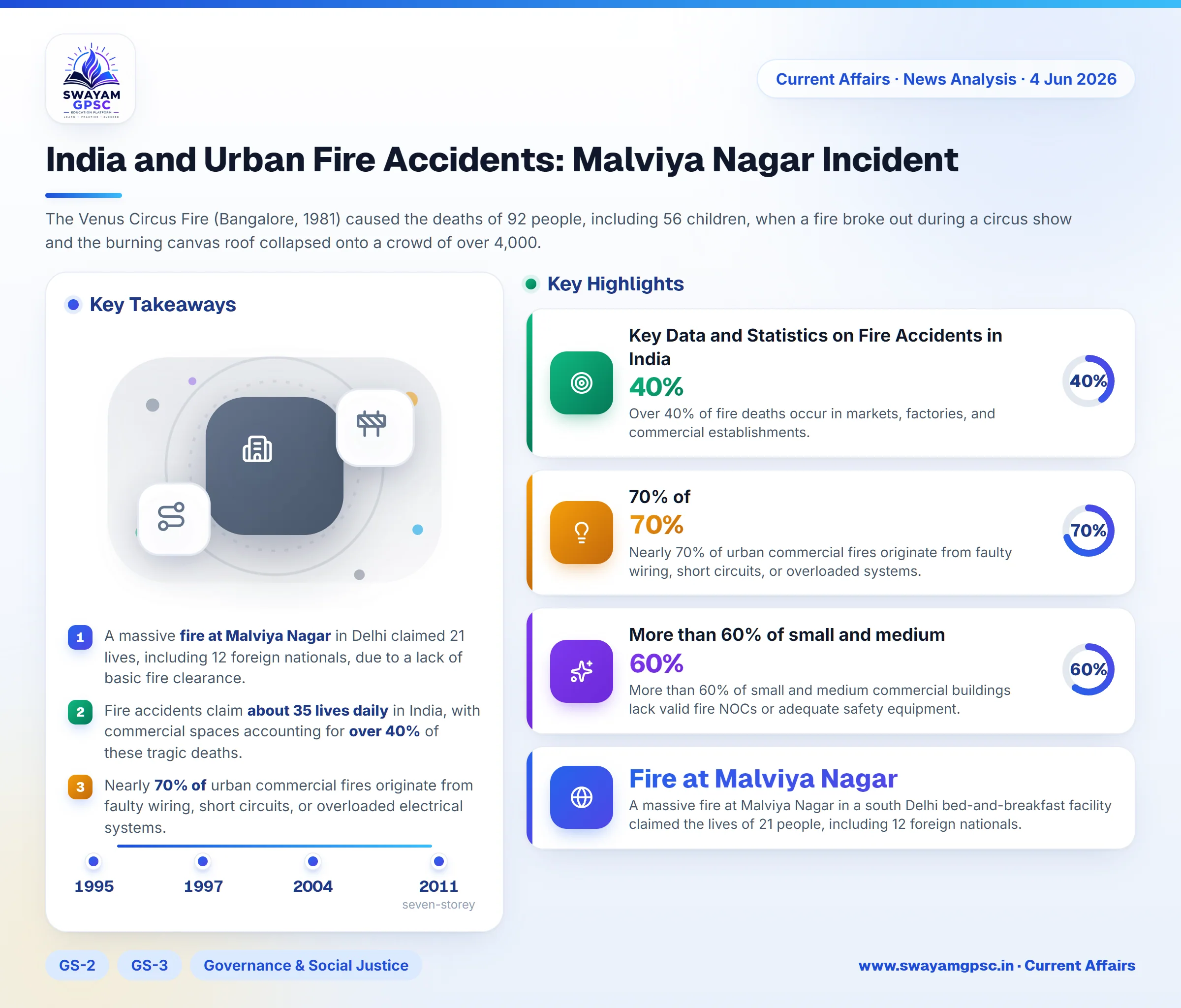
- A massive fire at Malviya Nagar in Delhi claimed 21 lives, including 12 foreign nationals, due to a lack of basic fire clearance.
- Fire accidents claim about 35 lives daily in India, with commercial spaces accounting for over 40% of these tragic deaths.
- Nearly 70% of urban commercial fires originate from faulty wiring, short circuits, or overloaded electrical systems.
- More than 60% of small and medium commercial buildings operate without valid fire NOCs or adequate safety equipment.
Why in News
- A massive fire at Malviya Nagar in a south Delhi bed-and-breakfast facility claimed the lives of 21 people, including 12 foreign nationals.
- The facility was operating without a proper fire clearance when the tragic incident occurred.
About Urban Fire Accidents
- Urban fire accidents are high-intensity and destructive blazes that happen in densely populated municipal areas, commercial structures, high-rises, factories, or informal settlements.
- Unlike wildland fires, urban blazes are typically triggered by built-environment vulnerabilities like faulty electrical systems, unauthorized structural changes, structural congestion, and a lack of functional fire-safety infrastructure.
Key Data and Statistics on Fire Accidents in India
- Fire accidents claim about 35 lives daily in India, making them a major cause of accidental deaths.
- Over 40% of fire deaths occur in markets, factories, and commercial establishments.
- Nearly 70% of urban commercial fires originate from faulty wiring, short circuits, or overloaded systems.
- More than 60% of small and medium commercial buildings lack valid fire NOCs or adequate safety equipment.
Major Fire Accidents in India A Historical Timeline
- The Venus Circus Fire (Bangalore, 1981) caused the deaths of 92 people, including 56 children, when a fire broke out during a circus show and the burning canvas roof collapsed onto a crowd of over 4,000.
- The Dabwali Tent Fire (Haryana, 1995) killed over 500 people, mostly children and parents, during a school function when an electrical short circuit ignited a synthetic pandal near a single and narrow exit.
- The Uphaar Grand Cinema Tragedy (Delhi, 1997) caused 60 people to choke to death from toxic smoke after a short circuit in a ground-floor transformer spread dense fumes through the air conditioning ducts.
- The Kumbakonam School Fire (Tamil Nadu, 2004) resulted in the deaths of 94 nursery schoolchildren when a spark from a thatch-roofed kitchen caught fire and spread to classrooms where children were trapped due to absent emergency response systems.
- The AMRI Hospital Disaster (Kolkata, 2011) killed 89 patients and staff who choked to death when an early morning blaze in the basement used for storing highly inflammable materials sent toxic smoke rising through a seven-storey building.
Recurring Causes of Fire Accidents
- Outdated wiring and transformers are frequently pushed past their capacity by modern climate control and industrial gear, sparking severe short circuits.
- Property owners often add extra rooms or modify floors beyond their permitted capacity, blocking natural air ventilation and emergency paths.
- Basements, stairwells, and parking structures are regularly misused to store chemicals, plastics, or gas cylinders, turning minor fires into massive explosions.
- Utilizing plastic sheets, synthetic tarpaulins, or thatched roofing allows fires to grow exponentially in minutes.
- Many buildings lack even basic and functional safety infrastructure like fire alarms, water sprinklers, smoke detectors, or fire extinguishers.
Challenges in Urban Fire Safety
- Many commercial setups operate with a single staircase or corridor for both entry and exit, making evacuation nearly impossible during a crisis.
- Corrupt or lazy inspection routines allow illegal hotels, coaching centers, and small factories to operate openly without fire clearance.
- Most building managers, employees, and tenants are never trained in emergency protocols, which can lead to panic and fatal stampedes.
- Narrow urban streets, heavy traffic, and poor municipal planning can leave fire trucks stuck, delaying life-saving support.
- Negligent owners often face weak fines or long court delays, which fails to create a strong deterrent against ignoring safety laws.
Way Forward
- Link municipal commercial licensing portals directly with fire department databases to instantly revoke business permits for any building operating without a valid Fire NOC.
- Require all commercial structures, hotels, and schools to maintain at least two wide, unblocked, and fire-resistant exit stairs on opposite sides of the building.
- Move cases under stricter criminal provisions like Section 105 of the Bharatiya Nyaya Sanhita (BNS) to hold negligent owners directly accountable for avoidable deaths.
- Launch continuous and month-long inspection drives to check safety compliance across vulnerable spaces like coaching centers, nursing homes, and crowded markets, sealing properties that fail.
- Invest in advanced, compact firefighting units and automated smoke-alert networks to ensure rapid and effective rescue operations even within congested city lanes.
Conclusion
- The tragic hotel fire in Malviya Nagar serves as a stark reminder of the immense human cost of ignoring urban safety rules.
- Moving from reactive post-disaster investigations to a system of strict and proactive enforcement is essential to break this pattern of avoidable loss.