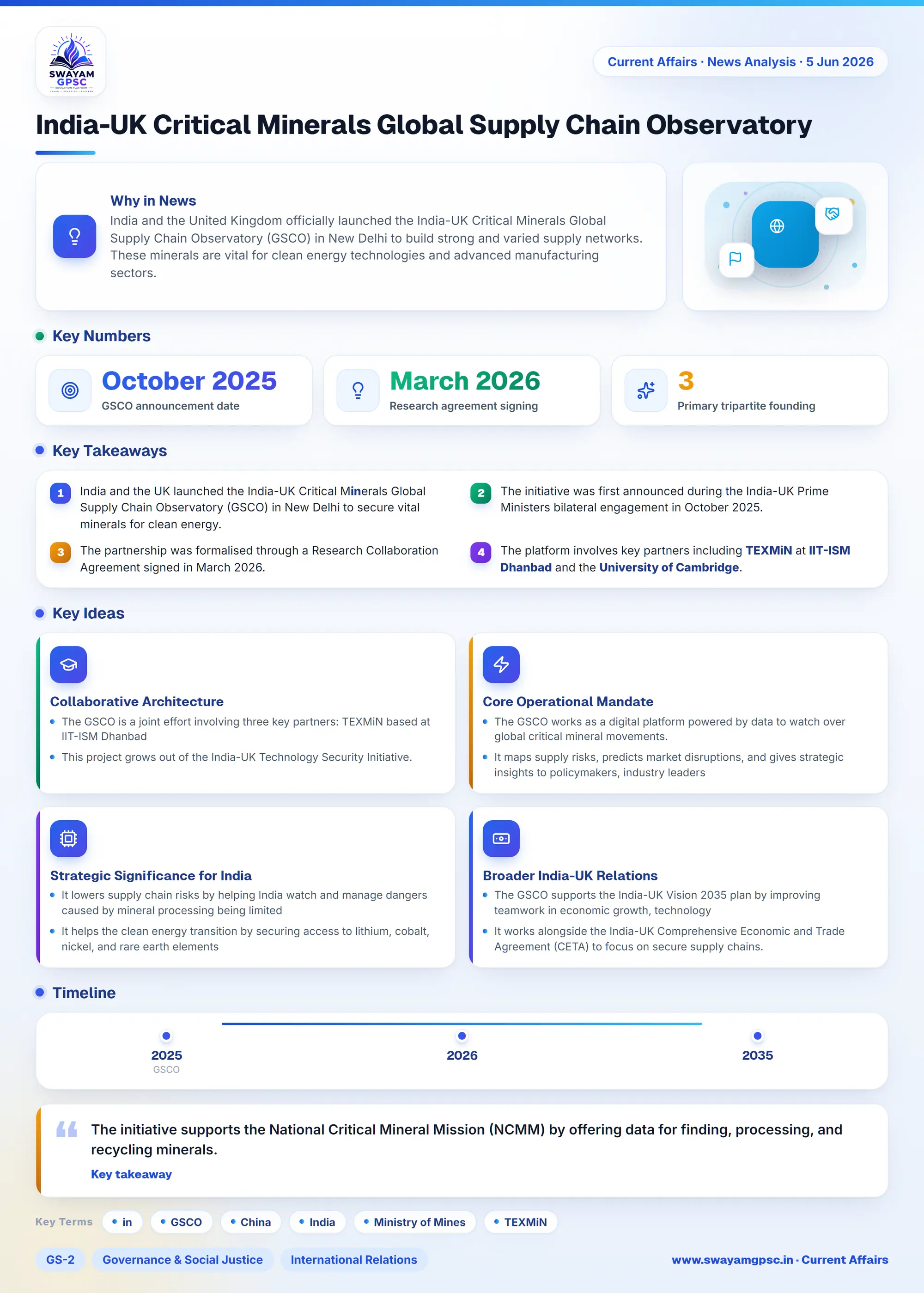
India-UK Critical Minerals Global Supply Chain Observatory
#GS-2 #Governance & Social Justice #Groupings & Agreements Involving India and/or Affecting India's Interests #International Relations #Economy #Infrastructure
Key takeaways
- India and the UK launched the India-UK Critical Minerals Global Supply Chain Observatory (GSCO) in New Delhi to secure vital minerals for clean energy.
- The initiative was first announced during the India-UK Prime Ministers bilateral engagement in October 2025.
- The partnership was formalised through a Research Collaboration Agreement signed in March 2026.
- The platform involves key partners including TEXMiN at IIT-ISM Dhanbad and the University of Cambridge.
- The GSCO directly supports India's National Critical Mineral Mission (NCMM) by tracking supply chains for minerals like lithium, cobalt, and nickel.
Why in News
- India and the United Kingdom officially launched the India-UK Critical Minerals Global Supply Chain Observatory (GSCO) in New Delhi to build strong and varied supply networks.
- These minerals are vital for clean energy technologies and advanced manufacturing sectors.
Collaborative Architecture
- The GSCO is a joint effort involving three key partners: TEXMiN based at IIT-ISM Dhanbad, the Indian Institute of Technology (ISM) Dhanbad, and the University of Cambridge.
- This project grows out of the India-UK Technology Security Initiative.
- Leaders first announced the GSCO during the India-UK Prime Ministers bilateral engagement in October 2025.
- Both nations later formalised this partnership through a Research Collaboration Agreement signed in March 2026.
Core Operational Mandate
- The GSCO works as a digital platform powered by data to watch over global critical mineral movements.
- It maps supply risks, predicts market disruptions, and gives strategic insights to policymakers, industry leaders, and researchers.
Strategic Significance for India
- The initiative supports the National Critical Mineral Mission (NCMM) by offering data for finding, processing, and recycling minerals.
- It lowers supply chain risks by helping India watch and manage dangers caused by mineral processing being limited to a few nations, especially China.
- It helps the clean energy transition by securing access to lithium, cobalt, nickel, and rare earth elements, which are needed for electric vehicles and renewable energy.
Broader India-UK Relations
- The GSCO supports the India-UK Vision 2035 plan by improving teamwork in economic growth, technology, and resource security.
- It works alongside the India-UK Comprehensive Economic and Trade Agreement (CETA) to focus on secure supply chains.
About The Observatory
- The Critical Minerals Global Supply Chain Observatory (GSCO) is a special bilateral intelligence platform backed by technology.
- It works under the goals of India's National Critical Mineral Mission (NCMM) and the India-UK Technology Security Initiative.
- The member nations involved in this platform are India and the United Kingdom.
Aim and Objectives
- The main goal of the observatory is to secure trusted access to strategic resources needed for modern economies and clean energy shifts.
- By tracking minerals in real time, the platform protects both democracies from market monopolies and resource shortages.
Key Features
- The platform uses a data tracking system to watch global supply chains and trace raw materials from mines to factories.
- It uses predictive models to spot supply risks, transport bottlenecks, and export controls instantly.
- It builds high-quality market intelligence on pricing trends and global stockpiles to help business leaders.
- It connects raw data with public policy to help governments make smart choices on trade deals.
- It links top academic experts by enabling shared research and data pooling between India and the UK.
- It brings together officials from the Ministry of Mines, the Ministry of External Affairs, and the British High Commission into regular talks.