India on Track to Achieve 3% Compressed Biogas Blending Target
#GS-3 #Economy #Infrastructure #Agriculture #Environment #Sustainable Development #Energy
Key takeaways
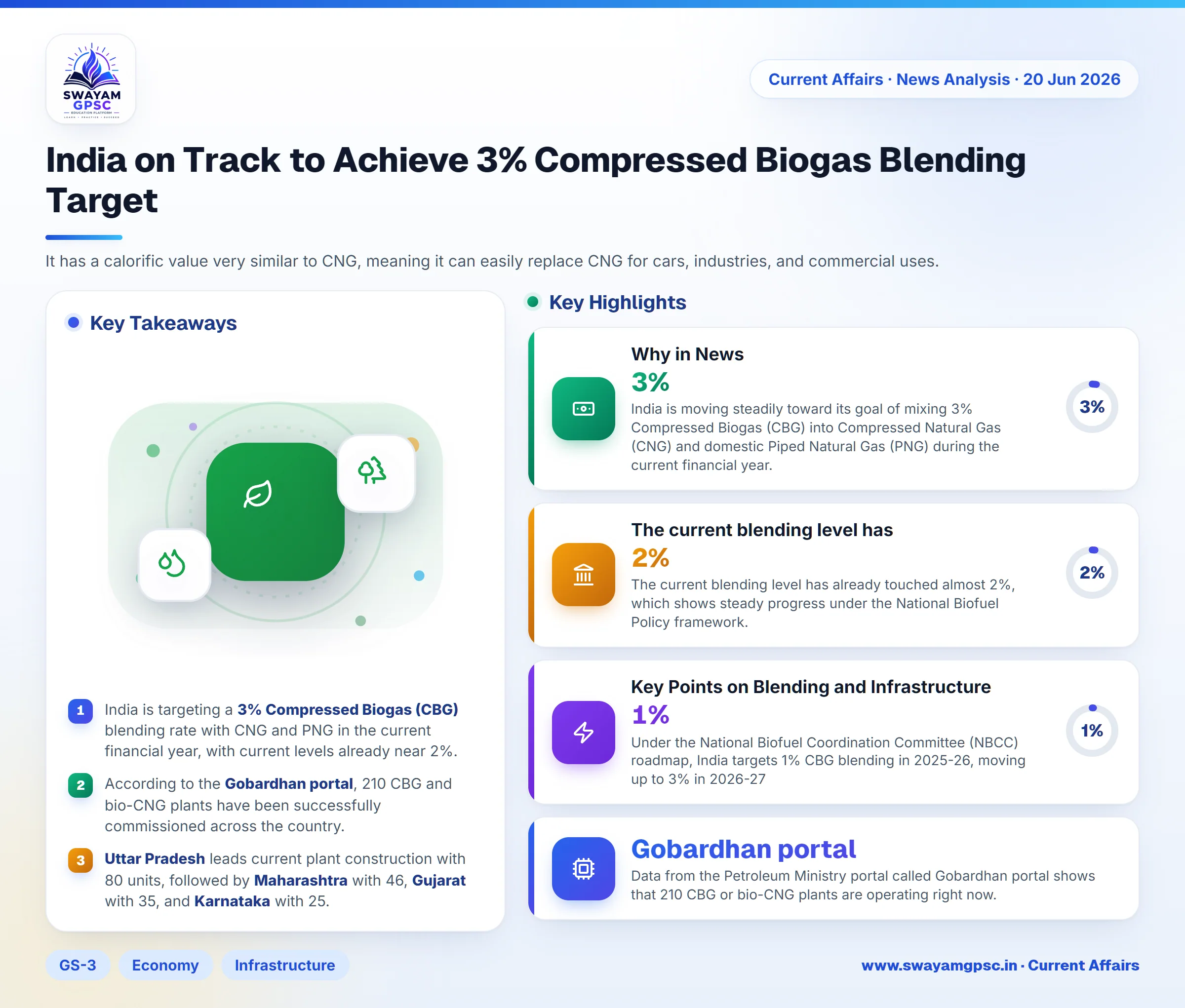
- India is targeting a 3% Compressed Biogas (CBG) blending rate with CNG and PNG in the current financial year, with current levels already near 2%.
- According to the Gobardhan portal, 210 CBG and bio-CNG plants have been successfully commissioned across the country.
- Uttar Pradesh leads current plant construction with 80 units, followed by Maharashtra with 46, Gujarat with 35, and Karnataka with 25.
- CBG is produced from organic waste using anaerobic decomposition and matches the energy output of conventional CNG.
Why in News
- India is moving steadily toward its goal of mixing 3% Compressed Biogas (CBG) into Compressed Natural Gas (CNG) and domestic Piped Natural Gas (PNG) during the current financial year.
- The current blending level has already touched almost 2%, which shows steady progress under the National Biofuel Policy framework.
Key Points on Blending and Infrastructure
- Under the National Biofuel Coordination Committee (NBCC) roadmap, India targets 1% CBG blending in 2025-26, moving up to 3% in 2026-27, and reaching 4-5% in subsequent years as part of its long-term clean energy plan.
- Data from the Petroleum Ministry portal called Gobardhan portal shows that 210 CBG or bio-CNG plants are operating right now.
- Looking at plants currently under construction, Uttar Pradesh leads with 80 plants, followed by Maharashtra with 46, Gujarat with 35, and Karnataka with 25 plants.
Significance and Challenges
- Mixing CBG helps build energy security, cuts down fuel imports, puts waste to good use, lowers methane emissions, and stops crop residue burning.
- Experts point out that the sector still needs a steady supply of raw materials and production-linked incentives to help CBG grow faster.
About Compressed Biogas
- Compressed Biogas (CBG) is a renewable fuel made from biomass and organic waste like farm residue, cattle dung, sugarcane press mud, and sewage through anaerobic decomposition where bacteria break down waste without oxygen.
- It has a calorific value very similar to CNG, meaning it can easily replace CNG for cars, industries, and commercial uses.