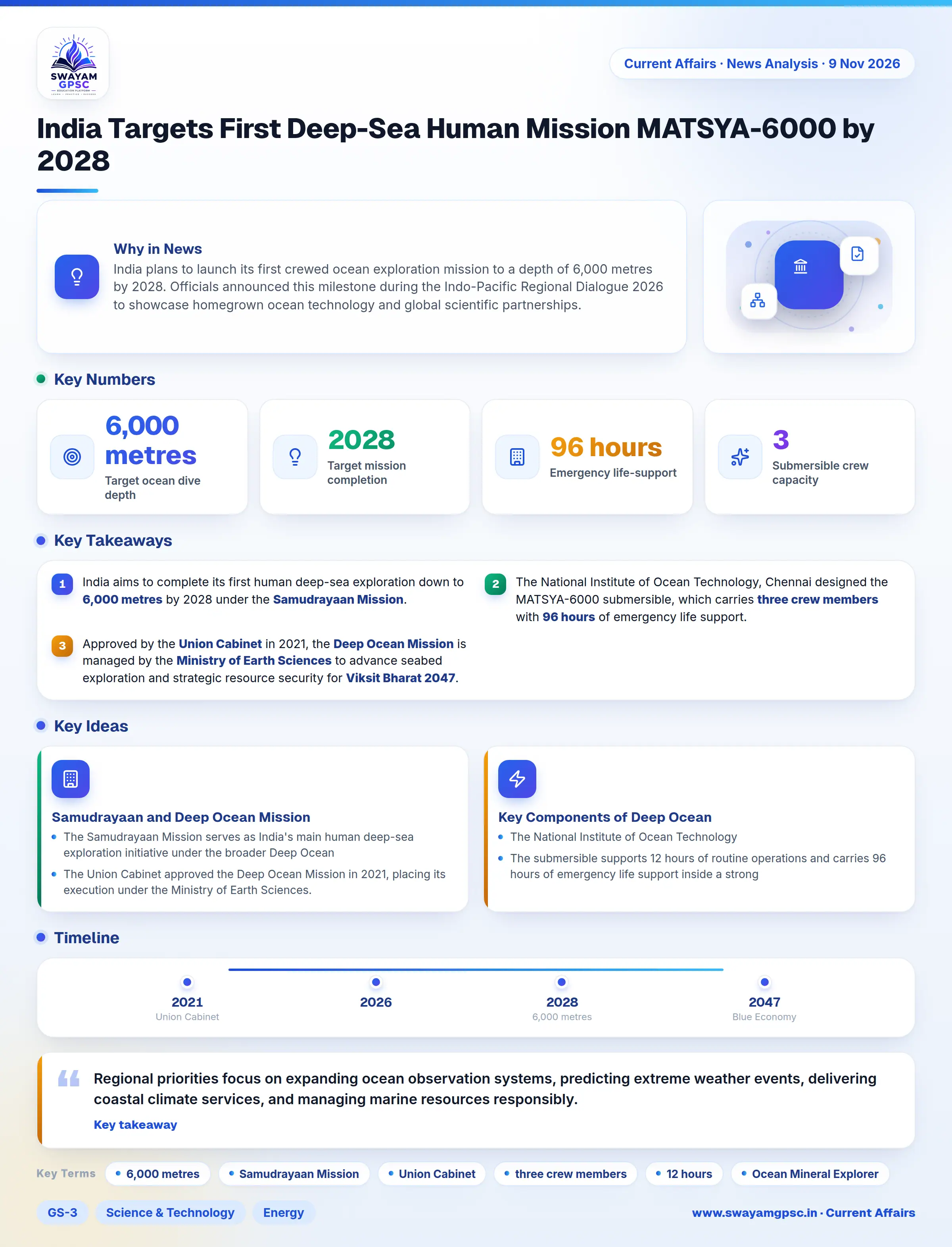
India Targets First Deep-Sea Human Mission MATSYA-6000 by 2028
#GS-3 #Science & Technology #Energy #Current Events #National #Indigenization of Technology #Deep Ocean Mission #Samudrayaan Mission #MATSYA-6000
Key takeaways
- India aims to complete its first human deep-sea exploration down to 6,000 metres by 2028 under the Samudrayaan Mission.
- The National Institute of Ocean Technology, Chennai designed the MATSYA-6000 submersible, which carries three crew members with 96 hours of emergency life support.
- Approved by the Union Cabinet in 2021, the Deep Ocean Mission is managed by the Ministry of Earth Sciences to advance seabed exploration and strategic resource security for Viksit Bharat 2047.
Why in News
- India plans to launch its first crewed ocean exploration mission to a depth of 6,000 metres by 2028.
- Officials announced this milestone during the Indo-Pacific Regional Dialogue 2026 to showcase homegrown ocean technology and global scientific partnerships.
Samudrayaan and Deep Ocean Mission Framework
- The Samudrayaan Mission serves as India's main human deep-sea exploration initiative under the broader Deep Ocean Mission.
- The Union Cabinet approved the Deep Ocean Mission in 2021, placing its execution under the Ministry of Earth Sciences.
- This umbrella initiative focuses on developing deep-sea mining tools, ocean climate advisory services, marine life conservation, seabed mapping, and ocean energy solutions.
Key Components of Deep Ocean Exploration
- The National Institute of Ocean Technology, Chennai indigenously designed the MATSYA-6000 battery-powered submersible to carry three crew members down to 6,000 metres.
- The submersible supports 12 hours of routine operations and carries 96 hours of emergency life support inside a strong titanium-alloy crew sphere.
- Researchers use the Ocean Mineral Explorer to conduct detailed surveys of hydrothermal sulphide deposits, helping identify key seabed mineral reserves.
- Scientists combine space satellite data on ocean temperature and wind vectors with sea research to study climate patterns and marine renewable energy potential.
- The mission enables direct scientific study of deep-sea ecosystems, ocean floor geology, and extreme underwater habitats.
- India advocates for collaborative scientific voyages, shared research facilities, and open data sharing under the vision of One Ocean, Shared Knowledge and Equitable Prosperity.
- Regional priorities focus on expanding ocean observation systems, predicting extreme weather events, delivering coastal climate services, and managing marine resources responsibly.
- This initiative builds self-reliant deep-sea technological skills, enhances strategic mineral security, and supports India's Blue Economy goals under Viksit Bharat 2047.