India's Strategy for Asymmetric Deterrence Against China
#GS-3 #Economy #Infrastructure #Current Events #National #International #Defence #India-China Relations
Key takeaways
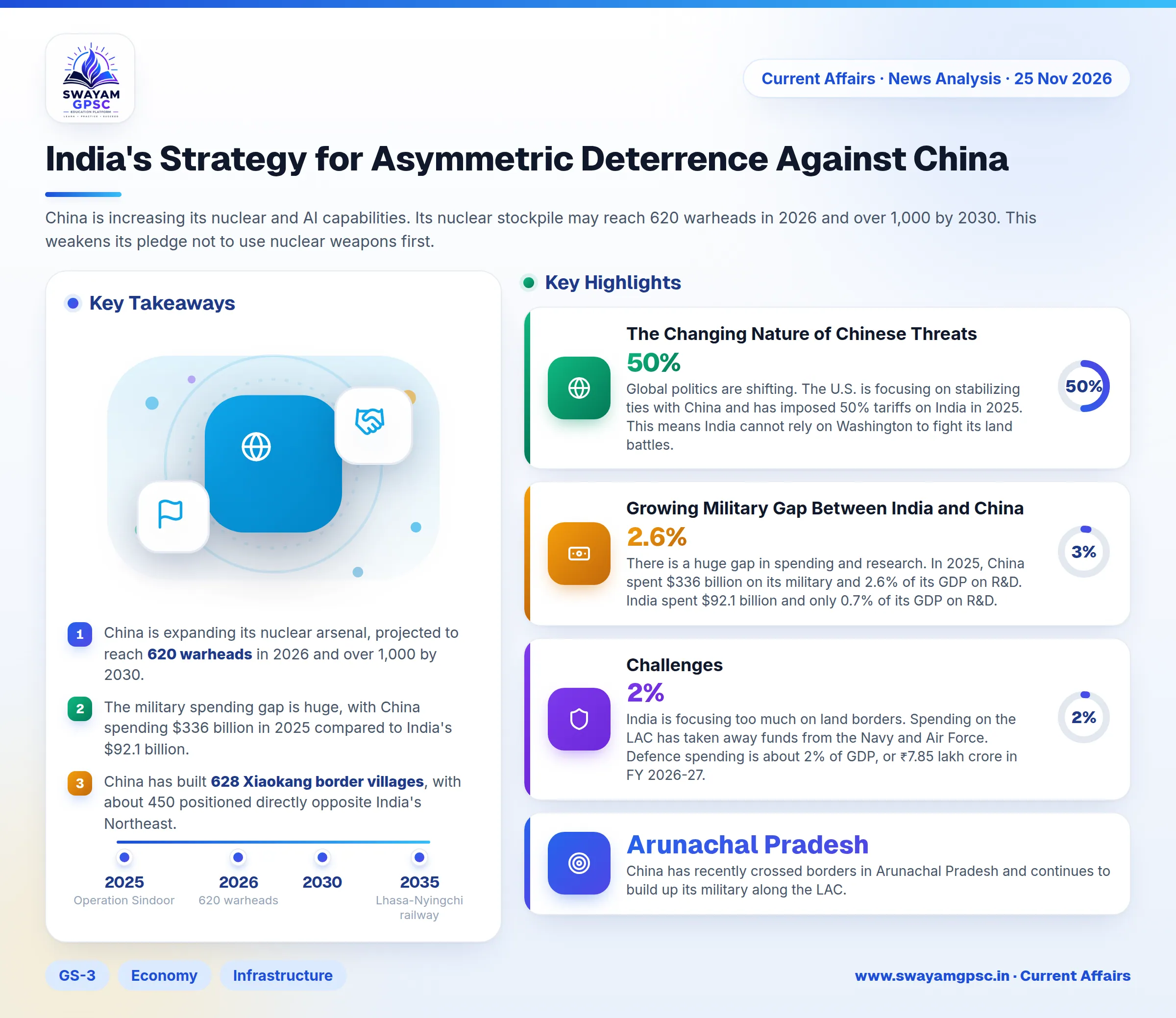
- China is expanding its nuclear arsenal, projected to reach 620 warheads in 2026 and over 1,000 by 2030.
- The military spending gap is huge, with China spending $336 billion in 2025 compared to India's $92.1 billion.
- China has built 628 Xiaokang border villages, with about 450 positioned directly opposite India's Northeast.
- India's defence budget for FY 2026-27 is approximately ₹7.85 lakh crore, which is about 2% of its GDP.
- India aims to use asymmetric deterrence by leveraging the Andaman and Nicobar Islands and precision weapons like BrahMos and Pralay.
Why in News
- China has recently crossed borders in Arunachal Pradesh and continues to build up its military along the LAC. This has led experts to suggest that India should use asymmetric deterrence instead of trying to match China's massive military spending.
Understanding Asymmetric Deterrence
- India should not try to match China's spending or infrastructure mile-for-mile. Instead, it should use its strong position in the Indian Ocean. The strategy involves using cheap precision strikes, unmanned systems, better defenses against grey-zone tactics, and completing military reforms.
The Changing Nature of Chinese Threats
- China uses Grey-Zone Probing to change the status quo without starting a full war. Examples include border intrusions, building 628 Xiaokang border villages (about 450 near India's Northeast), renaming places, and cyber attacks.
- China and Pakistan are working closer together. China provides Pakistan with live intelligence and satellite help. For example, during Operation Sindoor in May 2025, China gave Pakistan live deployment updates and BeiDou satellite support.
- Global politics are shifting. The U.S. is focusing on stabilizing ties with China and has imposed 50% tariffs on India in 2025. This means India cannot rely on Washington to fight its land battles.
- China is increasing its nuclear and AI capabilities. Its nuclear stockpile may reach 620 warheads in 2026 and over 1,000 by 2030. This weakens its pledge not to use nuclear weapons first.
Growing Military Gap Between India and China
- China has made Tibet a permanent military base. It has started the Lhasa-Nyingchi railway and plans the G695 Aksai Chin highway by 2035 to move troops quickly.
- India's air power advantage is shrinking. China has J-20 stealth fighters at Hotan and Damxung. Meanwhile, the IAF has only about 29 fighter squadrons, while the sanctioned number is 42.
- There is a huge gap in spending and research. In 2025, China spent $336 billion on its military and 2.6% of its GDP on R&D. India spent $92.1 billion and only 0.7% of its GDP on R&D.
- China's navy is growing very fast. The PLA Navy has over 370 ships and submarines, with a building capacity much larger than that of the U.S.
Weaknesses of the Chinese Military
- Political purges have hurt the PLA leadership. Over 100 generals were removed since 2023, including Zhang Youxia and Liu Zhenli in 2026. This makes leaders more afraid of risk.
- China's command structure is not fully integrated. Despite reforms in 2015-16, the army-led theatre commands still struggle to work together across different services.
- China is more worried about the Western Pacific. Its main focus is Taiwan and the U.S. A big war in the Himalayas would distract them from these more important goals.
- China's navy struggles in the Indian Ocean. Their ships must pass through narrow chokepoints like the Malacca Strait, where they lack air cover from their mainland.
Challenges
- The process of Theaterization is delayed. Even after creating the Chief of Defence Staff (CDS), disputes over command and assets have stalled the plan as of late 2026.
- India is focusing too much on land borders. Spending on the LAC has taken away funds from the Navy and Air Force. Defence spending is about 2% of GDP, or ₹7.85 lakh crore in FY 2026-27.
- India lacks a formal National Security Strategy. Also, the Agnipath scheme caused manpower issues, which were only partly fixed by a two-year extension in November 2026.
- India depends too much on foreign technology. Low R&D spending makes critical infrastructure vulnerable to Chinese supply chains and foreign AI systems.
Way Forward
- India should use the Andaman and Nicobar Islands as a hub for surveillance and strikes. This makes the Malacca Strait risky for China without needing a full blockade.
- India should combine border defense with precision attacks. It must use the Vibrant Villages Programme, close surveillance gaps, and use weapons like BrahMos, Pralay, and drones to target China's Tibetan roads and rails.
- The government must publish a National Security Strategy and force the creation of integrated theatre commands. India should also build its own AI systems and help private startups.
- India should strengthen ties with partners like Vietnam, the Philippines, and Japan. It must also increase sea-based nuclear patrols and start nuclear risk talks with Beijing.
Conclusion
- India cannot simply try to copy China's budget. Instead, it must use its geography in the Indian Ocean and precision weapons to make aggression too expensive for China. Completing reforms like theaterization is key to this strategy.