India-South Africa Technology Partnership and Africa Strategy
#GS-2 #International Relations #Bilateral Groupings & Agreements #Economy #Infrastructure #Science & Technology #Current Events #National #International #Gujarat
Key takeaways
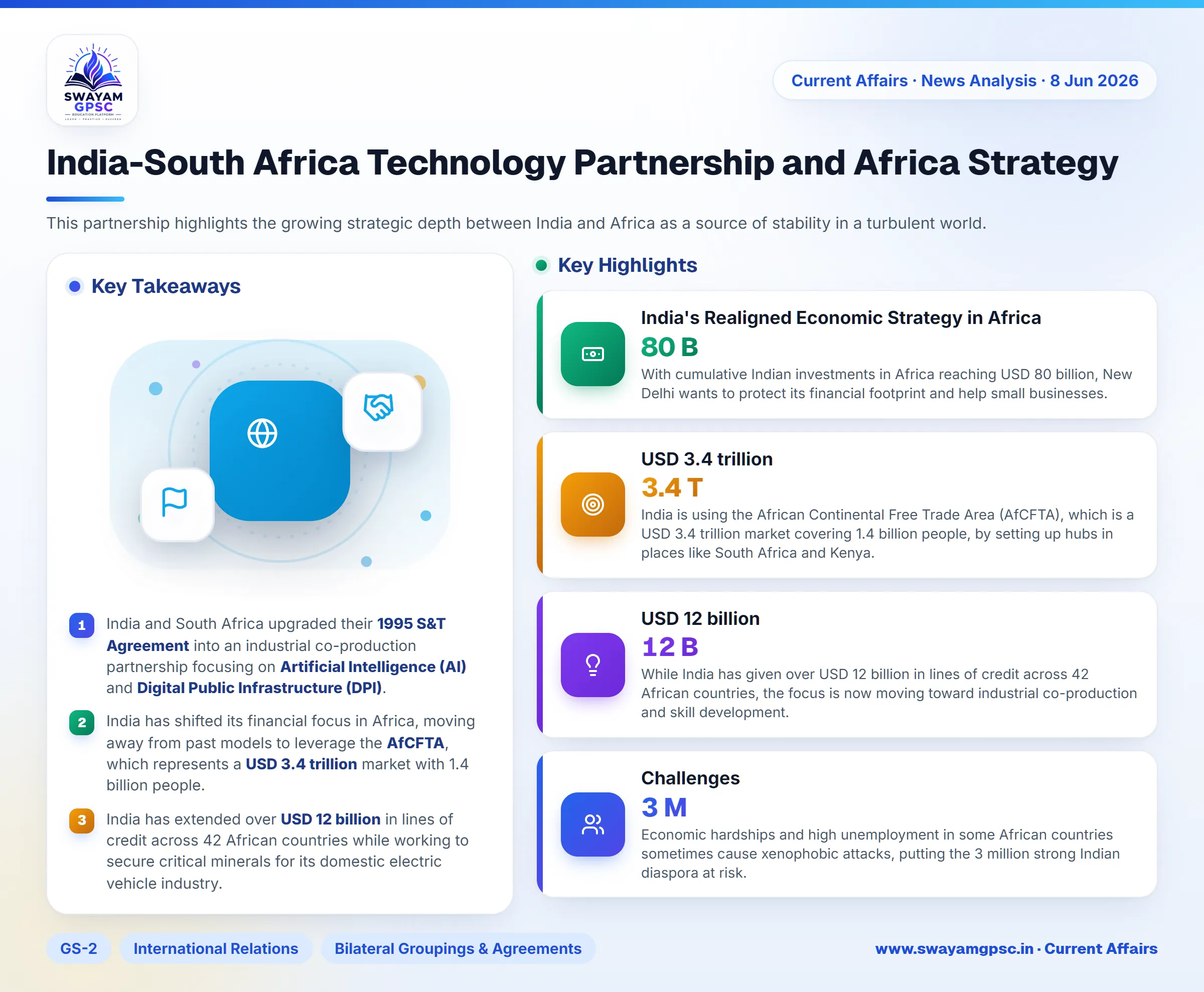
- India and South Africa upgraded their 1995 S&T Agreement into an industrial co-production partnership focusing on Artificial Intelligence (AI) and Digital Public Infrastructure (DPI).
- India has shifted its financial focus in Africa, moving away from past models to leverage the AfCFTA, which represents a USD 3.4 trillion market with 1.4 billion people.
- India has extended over USD 12 billion in lines of credit across 42 African countries while working to secure critical minerals for its domestic electric vehicle industry.
- India maintains its role as a security provider by deploying over 5,000 Indian peacekeepers in volatile regions like South Sudan and the DRC.
Why in News
- In June 2026, India and South Africa upgraded their 31-year-old science and technology partnership from simple research to industrial co-production.
- The original agreement was signed back in the 1995 S&T Agreement.
- A new collaboration framework between Telangana and South Africa further boosted these ties.
- This partnership highlights the growing strategic depth between India and Africa as a source of stability in a turbulent world.
Summary
- India and South Africa are moving beyond traditional research to focus on industrial co-production in areas like Artificial Intelligence (AI), Digital Public Infrastructure (DPI), critical minerals, healthcare, green energy, and advanced manufacturing.
- India is shifting its broader Africa strategy from credit-led development to economic integration and supply-chain resilience by using regional trade blocs, the African Continental Free Trade Area (AfCFTA), and critical mineral partnerships.
Core Priorities of the Partnership
- Both nations have made Artificial Intelligence (AI), Digital Public Infrastructure (DPI), and advanced manufacturing the main pillars of their technology deployment.
- The partnership is now expanding into Quantum Technologies, genomics, and cyber-physical systems to commercialize technology rather than just keeping it in theory.
- New projects will focus on renewable energy, hydrogen technologies, and vaccine development by combining India's affordable healthcare ecosystem with South Africa's green energy goals.
- The two countries reviewed their work on the Square Kilometre Array (SKA) project to boost global computing capabilities and big data analytics.
- Future projects will be judged on how well they create local jobs, improve public health, and build inclusive digital platforms for developing nations.
- Telangana signed a direct deal with South Africa to use Hyderabad's strengths in IT, Global Capability Centers (GCCs), defense, aerospace, healthcare, and pharmaceuticals.
- This state-level deal aims to boost medical tourism, vaccine co-production, and agro-processing while inviting South African companies to Telangana investment summits.
India's Realigned Economic Strategy in Africa
- India has paused plans for a continent-wide free trade deal and is now focusing on regional groups like the SouthernAfrican Customs Union (SACU) to ease trade across Botswana, Eswatini, Lesotho, Namibia, and South Africa.
- With cumulative Indian investments in Africa reaching USD 80 billion, New Delhi wants to protect its financial footprint and help small businesses.
- To avoid supply disruptions in the Gulf, India is building new fertilizer and energy partnerships with Algeria, Tunisia, Libya, and Morocco.
- India is securing supplies of lithium, cobalt, and rare earth elements to support domestic electric vehicle manufacturing and the National Green Hydrogen Mission.
- India is using the African Continental Free Trade Area (AfCFTA), which is a USD 3.4 trillion market covering 1.4 billion people, by setting up hubs in places like South Africa and Kenya.
- While India has given over USD 12 billion in lines of credit across 42 African countries, the focus is now moving toward industrial co-production and skill development.
- India invited South Africa to join the BRICS Science, Technology, and Innovation Ministerial Meeting in Chennai in August 2026.
- The South African delegation invited India to the Science Forum South Africa 2026 to build better institutional ties.
Geopolitical Significance
- India and the African Union are working together to push for reforms in the UN Security Council and other global financial bodies.
- Under the SAGAR doctrine, India is boosting maritime security with African nations through joint naval drills and information sharing via the Information Fusion Centre-Indian Ocean Region (IFC-IOR).
- India's development projects follow the Kampala Principles (2018), offering a transparent alternative to opaque state loans from other powers like China's FOCAC.
- India maintains global peace by deploying over 5,000 active Indian peacekeepers in difficult regions like South Sudan and the DRC.
- India opened 17 new diplomatic missions, bringing the total to 46 across the continent to improve crisis management and diplomatic reach.
- The upcoming IAFS-IV summit will help reset the diplomatic roadmap and build structural political alignments at the highest levels.
Challenges
- Parliamentary committees point out that heavy bureaucratic delays in using approved lines of credit hurt India's diplomatic trust.
- Chinese investments through the Belt and Road Initiative (BRI) and FOCAC far outscale Indian state investments, making it hard for private Indian companies to compete.
- Frequent military coups and political unrest in the Sahel region create a risky environment for long-term private investments.
- Complex domestic rules across 54 different African nations and a lack of direct flights and shipping routes create trade roadblocks.
- Economic hardships and high unemployment in some African countries sometimes cause xenophobic attacks, putting the 3 million strong Indian diaspora at risk.
- Foreign affairs belong exclusively to the Union List under Entry 10 of the 7th Schedule, meaning state-level efforts like Telangana's outreach still need central government clearance.
Way Forward
- India must quickly hold the IAFS-IV summit to create a post-pandemic technology roadmap aligned with the African Union's Agenda 2063.
- The government should set up a joint working group on critical minerals to secure steady supplies for India's electric vehicles and semiconductor goals.
- The Ministry of External Affairs should simplify guidelines to help state governments easily execute international commercial deals.
- Indian companies must move beyond just exporting goods and start manufacturing locally inside the AfCFTA market.
- India should expand defense training, cybersecurity cooperation, and local military equipment manufacturing with African nations.
- Exporting the India Stack to boost financial inclusion will help India grow its soft power across the Global South.
Conclusion
- India and Africa are successfully moving from a shared history to shared economic prosperity through technology and resilient supply chains.
- By securing critical resources and regional trade, this partnership is strengthening the voice of the Global South in an uncertain world.