India Showcases Climate Action at WTO Trade and Environment Week 2026
#GS-3 #Economy #Environment #Infrastructure #Climate Change #Sustainable Development #Environmental Pollution & Degradation #Conservation #Current Events #National
Key takeaways
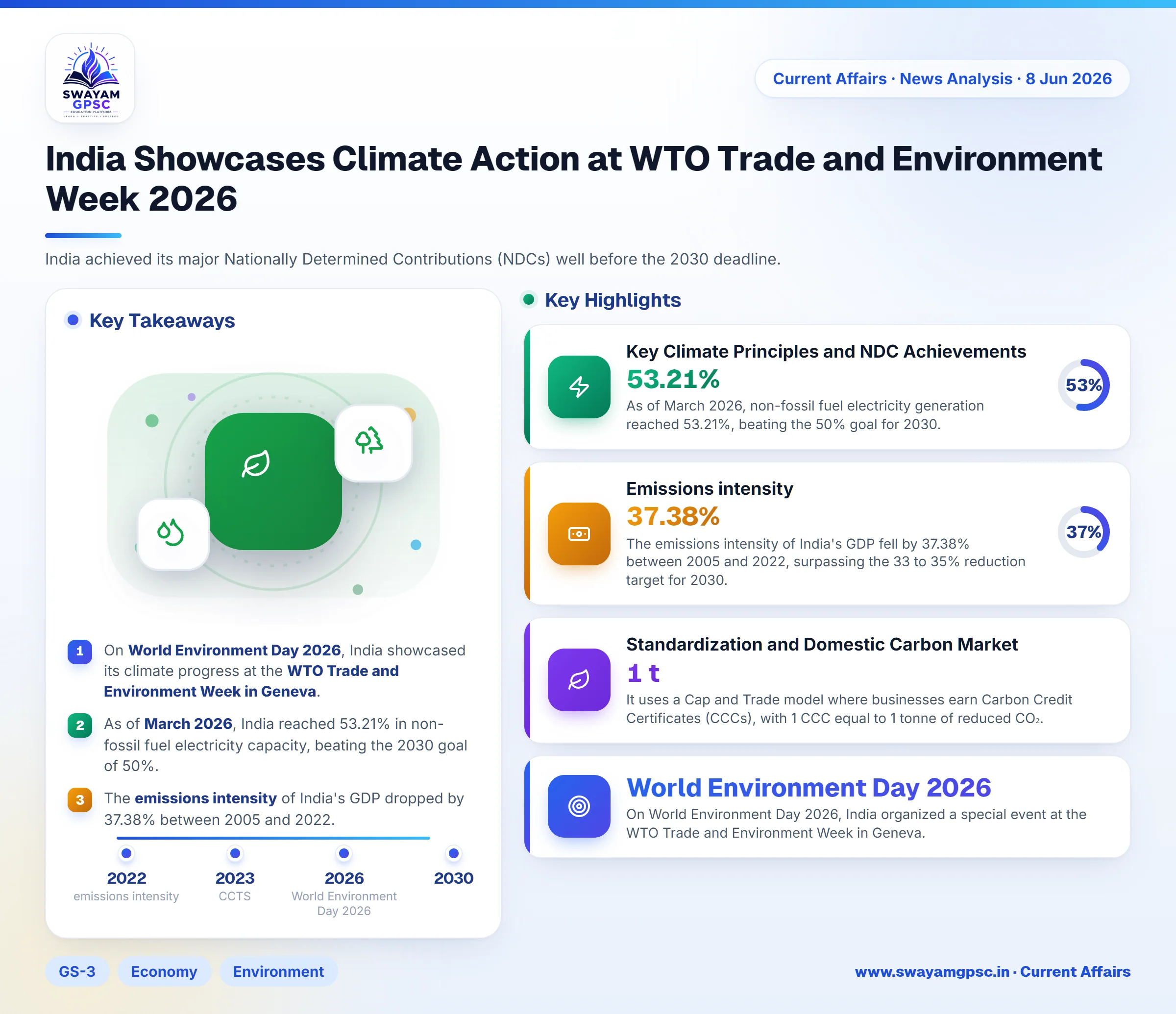
- On World Environment Day 2026, India showcased its climate progress at the WTO Trade and Environment Week in Geneva.
- As of March 2026, India reached 53.21% in non-fossil fuel electricity capacity, beating the 2030 goal of 50%.
- The emissions intensity of India's GDP dropped by 37.38% between 2005 and 2022.
- The Carbon Credit Trading Scheme (CCTS) operates on a Cap and Trade model where 1 CCC equals 1 tonne of CO₂ reduction.
Why in News
- On World Environment Day 2026, India organized a special event at the WTO Trade and Environment Week in Geneva.
- The event highlighted India's Carbon Credit Trading Scheme (CCTS) and new standards in renewable energy.
Key Climate Principles and NDC Achievements
- The presentation focused on India's push for a low-carbon economy and meeting targets under the Paris Agreement.
- India stressed that its climate actions follow UNFCCC rules of equity and Common but Differentiated Responsibilities and Respective Capabilities (CBDR-RC).
- India achieved its major Nationally Determined Contributions (NDCs) well before the 2030 deadline.
- As of March 2026, non-fossil fuel electricity generation reached 53.21%, beating the 50% goal for 2030.
- The emissions intensity of India's GDP fell by 37.38% between 2005 and 2022, surpassing the 33 to 35% reduction target for 2030.
Standardization and Domestic Carbon Market
- India showed progress under the National Green Hydrogen Mission with new rules to define Green Hydrogen.
- The Indian Carbon Market (ICM) framework was presented under the Carbon Credit Trading Scheme (CCTS).
- The CCTS sets up a national online platform to trade carbon credits and cut greenhouse gases.
- The Ministry of Power notified the CCTS in 2023 under the Energy Conservation Act, 2001.
- It uses a Cap and Trade model where businesses earn Carbon Credit Certificates (CCCs), with 1 CCC equal to 1 tonne of reduced CO₂.
- The Bureau of Energy Efficiency (BEE) manages the scheme, while the Central Electricity Regulatory Commission (CERC) handles trading rules.