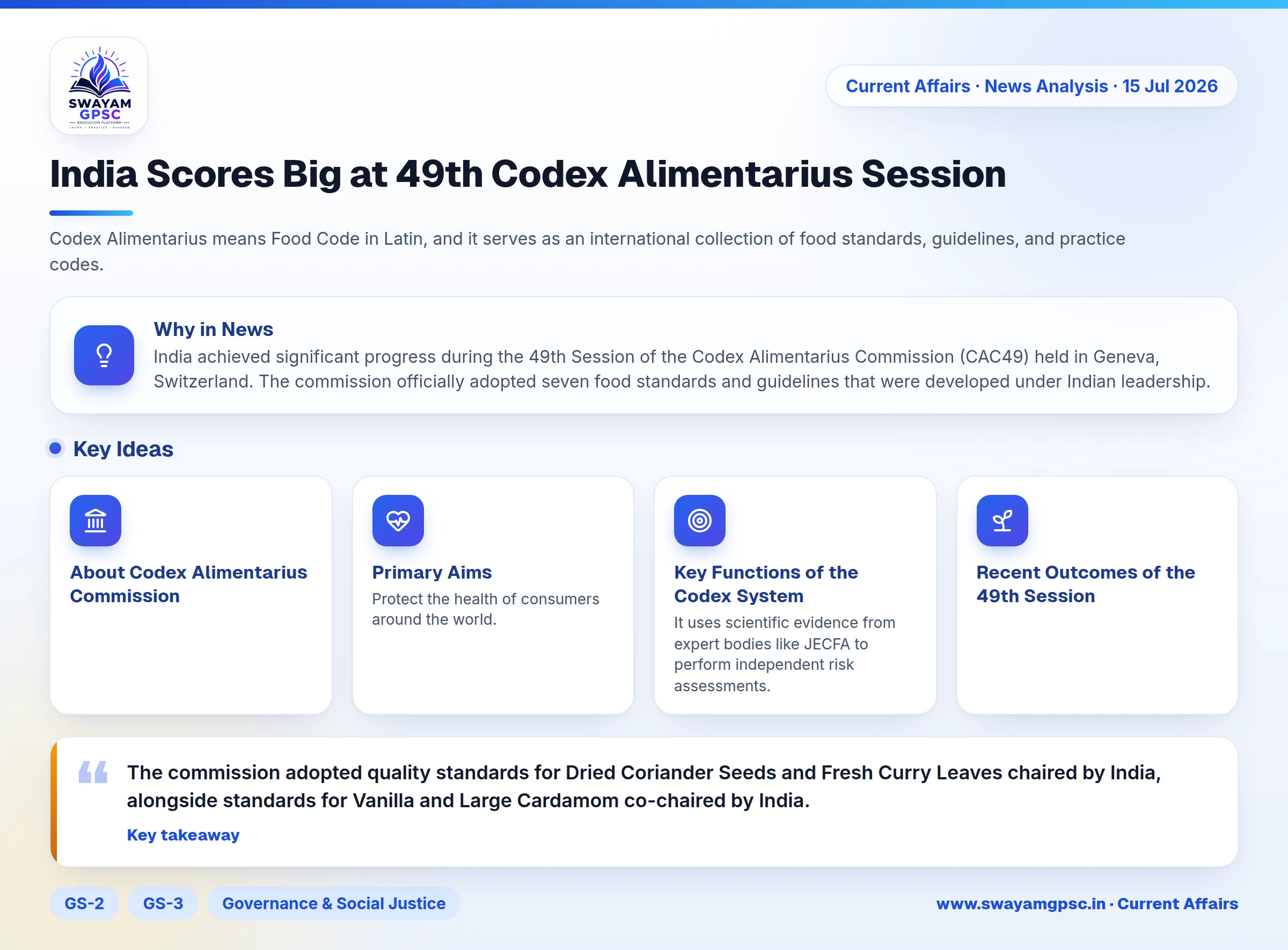
India Scores Big at 49th Codex Alimentarius Session
#GS-2 #GS-3 #Governance & Social Justice #Regulatory Bodies #Economy #Agriculture #Current Events #International #Codex Alimentarius Commission #Food Safety
Why in News
- India achieved significant progress during the 49th Session of the Codex Alimentarius Commission (CAC49) held in Geneva, Switzerland.
- The commission officially adopted seven food standards and guidelines that were developed under Indian leadership.
About Codex Alimentarius Commission
- Codex Alimentarius means Food Code in Latin, and it serves as an international collection of food standards, guidelines, and practice codes.
- It is not a legally binding law, but it acts as a scientific guide to help countries align their national food regulations.
- The Food and Agriculture Organization (FAO) created the commission in November 1961, and the World Health Organization (WHO) joined it in June 1962.
Primary Aims
- Protect the health of consumers around the world.
- Ensure fair and ethical practices in the international trade of food products.
- Facilitate transparent global trade by removing unnecessary technical hurdles.
Key Functions of the Codex System
- It sets safe maximum limits for food additives, contaminants, toxins, pesticide residues, and veterinary drug residues.
- It uses scientific evidence from expert bodies like JECFA to perform independent risk assessments.
- It creates uniform global standards for food packaging, hygiene, processing, and clear labelling.
- It serves as the official WTO-SPS reference for food safety, meaning countries need scientific evidence to apply stricter rules.
Recent Outcomes of the 49th Session
- The commission adopted quality standards for Dried Coriander Seeds and Fresh Curry Leaves chaired by India, alongside standards for Vanilla and Large Cardamom co-chaired by India.
- It approved India's proposal to create a new Codex Standard for Cashew Kernels under the CCPFV to reduce trade barriers for tree nuts.
- India was elected as Co-Chair of the new group on New Food Sources and Production Systems (NFPS) to assess safety risks in modern food technologies.
- The session updated guidelines to prevent foodborne illness, focusing on Listeria monocytogenes in ready-to-eat foods and Campylobacter and Salmonella in poultry.