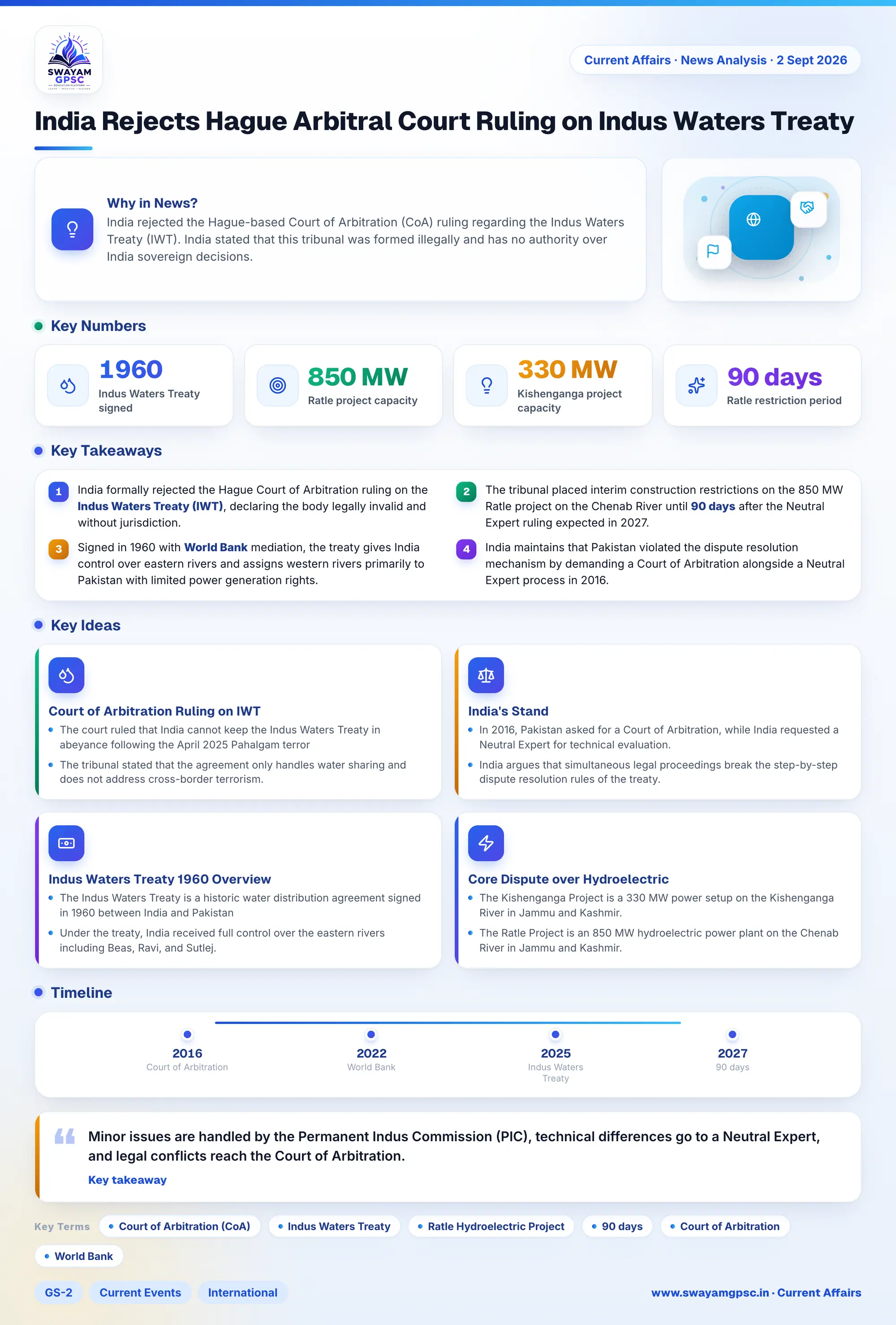
India Rejects Hague Arbitral Court Ruling on Indus Waters Treaty
#GS-2 #Current Events #International #National #Indus Waters Treaty #India-Pakistan Relations
Key takeaways
- India formally rejected the Hague Court of Arbitration ruling on the Indus Waters Treaty (IWT), declaring the body legally invalid and without jurisdiction.
- The tribunal placed interim construction restrictions on the 850 MW Ratle project on the Chenab River until 90 days after the Neutral Expert ruling expected in 2027.
- Signed in 1960 with World Bank mediation, the treaty gives India control over eastern rivers and assigns western rivers primarily to Pakistan with limited power generation rights.
- India maintains that Pakistan violated the dispute resolution mechanism by demanding a Court of Arbitration alongside a Neutral Expert process in 2016.
Why in News?
- India rejected the Hague-based Court of Arbitration (CoA) ruling regarding the Indus Waters Treaty (IWT).
- India stated that this tribunal was formed illegally and has no authority over India sovereign decisions.
Court of Arbitration Ruling on IWT
- The court ruled that India cannot keep the Indus Waters Treaty in abeyance following the April 2025 Pahalgam terror attack.
- The tribunal stated that the agreement only handles water sharing and does not address cross-border terrorism.
- It concluded that terrorist attacks do not amount to a material breach of the water treaty by Pakistan.
- The court placed temporary restrictions on certain construction steps at the Ratle Hydroelectric Project on the Chenab River.
- These restrictions will stay until 90 days after the Neutral Expert gives a final decision in 2027.
India's Stand
- In 2016, Pakistan asked for a Court of Arbitration, while India requested a Neutral Expert for technical evaluation.
- India argues that simultaneous legal proceedings break the step-by-step dispute resolution rules of the treaty.
- The World Bank paused both proceedings in 2016 but allowed them to run at the same time in 2022.
- India joined the Neutral Expert process but completely boycotted the Court of Arbitration hearings.
- India maintains that the Court of Arbitration has no jurisdiction over its sovereign decision to suspend treaty obligations.
Indus Waters Treaty 1960 Overview
- The Indus Waters Treaty is a historic water distribution agreement signed in 1960 between India and Pakistan with World Bank mediation.
- Under the treaty, India received full control over the eastern rivers including Beas, Ravi, and Sutlej.
- The western rivers including Chenab, Indus, and Jhelum were allocated mostly to Pakistan.
- India holds limited rights on western rivers for basic domestic use, farming, and run-of-the-river power generation.
- Minor issues are handled by the Permanent Indus Commission (PIC), technical differences go to a Neutral Expert, and legal conflicts reach the Court of Arbitration.
Core Dispute over Hydroelectric Projects
- The Kishenganga Project is a 330 MW power setup on the Kishenganga River in Jammu and Kashmir.
- The Ratle Project is an 850 MW hydroelectric power plant on the Chenab River in Jammu and Kashmir.
- Pakistan claims that India design creates too much water storage and affects natural river flow.
- Because of this design dispute, Pakistan demanded a Court of Arbitration while India asked for a Neutral Expert.
Structure of Court of Arbitration
- The Court of Arbitration is a five-member special tribunal formed under Annexure G of the treaty.
- The Permanent Court of Arbitration (PCA) located in The Hague serves as its administrative secretariat.
- The World Bank set up this tribunal during 2022-23 after Pakistan made a formal request.