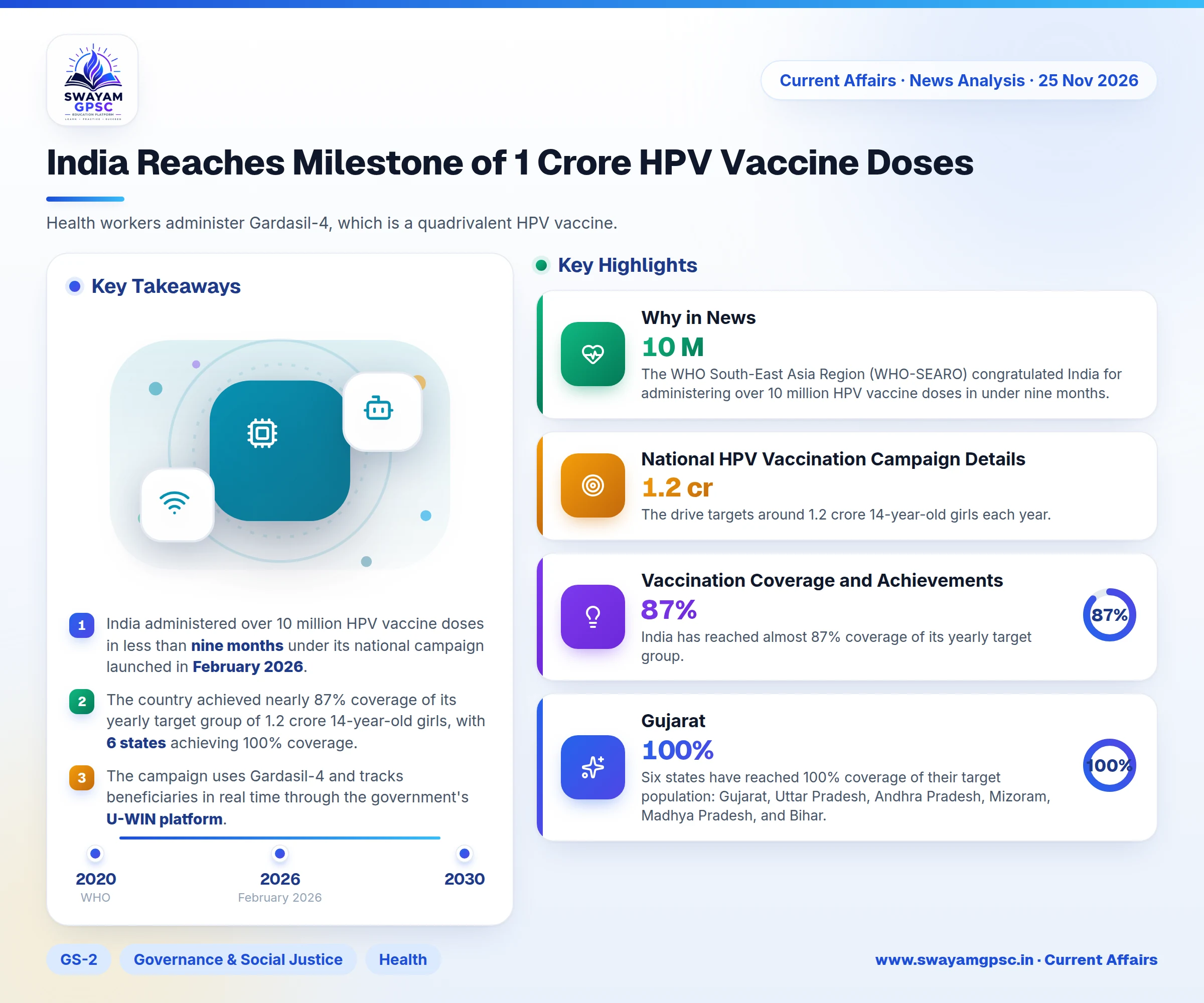
India Reaches Milestone of 1 Crore HPV Vaccine Doses
#GS-2 #Governance & Social Justice #Health #Government Policies & Interventions #GS-3 #Science & Technology #Biotechnology #Current Events #National #Achievements of Indians in Science & Technology
Key takeaways
- India administered over 10 million HPV vaccine doses in less than nine months under its national campaign launched in February 2026.
- The country achieved nearly 87% coverage of its yearly target group of 1.2 crore 14-year-old girls, with 6 states achieving 100% coverage.
- The campaign uses Gardasil-4 and tracks beneficiaries in real time through the government's U-WIN platform.
- India also developed its own indigenous quadrivalent vaccine named CERVAVAC, created by the Serum Institute of India to protect against HPV types 6, 11, 16, and 18.
- These efforts support the WHO 2030 target to reduce cervical cancer cases to under 4 per 1 lakh women annually.
Why in News
- The WHO South-East Asia Region (WHO-SEARO) congratulated India for administering over 10 million HPV vaccine doses in under nine months.
- This achievement marks a major step forward in the country's efforts to prevent cervical cancer.
National HPV Vaccination Campaign Details
- India launched the National HPV Vaccination Campaign in February 2026.
- The drive targets around 1.2 crore 14-year-old girls each year.
- Eligible girls receive a free, voluntary, single-dose HPV shot at government health centers with parental consent.
- Health workers administer Gardasil-4, which is a quadrivalent HPV vaccine.
Vaccination Coverage and Achievements
- India has reached almost 87% coverage of its yearly target group.
- Six states have reached 100% coverage of their target population: Gujarat, Uttar Pradesh, Andhra Pradesh, Mizoram, Madhya Pradesh, and Bihar.
- Another 12 states have successfully passed the 80% coverage mark.
Digital Tracking via U-WIN Platform
- The government uses the U-WIN platform to track the campaign in real time.
- This system helps track beneficiaries, spot coverage gaps, book slots, and issue digital certificates.
About Human Papillomavirus (HPV)
- HPV consists of a group of around 200 related viruses that spread through skin-to-skin contact.
- High-risk types 16 and 18 cause most cervical cancer cases, while low-risk types 6 and 11 cause genital warts.
- Long-term infection with high-risk HPV types can cause cervical, anal, vaginal, vulvar, penile, and throat cancers.
HPV Vaccines and CERVAVAC
- The HPV vaccine prevents new infections from specific HPV types, but it cannot cure existing infections.
- The WHO recommends vaccinating girls aged 9 to 14 years as the primary focus.
- Getting vaccinated does not eliminate the need for regular cervical cancer screening.
- India developed CERVAVAC, its first domestic quadrivalent HPV vaccine.
- The Serum Institute of India created CERVAVAC alongside the Department of Biotechnology and BIRAC, with funding support from the Bill & Melinda Gates Foundation.
- This vaccine protects against HPV types 6, 11, 16, and 18.
WHO Global Strategy to Eliminate Cervical Cancer
- The WHO launched a global strategy in 2020 to bring cervical cancer cases down to fewer than 4 per 1 lakh women per year.
- The plan sets the 90-70-90 targets to reach by 2030.
- The first target requires 90% of girls to be fully vaccinated against HPV by age 15.
- The second target requires 70% of women to get screened with high-performance tests by ages 35 and 45.
- The third target requires 90% of women with cervical precancer to receive treatment and 90% with invasive cancer to get managed properly.