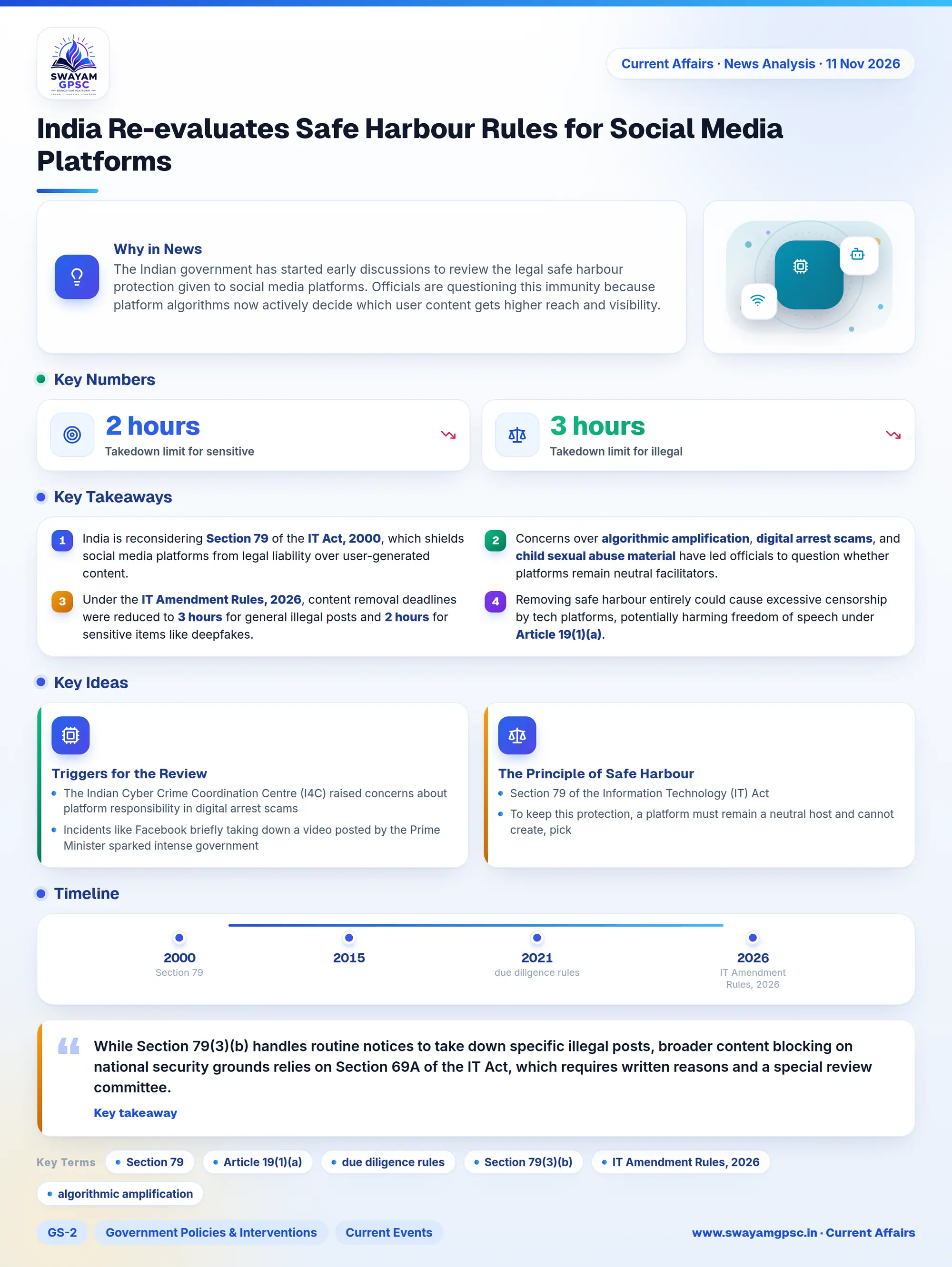
India Re-evaluates Safe Harbour Rules for Social Media Platforms
#GS-2 #Government Policies & Interventions #Current Events #National #GS-3 #IT & Computers #Cyber Security
Key takeaways
- India is reconsidering Section 79 of the IT Act, 2000, which shields social media platforms from legal liability over user-generated content.
- Concerns over algorithmic amplification, digital arrest scams, and child sexual abuse material have led officials to question whether platforms remain neutral facilitators.
- Under the IT Amendment Rules, 2026, content removal deadlines were reduced to 3 hours for general illegal posts and 2 hours for sensitive items like deepfakes.
- Removing safe harbour entirely could cause excessive censorship by tech platforms, potentially harming freedom of speech under Article 19(1)(a).
Why in News
- The Indian government has started early discussions to review the legal safe harbour protection given to social media platforms.
- Officials are questioning this immunity because platform algorithms now actively decide which user content gets higher reach and visibility.
Triggers for the Review
- The Indian Cyber Crime Coordination Centre (I4C) raised concerns about platform responsibility in digital arrest scams and suggested creating a victim compensation fund.
- Incidents like Facebook briefly taking down a video posted by the Prime Minister sparked intense government and parliamentary scrutiny regarding platform accountability.
- Social media platforms use recommendation algorithms to promote specific posts, which challenges their status as neutral networks and calls into question their automatic legal immunity.
- The Supreme Court questioned whether Section 79 provides enough protection against child sexual abuse material, suggesting proportional fines while reserving safe harbour loss for extreme cases.
- Digital rights groups warn that taking away safe harbour could create a chilling effect on public discourse.
- If platforms face direct legal punishment for user posts, they may over-censor news reports, political criticism, or satire, directly hurting free speech under Article 19(1)(a).
The Principle of Safe Harbour
- Section 79 of the Information Technology (IT) Act, 2000 protects neutral online platforms from legal liability for user-created posts and uploaded content.
- To keep this protection, a platform must remain a neutral host and cannot create, pick, or modify the user content it stores.
- Platforms must follow basic due diligence rules, such as the IT Rules, 2021, which require appointing local officers like a Chief Compliance Officer, Nodal Contact Person, and Grievance Officer, along with sharing monthly reports.
- Platforms must quickly delete or block access to illegal content after getting a formal government notification or court order.
- Under Section 79(3)(b), platforms lose their legal immunity if they fail to remove illegal content promptly after official notification.
- Under the IT Amendment Rules, 2026, platforms that knowingly allow, spread, or fail to act on harmful synthetic content will lose their due diligence protection.
- In the landmark *Shreya Singhal v. Union of India (2015)* case, the Supreme Court ruled that takedown requests need a formal court order or government notice rather than private complaints.
- While Section 79(3)(b) handles routine notices to take down specific illegal posts, broader content blocking on national security grounds relies on Section 69A of the IT Act, which requires written reasons and a special review committee.
- The IT Amendment Rules, 2026 shortened content removal deadlines to 3 hours for general illegal material and 2 hours for sensitive content like non-consensual deepfakes, raising compliance pressure on tech companies.