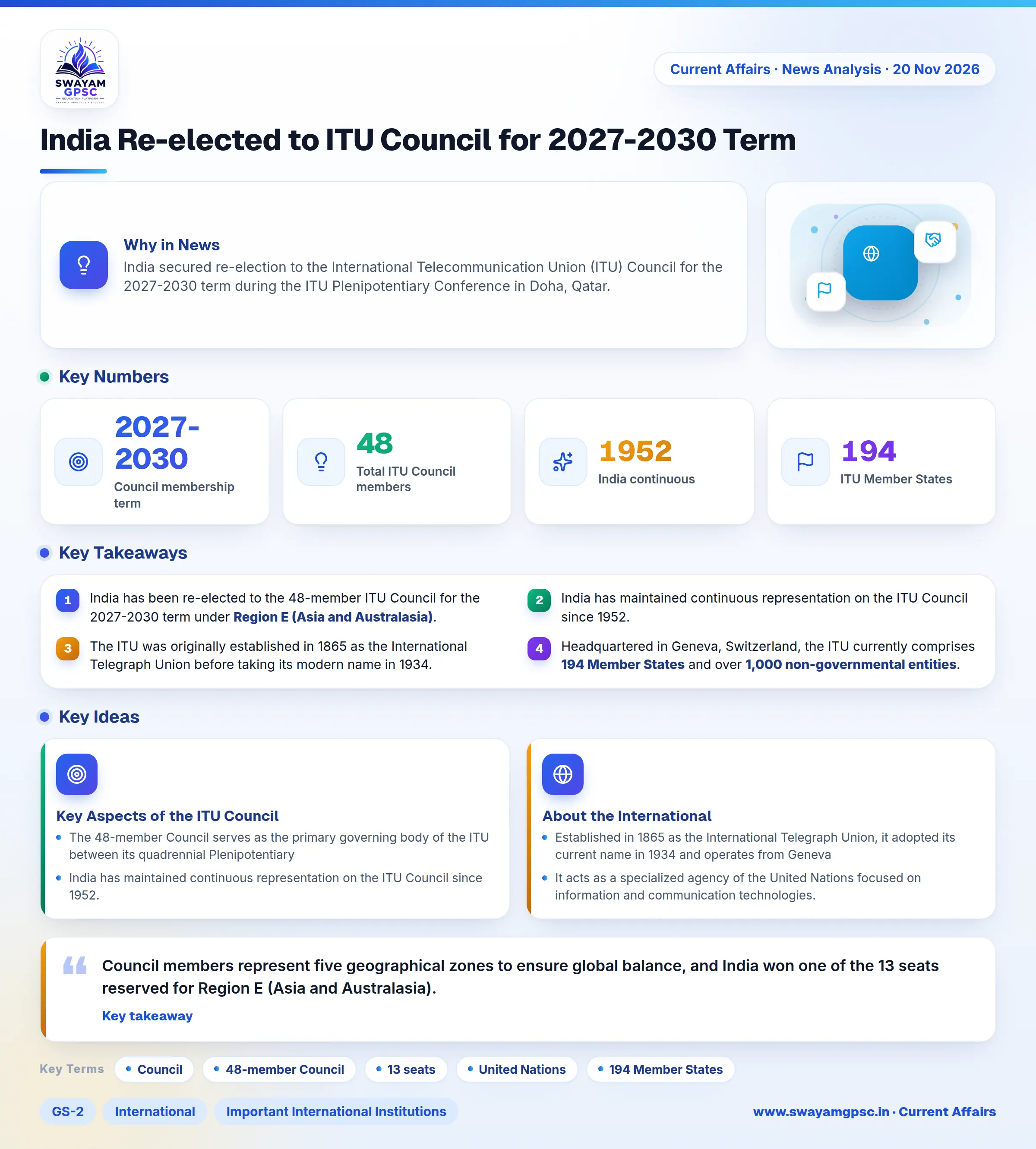
India Re-elected to ITU Council for 2027-2030 Term
#GS-2 #International #Important International Institutions #International Telecommunication Union #ITU Council #Rapid Fire CA
Key takeaways
- India has been re-elected to the 48-member ITU Council for the 2027-2030 term under Region E (Asia and Australasia).
- India has maintained continuous representation on the ITU Council since 1952.
- The ITU was originally established in 1865 as the International Telegraph Union before taking its modern name in 1934.
- Headquartered in Geneva, Switzerland, the ITU currently comprises 194 Member States and over 1,000 non-governmental entities.
Why in News
- India secured re-election to the International Telecommunication Union (ITU) Council for the 2027-2030 term during the ITU Plenipotentiary Conference in Doha, Qatar.
Key Aspects of the ITU Council
- The 48-member Council serves as the primary governing body of the ITU between its quadrennial Plenipotentiary Conferences.
- India has maintained continuous representation on the ITU Council since 1952.
- Council members represent five geographical zones to ensure global balance, and India won one of the 13 seats reserved for Region E (Asia and Australasia).
- The Council directs ITU operations, manages working groups, and drafts long-term strategic and financial plans for the main conference.
- This election victory helps India influence global telecom policy, expand internet access, and build a secure digital world.
About the International Telecommunication Union (ITU)
- Established in 1865 as the International Telegraph Union, it adopted its current name in 1934 and operates from Geneva, Switzerland.
- It acts as a specialized agency of the United Nations focused on information and communication technologies.
- The organization includes 194 Member States alongside over 1,000 private companies, universities, and international organizations.
- The ITU coordinates global radio spectrums, assigns satellite orbits, sets worldwide ICT standards, and works to improve global internet access.