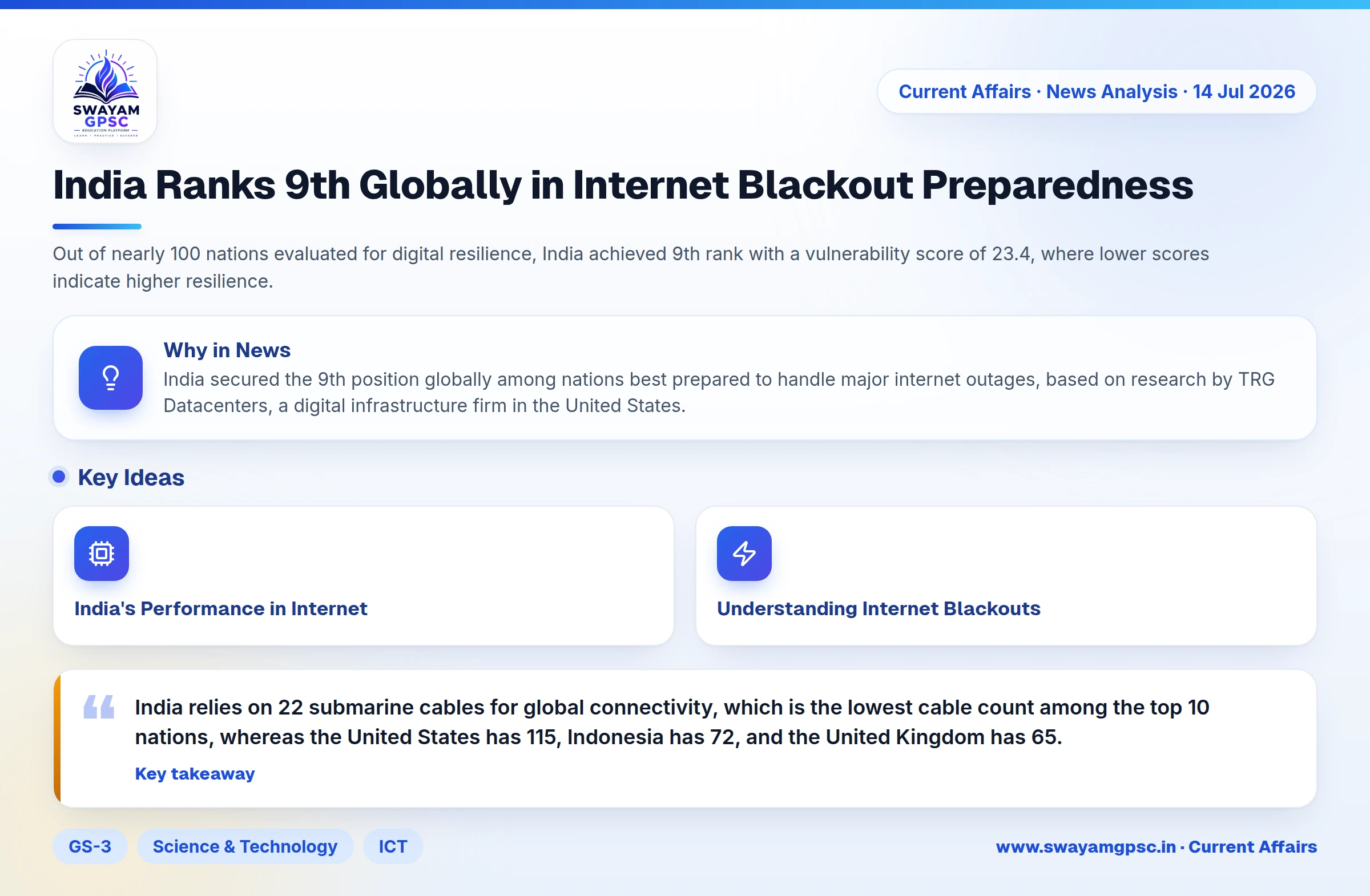
India Ranks 9th Globally in Internet Blackout Preparedness
#GS-3 #Science & Technology #ICT #Cyber Security #Infrastructure #Current Events #National #Internet Blackout Preparedness
Why in News
- India secured the 9th position globally among nations best prepared to handle major internet outages, based on research by TRG Datacenters, a digital infrastructure firm in the United States.
- The United States grabbed the top position with a vulnerability score of 0, with Indonesia and the United Kingdom taking the second and third spots.
India's Performance in Internet Blackout Preparedness
- Out of nearly 100 nations evaluated for digital resilience, India achieved 9th rank with a vulnerability score of 23.4, where lower scores indicate higher resilience.
- India relies on 22 submarine cables for global connectivity, which is the lowest cable count among the top 10 nations, whereas the United States has 115, Indonesia has 72, and the United Kingdom has 65.
- India operates 40 Internet Exchange Points, which allow local networks to trade data directly, boosting speeds, lowering costs, and maintaining domestic traffic if global lines fail.
- Nearly 99.5% of India's population has access to electricity, providing steady power needed for data centres, landing stations, telecom systems, and exchange points.
- India earned a cybersecurity score of 98.5 out of 100, demonstrating robust defence mechanisms against major cyber threats and network disruptions.
- Approximately 70% of the Indian population uses the internet, meaning any widespread blackout would cause massive economic and social fallout.
- India's main advantages include widespread power availability, a strong cybersecurity network, and a solid setup of local internet exchange points.
- India's biggest weakness is its low count of undersea cables, creating single points of failure where multiple providers share common landing points or power lines.
- In September 2025, damage to submarine cables near Saudi Arabia slowed down internet services across India, Pakistan, and the United Arab Emirates for days.
- To fix these gaps, India must add more undersea cable routes, build new landing stations, expand domestic fiber lines, setup local exchange points, and run regular network failure tests.
Understanding Internet Blackouts
- An internet blackout means a complete or partial loss of web connectivity across a country or region, caused by cable damage, cyber threats, power outages, or physical sabotage.
- Submarine fiber cables handle almost all overseas web traffic, while local exchange points handle domestic data transfer without relying on foreign networks.
- If a cable breaks, data gets rerouted through other cables and stations, preventing total shutdown but causing slower internet speeds and higher latency.
- Long disruptions badly affect online banking, digital payments, cloud storage, emergency services, private businesses, and everyday government work.
- Critical web infrastructure remains vulnerable to ship anchors, underwater accidents, natural disasters, cyber threats, and geopolitical tensions.