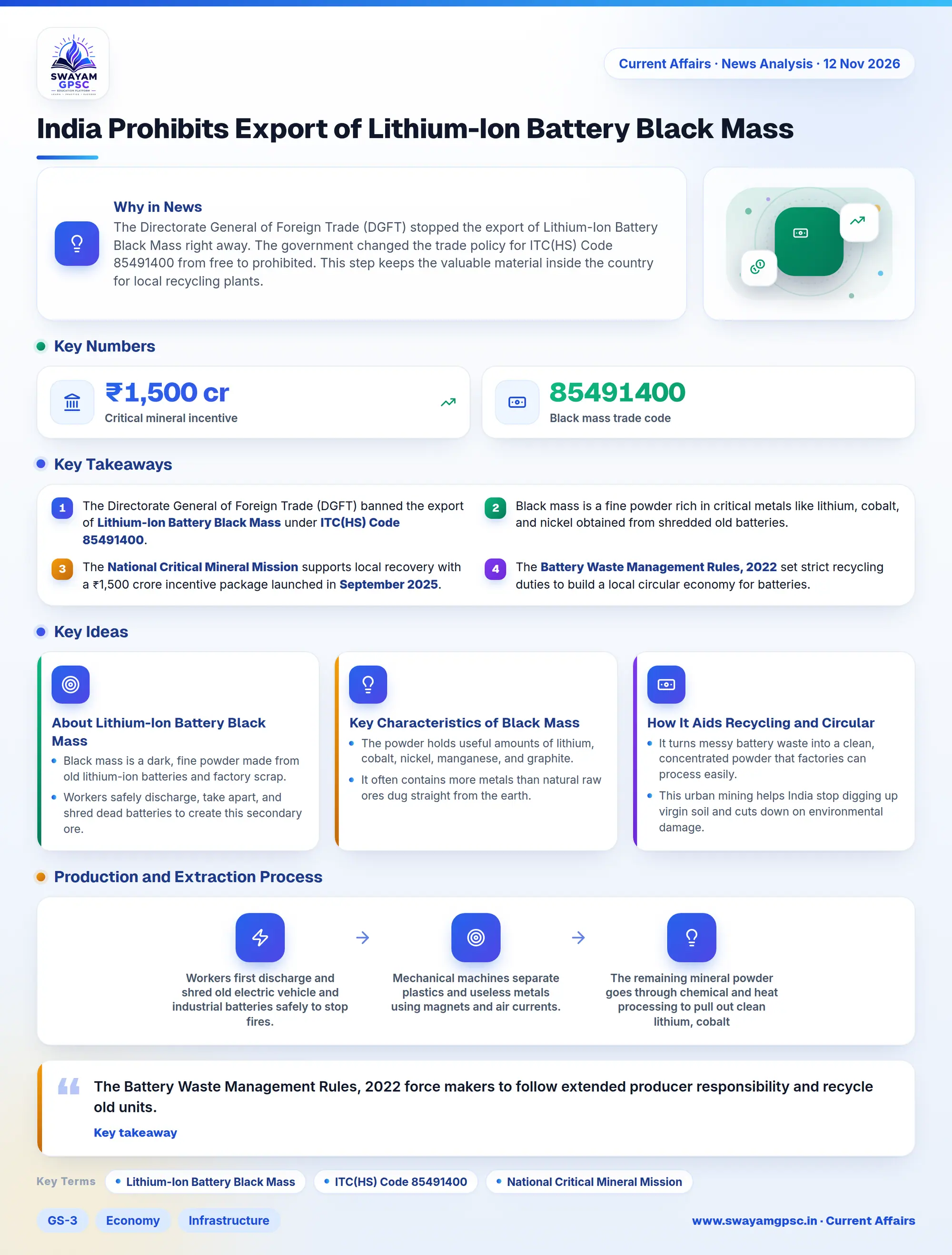
India Prohibits Export of Lithium-Ion Battery Black Mass
#GS-3 #Economy #Infrastructure #Environment #Science & Technology #Energy
Key takeaways
- The Directorate General of Foreign Trade (DGFT) banned the export of Lithium-Ion Battery Black Mass under ITC(HS) Code 85491400.
- Black mass is a fine powder rich in critical metals like lithium, cobalt, and nickel obtained from shredded old batteries.
- The National Critical Mineral Mission supports local recovery with a ₹1,500 crore incentive package launched in September 2025.
- The Battery Waste Management Rules, 2022 set strict recycling duties to build a local circular economy for batteries.
Why in News
- The Directorate General of Foreign Trade (DGFT) stopped the export of Lithium-Ion Battery Black Mass right away.
- The government changed the trade policy for ITC(HS) Code 85491400 from free to prohibited.
- This step keeps the valuable material inside the country for local recycling plants.
About Lithium-Ion Battery Black Mass
- Black mass is a dark, fine powder made from old lithium-ion batteries and factory scrap.
- Workers safely discharge, take apart, and shred dead batteries to create this secondary ore.
- It holds high-value critical metals inside a concentrated powder form.
Production and Extraction Process
- Workers first discharge and shred old electric vehicle and industrial batteries safely to stop fires.
- Mechanical machines separate plastics and useless metals using magnets and air currents.
- The remaining mineral powder goes through chemical and heat processing to pull out clean lithium, cobalt, and nickel.
Key Characteristics of Black Mass
- The powder holds useful amounts of lithium, cobalt, nickel, manganese, and graphite.
- It often contains more metals than natural raw ores dug straight from the earth.
- The material is dangerous and reactive because it holds leftover chemicals that can catch fire.
- The exact mix of minerals changes depending on whether the old battery used NMC, LCO, or LFP chemistry.
How It Aids Recycling and Circular Economy
- It turns messy battery waste into a clean, concentrated powder that factories can process easily.
- This urban mining helps India stop digging up virgin soil and cuts down on environmental damage.
- Recycled materials go straight to local advanced chemistry cell factories to build supply chain safety.
- Keeping the scrap at home stops economic value from leaking to other countries.
Current Status in India
- DGFT Notification No. 49/2026-27 officially banned these exports to help local recycling companies.
- The National Critical Mineral Mission backs a ₹1,500 crore incentive plan approved in September 2025.
- The Battery Waste Management Rules, 2022 force makers to follow extended producer responsibility and recycle old units.