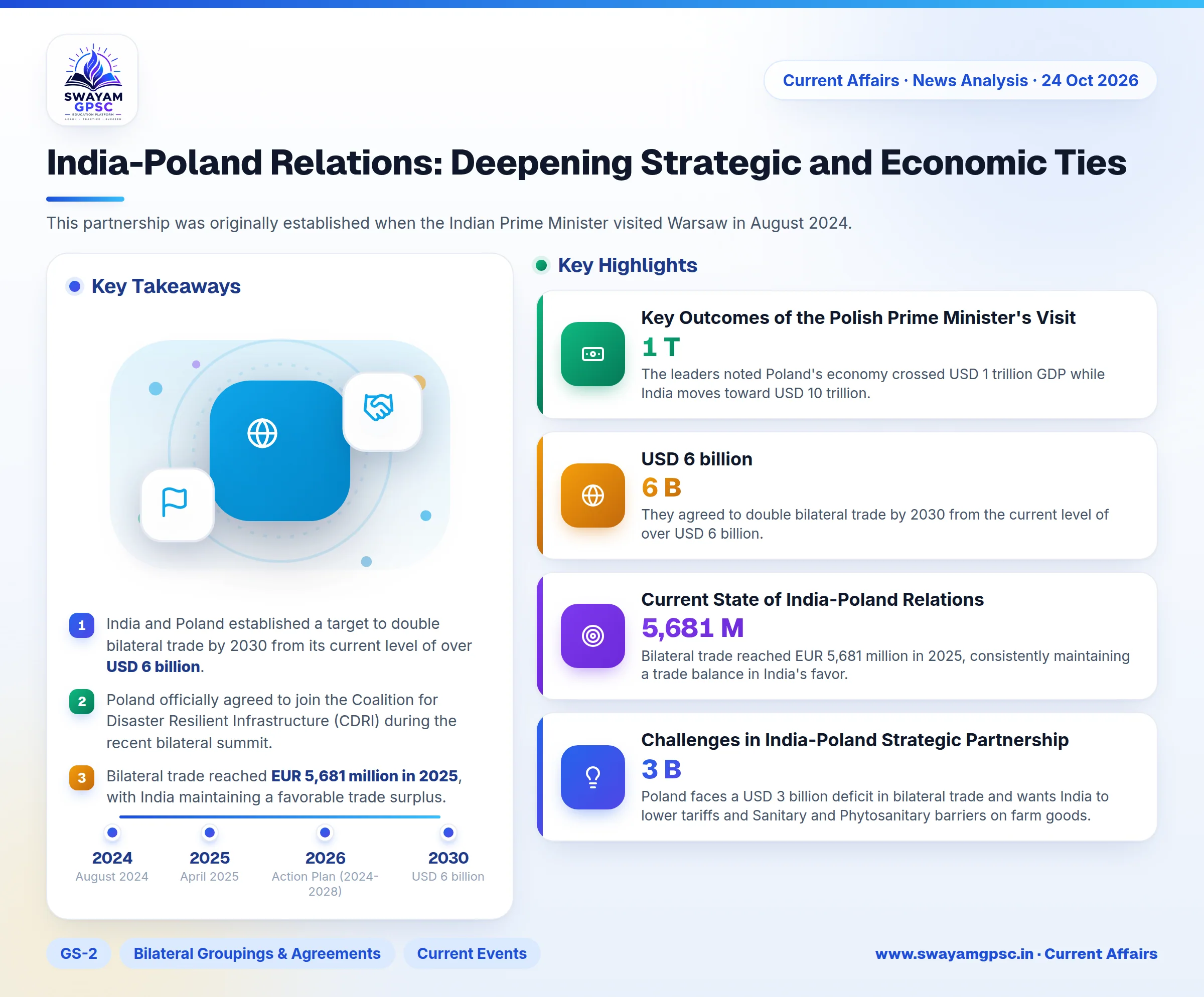
India-Poland Relations: Deepening Strategic and Economic Ties
#GS-2 #Bilateral Groupings & Agreements #Groupings & Agreements Involving India and/or Affecting India's Interests #Current Events #International #International Relations #India-Poland Relations #Trade & Defense Agreements
Key takeaways
- India and Poland established a target to double bilateral trade by 2030 from its current level of over USD 6 billion.
- Poland officially agreed to join the Coalition for Disaster Resilient Infrastructure (CDRI) during the recent bilateral summit.
- Bilateral trade reached EUR 5,681 million in 2025, with India maintaining a favorable trade surplus.
- Defense collaboration depends heavily on finalizing the pending Agreement on Mutual Protection and Exchange of Classified Information.
- Poland supported India's permanent membership bid in the United Nations Security Council (UNSC) and its 2028-29 non-permanent seat.
Why in News
- The Prime Minister of the Republic of Poland recently paid an official visit to India.
- During this visit, both leaders held high-level discussions to review their bilateral ties.
- They aimed to add fresh momentum to the India-Poland Strategic Partnership.
- This partnership was originally established when the Indian Prime Minister visited Warsaw in August 2024.
Summary
- India and Poland are expanding cooperation in trade, defense, clean energy, and modern technology.
- Poland serves as a key gateway for India to access the wider European Union market.
- Both nations face strategic differences over Russia, defense technology transfers, trade tariffs, and visa delays.
- Solving these issues requires stronger joint institutions, co-manufacturing, and better transport connections.
Key Outcomes of the Polish Prime Minister's Visit
- The leaders noted Poland's economy crossed USD 1 trillion GDP while India moves toward USD 10 trillion.
- They agreed to double bilateral trade by 2030 from the current level of over USD 6 billion.
- Both sides decided to resume the bilateral working group focused on agriculture.
- They proposed a new framework to encourage military manufacturing, joint development, and technology partnerships.
- Leaders highlighted the need to sign the Agreement on Mutual Protection and Exchange of Classified Information to enable deep defense cooperation.
- Both nations agreed to cooperate on artificial intelligence, semiconductors, quantum technology, startups, critical minerals, and battery recycling.
- Poland officially decided to join the Coalition for Disaster Resilient Infrastructure (CDRI).
- India invited Poland to join the International Solar Alliance (ISA), Global Biofuels Alliance (GBA), and Indo-Pacific Oceans Initiative (IPOI).
- Poland supported India's bid for permanent membership in a reformed United Nations Security Council (UNSC) and a non-permanent seat for 2028-29.
- Both countries strongly condemned the April 2025 terrorist attack in Pahalgam located in Jammu and Kashmir.
- They called for the fast adoption of the UN Comprehensive Convention on International Terrorism (CCIT) and agreed to launch a counter-terrorism dialogue.
Current State of India-Poland Relations
- Humanitarian history binds both nations back to World War II.
- The Maharaja of Nawanagar (Jam Saheb Digvijay Sinhji) gave shelter to 1,000 Polish orphans who were evacuated from the USSR.
- The Valivade camp in Kolhapur hosted 5,000 Polish refugees during the same war period.
- Poland provided logistical help during Operation Ganga in 2022 to evacuate over 2,000 Indian students from Ukraine.
- Poland is India's largest trading and investment partner in Central and Eastern Europe.
- Bilateral trade reached EUR 5,681 million in 2025, consistently maintaining a trade balance in India's favor.
- India exports textiles, machinery, and pharmaceuticals, while importing turbojet engines and minerals from Poland.
- India is the second-largest Asian destination for Polish investment.
- The bilateral relationship follows the Action Plan (2024-2028), which underwent a mid-term review in September 2026.
- Polish artist Stefan Norblin blended Polish art with Indian mythology at the Umaid Bhawan Palace in Jodhpur during WWII.
- Academic connections started in the 19th century with the Chair of Sanskrit at the Jagiellonian University in Kraków.
Significance of the Relations
- Poland acts as a strategic entry point for Indian businesses aiming to expand into European Union markets.
- Poland's defense production capabilities complement India's Atmanirbhar Bharat initiative.
- Poland's experience with Soviet military hardware and NATO integration helps maintain India's legacy weapons systems.
- Stronger ties align with the India-EU Security and Defence Partnership signed in January 2026 and the proposed EU-India Free Trade Agreement (FTA).
Challenges in India-Poland Strategic Partnership
- Poland's strict position as a frontline NATO state conflicts with India's policy of Strategic Autonomy regarding Russia.
- Joint defense production is stalled because European firms need a signed Agreement on Exchange of Classified Information to transfer technology.
- Poland faces a USD 3 billion deficit in bilateral trade and wants India to lower tariffs and Sanitary and Phytosanitary barriers on farm goods.
- Trade routes suffer from Red Sea maritime disruptions and a complete lack of direct flights between both nations.
- Integrating Polish Baltic ports into the India-Middle East-Europe Economic Corridor (IMEC) remains unfulfilled.
- Indian IT workers and students face visa delays due to the absence of a Migration and Mobility Partnership Agreement (MMPA) and a Social Security Agreement.
Way Forward
- Set up a dedicated 'Poland Plus' desk within Invest India to assist Polish companies and attract foreign direct investment.
- Use Poland as a hub for nearshoring in software, semiconductor design, and pharmaceutical delivery into the European market.
- Invite Polish defense firms to build joint facilities inside the Uttar Pradesh and Tamil Nadu Defence Industrial Corridors.
- Focus defense partnerships on specialized technologies like electronic warfare, drone swarms, and cybersecurity.
- Build commercial space ties by linking NSIL with the Polish Space Agency for satellite launches and remote sensing.
- Share transition knowledge regarding coal mining and create a joint research fund for Small Modular Reactors (SMRs) and green hydrogen.
- Turn irregular meetings with the Visegrad Group (V4) into an annual formal summit to deepen ties across Central Europe.
Conclusion
- India and Poland are steadily building deeper ties across defense, clean energy, and commercial sectors.
- Addressing geopolitical views, trade barriers, and worker movement issues will unlock the full potential of this strategic partnership.