India and New Zealand Strategic Partnership Overview
#GS-3 #Current Events #International #Economy #Trade #India-New Zealand Relations #Indo-Pacific #Free Trade Agreement
Why in News
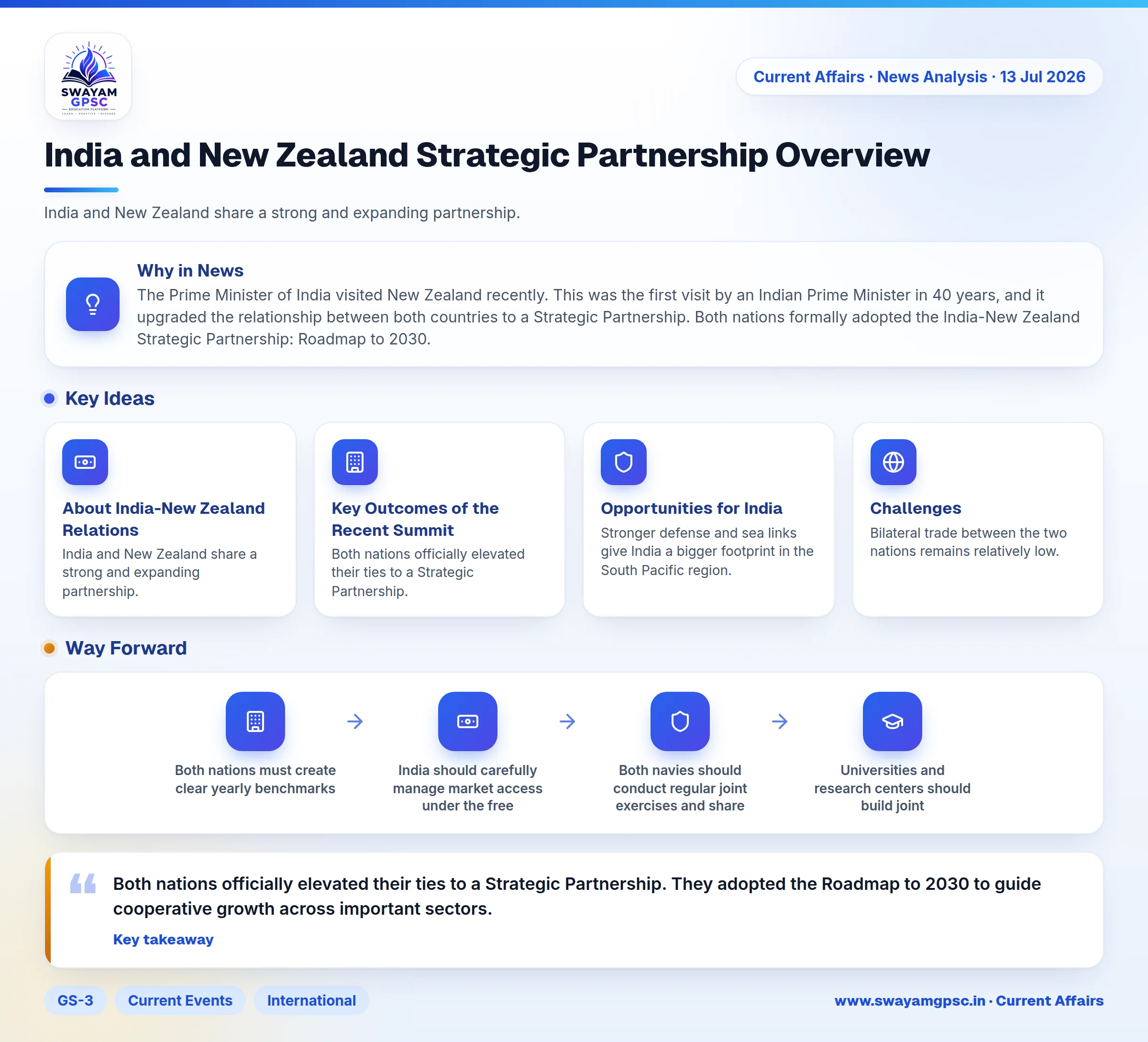
- The Prime Minister of India visited New Zealand recently. This was the first visit by an Indian Prime Minister in 40 years, and it upgraded the relationship between both countries to a Strategic Partnership.
- Both nations formally adopted the India-New Zealand Strategic Partnership: Roadmap to 2030. This document will guide future efforts in areas like climate change and people-to-people connections.
About India-New Zealand Relations
- India and New Zealand share a strong and expanding partnership. This relationship relies on shared democratic values, ties through the Commonwealth, strong cultural links, economic synergy, and a mutual desire for a free and open Indo-Pacific region.
Key Outcomes of the Recent Summit
- Both nations officially elevated their ties to a Strategic Partnership. They adopted the Roadmap to 2030 to guide cooperative growth across important sectors.
- They strengthened diplomatic connections by setting up a Foreign Ministers Dialogue, holding annual senior official meetings, and increasing contacts between their parliaments.
- Defence ties grew stronger through new arrangements. These include the Maritime Cooperation Arrangement, Mutual Logistics Support Arrangement, joint hydrography work, naval exercises, and an annual Maritime Security Dialogue.
- Both countries created a Joint Working Group on Counter-Terrorism. They agreed to fight together against drug trafficking, cybercrime, money crimes, human trafficking, and organized crime groups.
- Leaders welcomed the completion of the India-New Zealand Free Trade Agreement. They set a clear goal to increase total bilateral trade to NZ$7 billion (around Rs 35,000 crore) by the year 2030.
- Both sides launched the Agricultural Productivity Partnership. This initiative focuses on crops like kiwifruit, apples, and honey, along with animal husbandry, dairy production, and food security.
- Both governments signed a Tourism Arrangement. They agreed to encourage direct flights between the two countries and recognize each other's maritime competency certificates for seafarers.
- To boost social ties, both nations adopted a Joint Action Plan on Sport. They also agreed to expand cultural programs and preserve shared maritime history.
- Education and technology ties received a boost through expanded student mobility and joint research. New Zealand also formally joined the Global Biofuels Alliance.
- Both nations reiterated support for a free Indo-Pacific region based on UNCLOS and ASEAN leadership. Additionally, New Zealand backed India's bid for permanent membership in the UNSC and entry into the Nuclear Suppliers Group (NSG).
Opportunities for India
- Stronger defense and sea links give India a bigger footprint in the South Pacific region. This complements India's Indo-Pacific Oceans Initiative and strengthens its ties with Pacific island nations.
- The new trade agreement gives Indian exporters better access to new markets. Indian sectors like pharmaceuticals, textiles, engineering, and digital services can lower their reliance on traditional trading partners.
- New Zealand has modern farming technology. India can use this technical knowledge in post-harvest handling and food safety to modernize its farm sector, especially for apples, kiwifruit, and honey.
- Deeper institutional ties will help Indian students, researchers and professionals gain better access to educational opportunities abroad. Joint projects will also drive growth in clean technology and agriculture.
- New Zealand has long-standing historic links in Oceania. India can leverage these links alongside its Act East Policy and the Forum for India-Pacific Islands Cooperation (FIPIC) to build stronger diplomatic ties.
Challenges
- Bilateral trade between the two nations remains relatively low. Total trade numbers are much smaller when compared to India's trade with Australia, Japan, or key ASEAN countries.
- New Zealand has a very competitive dairy sector. Opening Indian markets too quickly could create economic pressure on millions of small and marginal farmers in India.
- Large physical distances and limited direct flights make transport expensive. This creates barriers for trade, tourism, and business travel.
- Both countries hold different strategic views on global security. New Zealand generally takes a more cautious position on defense and military matters than India does.
- Without clear time limits and committed funding, many signed agreements risk slow action. Effective governance needs strong tracking systems.
Way Forward
- Both nations must create clear yearly benchmarks under the Roadmap to 2030. Annual reviews will ensure diplomatic promises lead to real outcomes.
- India should carefully manage market access under the free trade agreement. It must protect vulnerable local farming communities while expanding exports in services, textiles, and medicines.
- Both navies should conduct regular joint exercises and share information about sea routes. This will turn defense agreements into practical security results across the region.
- Universities and research centers should build joint development corridors. Funding should target key areas like agritech, clean energy, artificial intelligence, and disaster management.
Conclusion
- Upgrading ties to a Strategic Partnership marks a significant milestone in India-New Zealand relations. Combined with the Roadmap to 2030 and the FTA, both countries now have a strong platform to turn diplomatic goodwill into real strategic results across the Indo-Pacific region.