India-Nepal Joint Vision 2026: Strengthening Strategic Partnership
#GS-2 #Current Events #National #International #Bilateral Groupings & Agreements #Neighbourhood First Policy #India-Nepal Relations
Key takeaways
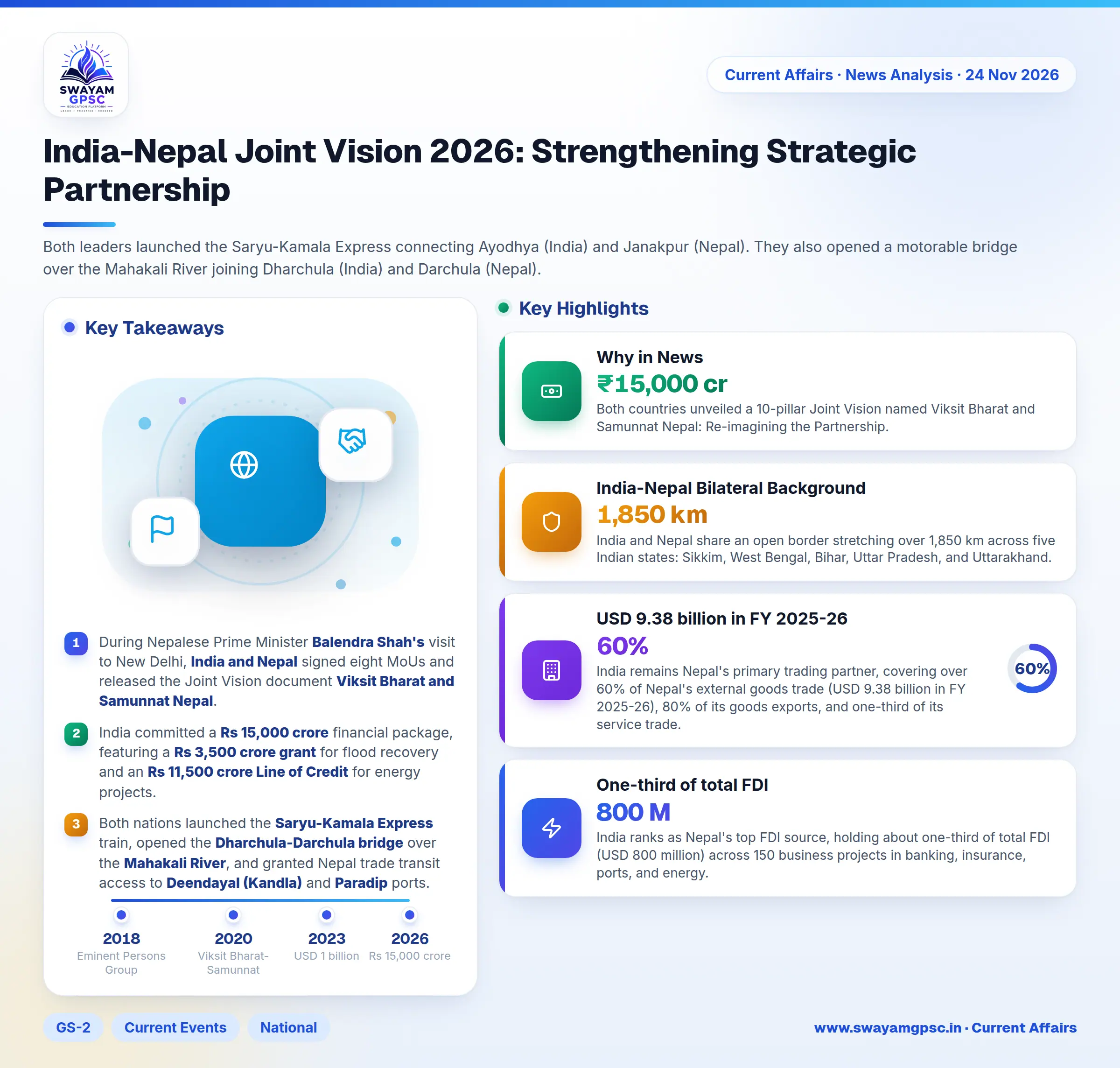
- During Nepalese Prime Minister Balendra Shah's visit to New Delhi, India and Nepal signed eight MoUs and released the Joint Vision document Viksit Bharat and Samunnat Nepal.
- India committed a Rs 15,000 crore financial package, featuring a Rs 3,500 crore grant for flood recovery and an Rs 11,500 crore Line of Credit for energy projects.
- Both nations launched the Saryu-Kamala Express train, opened the Dharchula-Darchula bridge over the Mahakali River, and granted Nepal trade transit access to Deendayal (Kandla) and Paradip ports.
- To support economic integration, both nations set a target of 10,000 MW of power exports from Nepal to India over ten years, while advancing the 669 MW Lower Arun hydro project.
- Both sides established a twice-yearly High-Level Monitoring Group to track project progress and agreed to address boundary issues over Kalapani-Lipulekh-Limpiyadhura and Susta through foreign secretary talks.
Why in News
- Nepalese Prime Minister Balendra Shah made his first official visit to New Delhi. During this state visit, India and Nepal signed eight Memorandum of Understanding documents.
- Both countries unveiled a 10-pillar Joint Vision named Viksit Bharat and Samunnat Nepal: Re-imagining the Partnership. India also announced a financial support package worth Rs 15,000 crore to boost Nepal's development.
Key Highlights of the Joint Vision Document
- India provided Rs 15,000 crore in total assistance. This funding includes a Rs 3,500 crore grant for rebuilding damage from the August 2026 Rasuwa-Trishuli/Bhotekoshi floods, along with a Rs 11,500 crore Line of Credit in Indian Rupees for clean energy projects.
- Both nations decided to build cross-border Special Economic Zones (SEZs) for export manufacturing, construct new IT parks, and launch new transit options. They made the B345 Kathmandu-Bhairahawa-Lucknow flight path bidirectional.
- Both leaders launched the Saryu-Kamala Express connecting Ayodhya (India) and Janakpur (Nepal). They also opened a motorable bridge over the Mahakali River joining Dharchula (India) and Darchula (Nepal).
- India granted Nepal trade access to Deendayal (Kandla) Port in Gujarat and Paradip Port in Odisha to process sea cargo.
- Both sides agreed to speed up work on Integrated Check Posts at Bhairahawa-Sunauli and Banbasa-Dodhara Chandani. They also committed to finish the Jayanagar-Bardibas and Jogbani-Biratnagar rail routes, advance the Raxaul-Kathmandu and East-West Rail tracks, construct the Siliguri-Jhapa oil pipeline, and expand cross-border UPI-Nepal mobile payments.
- Both governments proposed using PM Gati Shakti models for shared infrastructure mapping, while keeping open border entry points secure and regulated to block cross-border crime.
- India will increase investments in Nepal's hydro dams and power grids. Both countries pledged to speed up major water ventures including the Pancheshwar, Saptakoshi, and Sunkoshi projects.
- Both nations will share real-time hydro-meteorological data, track dangerous glacial lakes, run early warning alerts, and hold joint Humanitarian Assistance and Disaster Relief (HADR) exercises.
- India and Nepal will start a Green Hydrogen pilot project in Nepal. They will also expand ties through environmental groups like ISA, CDRI, ICIMOD, and the International Big Cat Alliance (IBCA).
- Both governments will share technical knowledge in digital identities and e-governance to back the Digital Nepal Framework while protecting data rights. Nepalese officers will train at India's National Centre for Good Governance (NCGG), accompanied by legislative staff visits.
- Both nations will grow the India-Nepal Startup Partnership Network (IN-SPAN), build a Startup Centre of Excellence in Kathmandu, create an Innovation Hub in Pokhara, and construct new digital data parks.
- India will help build a Nepali Language model using its BHASHINI AI system. Both countries will also deepen 5G/6G research and satellite cooperation between NAST and ISRO/IN-SPACE.
- Both sides agreed to build a SATCOM network using the South Asia Satellite.
- India plans to explore opening an IIT campus in Nepal, offer more college scholarships in technology, and set up vocational training centres with teacher swaps.
- Both countries agreed to launch a National Cricket Coaching Academy in Nepal, build sports complexes, and train Nepalese athletes in mountain sports.
- Both partners will jointly develop tourism along the Ramayana Circuit (Janakpur-Ayodhya), Buddhist Circuit (Lumbini-Bodhgaya-Sarnath-Kushinagar), and Shiv-Shakti Circuit (Kathmandu/Pashupatinath-Varanasi), supported by new sister-city agreements.
- Both nations will set up a Nalanda Centre at Lumbini Buddhist University (LBU), run an annual youth cultural festival, and encourage tourism using digital creators.
- India will build health facilities under High-Impact Community Development Projects (HICDPs), upgrade Nepal's National Medical Laboratory, open India-Nepal Jan Aushadhi Kendras, and offer medical training via ITEC.
- India will fund an Agro-Industrial Park in Chitwan through grants, set up an ICAR Centre of Excellence in Nepal, and execute the ICAR-NARC Work Plan (2026-2030).
India-Nepal Bilateral Background
- India and Nepal share an open border stretching over 1,850 km across five Indian states: Sikkim, West Bengal, Bihar, Uttar Pradesh, and Uttarakhand.
- India remains Nepal's primary trading partner, covering over 60% of Nepal's external goods trade (USD 9.38 billion in FY 2025-26), 80% of its goods exports, and one-third of its service trade.
- India ranks as Nepal's top FDI source, holding about one-third of total FDI (USD 800 million) across 150 business projects in banking, insurance, ports, and energy.
- Military ties rest on the Gorkha Regiment, where roughly 32,000 Nepalese Gorkha soldiers serve in the Indian Army. Both militaries run the annual Surya Kiran exercise.
- In February 2026, both nations signed a Mutual Legal Assistance Agreement (MLAA) to improve joint criminal probes.
- India acts as the primary emergency helper for Nepal. India gave USD 1 billion after the 2015 earthquake, USD 75 million for the 2023 Jajarkot quake, and launched Operation Maitri.
- Power trade relies on the 2014 Power Trade Agreement, targeting 10,000 MW of electricity exports from Nepal to India over ten years.
- Nepal sold around 1,100 MW of power to India in 2025-26 and started selling electricity to Bangladesh across the Indian power grid.
- The Muzaffarpur-Dhalkebar power line operates actively, while construction moves ahead on the Gorakhpur-Butwal, Dododhara-Bareilly, and Inaruwa-Purnea lines.
- Indian firm SJVN is building the Arun-III (900 MW) and Lower Arun (669 MW) hydro plants on the Arun River.
Historical Evolution of Bilateral Ties
- The 1950 Treaty of Peace and Friendship established open borders, equal job rights, and close defense cooperation between both nations.
- Water agreements like the Kosi Agreement (1954), Gandak Agreement (1959), and Mahakali Treaty (1996) created early rules for joint river management.
- India backed Nepal's democratic growth through the 1951 Delhi Compromise and supported peace talks under the 2005 12-Point Understanding.
- Tensions grew in 2015 due to border protests over Nepal's new constitution. This strain led Nepal to seek closer trade and transit links with China.
- Relations recovered from 2020 to 2026 through new railway lines, fuel pipelines, long-term power agreements, and the Viksit Bharat-Samunnat Nepal vision.
Significance of the Strategic Partnership
- A peaceful Nepal acts as a security buffer along India's 1,751-km open border, helping stop illegal cross-border smuggling and insurgent activity.
- Nepal's mountain rivers offer clean hydro power to help India reach its renewable energy goals.
- Modern check posts, train tracks, and oil pipelines strengthen trade networks across South Asia under the BBIN initiative.
- Shared cultural sites along the Ramayana and Buddhist circuits, together with family ties and Gorkha military service, maintain strong social connections between both populations.
Challenges in India-Nepal Relations
- Border disputes over Kalapani-Lipulekh-Limpiyadhura and Susta cause periodic political friction. Nepal updated its official map in 2020 to claim these areas.
- Nepalese political leaders view the 1950 Treaty of Peace and Friendship as unbalanced. The Eminent Persons Group (EPG) report from 2018 remains unaccepted by New Delhi.
- China's growing economic activity in Nepal under the Belt and Road Initiative creates security concerns for India along the open border.
- Delays in completing Indian projects, like the Pancheshwar hydro plan, lower trust and encourage Nepal to hire Chinese companies.
- Nepal faces a large trade deficit with India and wants simpler quality checks along with new high-altitude flight routes via Mahendranagar and Nepalgunj.
- Open borders create security problems by allowing drug smuggling, fake currency movements, and illegal border crossings.
Way Forward
- India must complete the Rs 15,000 crore development project, the Lower Arun plant, and Banbasa check post quickly to fix past execution delays.
- Both governments should use Foreign Secretary talks to resolve boundary disputes quietly without letting political disagreements block power and trade deals.
- India should follow the Gujral Doctrine principles of equality to lower Nepal's trade deficit through new supply chains like the Chitwan agro park.
- Both nations need to move past temp disaster aid by building shared Himalayan early-warning systems for flood risks.
- Both governments activated a High-Level Monitoring Group led by Nepal's Foreign Secretary and India's Ambassador to ensure fast project completion.