India-Nepal Bilateral Relations 2026 Summit and Cooperation
#GS-2 #Current Events #International #International Relations #India-Nepal Relations #Bilateral Trade #Hydropower Cooperation
Key takeaways
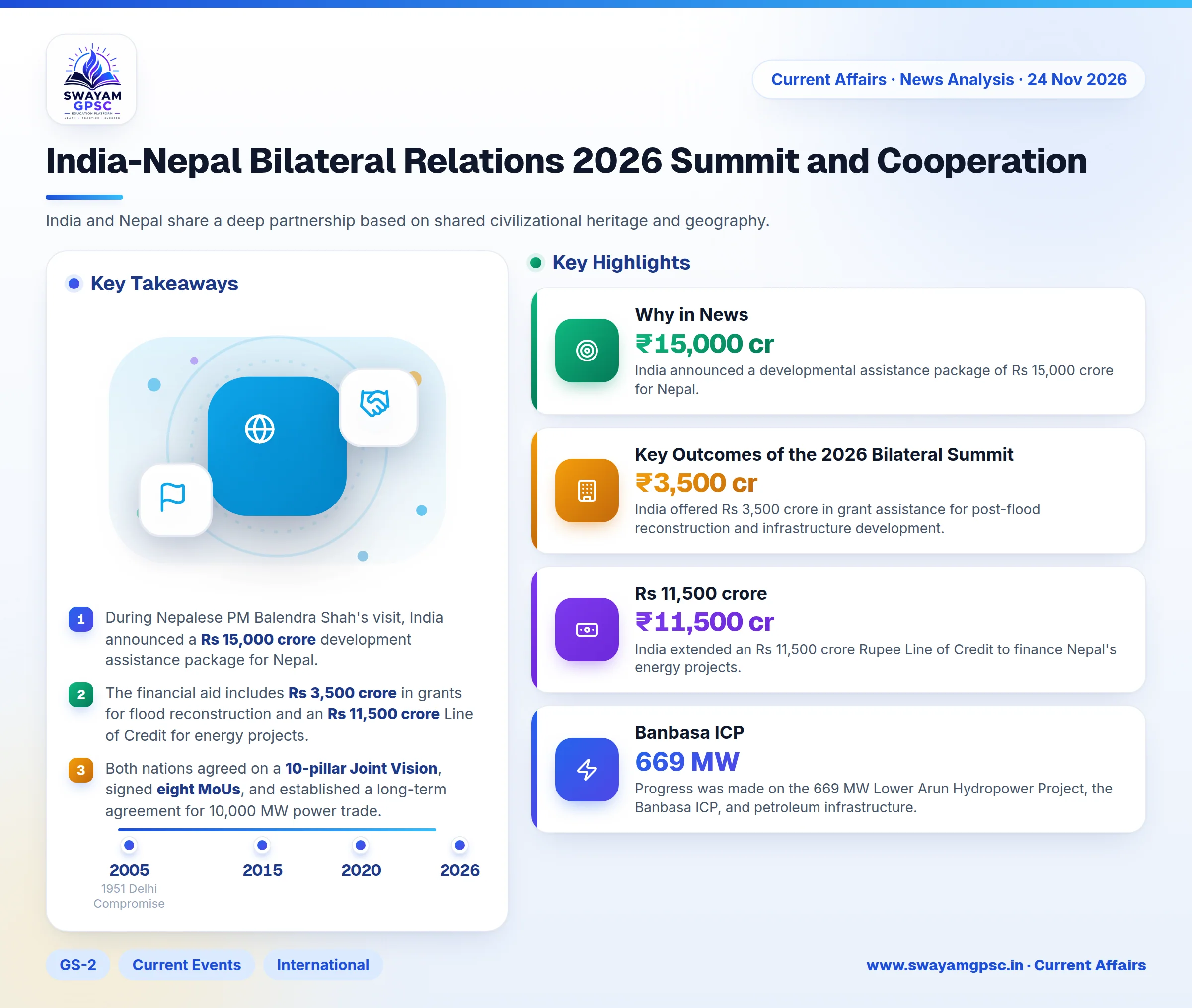
- During Nepalese PM Balendra Shah's visit, India announced a Rs 15,000 crore development assistance package for Nepal.
- The financial aid includes Rs 3,500 crore in grants for flood reconstruction and an Rs 11,500 crore Line of Credit for energy projects.
- Both nations agreed on a 10-pillar Joint Vision, signed eight MoUs, and established a long-term agreement for 10,000 MW power trade.
- Key infrastructure milestones included launching the Sarayu-Kamala Express and inaugurating the Dharchula-Darchula bridge along India's 1,751-km open border.
- Boundary disputes over Kalapani, Lipulekh, Limpiyadhura, and Susta continue to present diplomatic challenges.
Why in News
- Nepalese Prime Minister Balendra Shah visited India recently to strengthen bilateral relations.
- Both countries signed eight MoUs during the visit to boost cooperation in multiple sectors.
- They unveiled a 10-pillar Joint Vision to guide future bilateral collaboration.
- India announced a developmental assistance package of Rs 15,000 crore for Nepal.
Overview of India-Nepal Relations
- India and Nepal share a deep partnership based on shared civilizational heritage and geography.
- The two countries maintain an open border that allows free movement of people and goods.
- Both nations depend heavily on each other for security, economic growth, and hydropower development.
Key Outcomes of the 2026 Bilateral Summit
- India offered Rs 3,500 crore in grant assistance for post-flood reconstruction and infrastructure development.
- India extended an Rs 11,500 crore Rupee Line of Credit to finance Nepal's energy projects.
- The eight bilateral MoUs focus on satellite communications, forensic sciences, police training, and civil service capacity building.
- The agreements also cover cooperation in Ayurveda, healthcare, urban development, and livestock and fisheries.
- Both sides launched the Sarayu-Kamala Express train service to improve cross-border transit.
- They inaugurated the Dharchula-Darchula bridge to connect border communities directly.
- Progress was made on the 669 MW Lower Arun Hydropower Project, the Banbasa ICP, and petroleum infrastructure.
- Both nations committed to updating the 1950 Treaty of Peace and Friendship through mutual agreement.
- They agreed to resolve long-standing disputes regarding boundaries, water sharing, and trade through dialogue.
- Both sides decided to strengthen the Digital Nepal Framework and expand cross-border UPI payments.
- They agreed to develop a Nepali Large Language Model using Bhashini and set up an IIT campus in Nepal.
- Plans were made to establish India-Nepal Jan Aushadhi Kendras to provide affordable medicines.
- They agreed to set up a grant-assisted Agro-Industrial Park in Chitwan to support agricultural processing.
- A twice-yearly High-Level Monitoring Group led by Nepal's Foreign Secretary and India's Ambassador was activated to oversee project execution.
Background and Historical Context
- The 1950 Treaty of Peace and Friendship established modern bilateral ties with an open border and open employment privileges.
- River basin collaboration began early with the Kosi Agreement (1954) and the Gandak Agreement (1959).
- The two nations signed the Mahakali Treaty (1996), which includes the Pancheshwar Multipurpose Project.
- India supported Nepal's democratic changes through the 1951 Delhi Compromise and the 2005 12-Point Understanding.
- Relations faced friction in 2015 due to Nepal's new constitution and Madhesi border protests, leading Nepal closer to China.
- Ties recovered between 2020 and 2026 through railways, pipelines, a 10,000 MW power trade deal, and the Viksit Bharat-Samunnat Nepal Joint Vision.
Challenges
- Cartographic disagreements over border regions cause diplomatic strain and political issues in Nepal.
- In 2020, Nepal updated its political map to include Kalapani, Lipulekh, and Limpiyadhura, while boundary issues in Susta remain unresolved.
- Nepal's involvement in China's Belt and Road Initiative (BRI) raises security concerns for India along the open border.
- Chinese investments in Pokhara and Lumbini airports, hydropower tenders, and telecom projects near India's border add to strategic worries.
- Major river projects face decades of delay over benefit-sharing formulas, environmental clearances, and flood control.
- The Pancheshwar Multipurpose Project remains delayed, while monsoon flooding along Bihar border rivers like the Kosi and Gandak creates local tension.
- Nepal suffers from a massive merchandise trade deficit with India.
- Nepal has requested extra high-altitude air entry routes via Mahendranagar, Nepalgunj, and Janakpur to make its new international airports viable.
Significance of the Partnership
- A stable Nepal serves as a key security buffer along India's 1,751-km open border against cross-border crime and insurgency.
- Nepal's hydropower potential provides clean energy to help India reach its net-zero and renewable targets.
- Modern check posts, railways, and pipelines promote sub-regional trade integration across the BBIN region.
- Shared cultural circuits like the Ramayana and Buddhist trails, along with Gorkha military recruitment, create strong societal ties.
Way Forward
- Both nations must keep project implementation on schedule using the newly activated High-Level Monitoring Group.
- Sensitive boundary and treaty issues should be resolved through open, constructive dialogue.
- Expanding digital, energy, and educational ties will help build a modern partnership that satisfies current aspirations.