India Needs Innovative Strategies to Eliminate TB
#GS-2 #Governance & Social Justice #Health #Economy #Current Events #National
Key takeaways
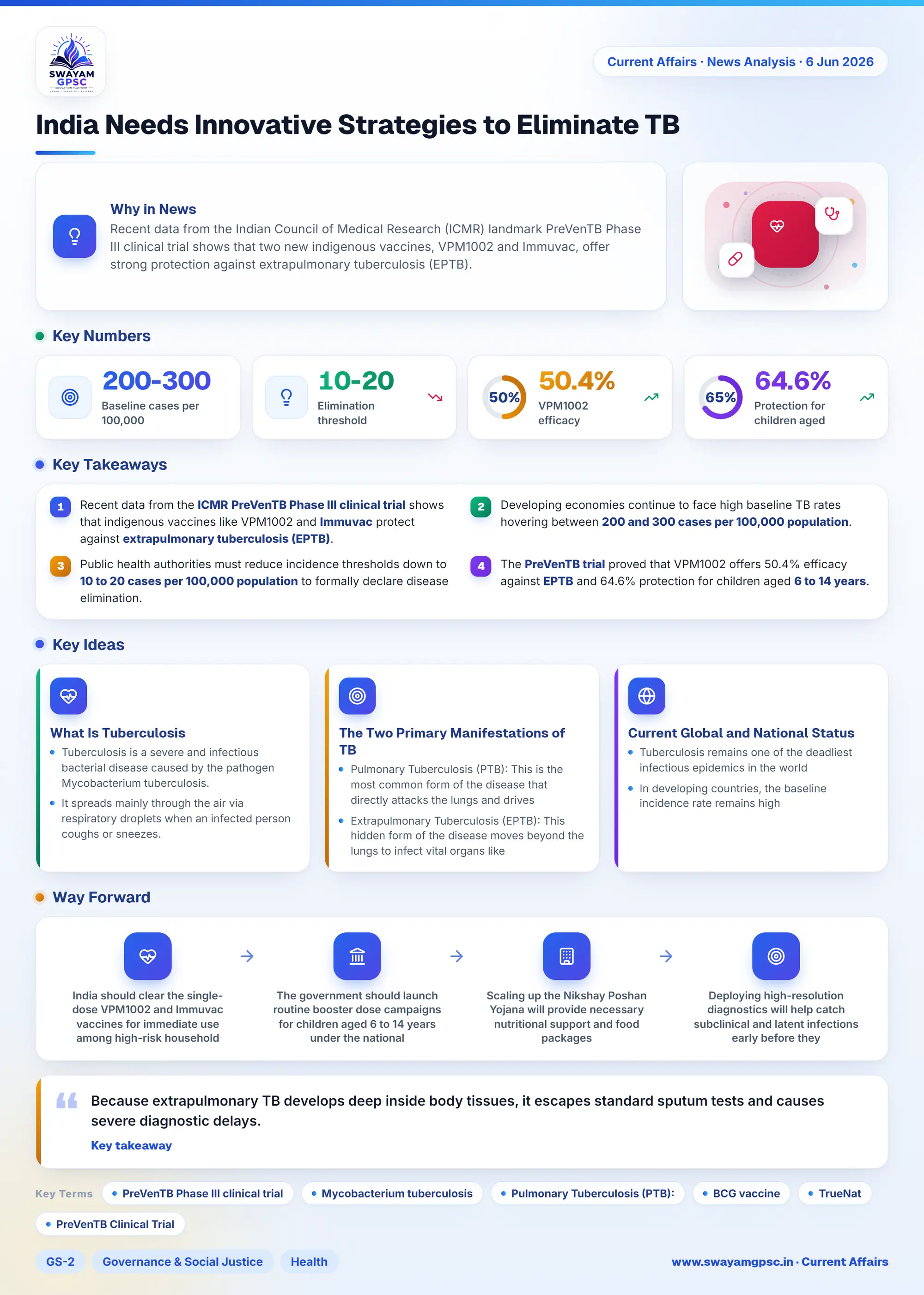
- Recent data from the ICMR PreVenTB Phase III clinical trial shows that indigenous vaccines like VPM1002 and Immuvac protect against extrapulmonary tuberculosis (EPTB).
- Developing economies continue to face high baseline TB rates hovering between 200 and 300 cases per 100,000 population.
- Public health authorities must reduce incidence thresholds down to 10 to 20 cases per 100,000 population to formally declare disease elimination.
- The PreVenTB trial proved that VPM1002 offers 50.4% efficacy against EPTB and 64.6% protection for children aged 6 to 14 years.
Why in News
- Recent data from the Indian Council of Medical Research (ICMR) landmark PreVenTB Phase III clinical trial shows that two new indigenous vaccines, VPM1002 and Immuvac, offer strong protection against extrapulmonary tuberculosis (EPTB).
What Is Tuberculosis
- Tuberculosis is a severe and infectious bacterial disease caused by the pathogen Mycobacterium tuberculosis.
- It spreads mainly through the air via respiratory droplets when an infected person coughs or sneezes.
- The human immune system can keep the bacteria in a hidden latent state for years, but the infection can later turn into an active disease.
The Two Primary Manifestations of TB
- Pulmonary Tuberculosis (PTB): This is the most common form of the disease that directly attacks the lungs and drives airborne transmission across communities.
- Extrapulmonary Tuberculosis (EPTB): This hidden form of the disease moves beyond the lungs to infect vital organs like the lymph nodes, spine, brain, or kidneys, making it much harder to diagnose.
Current Global and National Status of TB
- Tuberculosis remains one of the deadliest infectious epidemics in the world, killing more people annually than any other pathogen.
- In developing countries, the baseline incidence rate remains high, staying between 200 and 300 cases per 100,000 population.
- To declare the elimination of the disease, public health systems must reduce this rate down to 10 to 20 cases per 100,000 population.
- Despite more than a century passing since the infant BCG vaccine was introduced, there is still no universally effective commercial vaccine for adults.
Challenges
- Because extrapulmonary TB develops deep inside body tissues, it escapes standard sputum tests and causes severe diagnostic delays.
- Access to advanced molecular testing platforms and preventive therapies is deeply uneven across different regions.
- Widespread malnutrition lowers human immunity and directly reduces the effectiveness of vaccines among undernourished populations.
- Past global trials failed because they looked for a single silver bullet focused only on lung infections while ignoring other disease pathways.
- India lacks structured vaccination or booster guidelines for school-aged children, adolescents, and adults.
Initiatives Taken So Far
- The National TB Elimination Programme (NTEP) tracks active cases and distributes free anti-TB drugs across the country.
- India pioneered the nationwide rollout of an indigenous molecular test named TrueNat to speed up case detection.
- The PreVenTB Clinical Trial covered 12,700 household contacts across 18 sites and proved that VPM1002 offers 50.4% efficacy against EPTB along with 64.6% protection for children aged 6 to 14 years.
- Global frameworks like the WHO End TB Strategy and the UN High-Level Meetings on TB aim to scale up funding and close diagnostic gaps.
Way Forward
- India should clear the single-dose VPM1002 and Immuvac vaccines for immediate use among high-risk household contacts.
- The government should launch routine booster dose campaigns for children aged 6 to 14 years under the national immunization framework.
- Scaling up the Nikshay Poshan Yojana will provide necessary nutritional support and food packages to undernourished communities.
- Deploying high-resolution diagnostics will help catch subclinical and latent infections early before they progress.
- Building a multi-vaccine combination framework will help target different age groups and disease pathways effectively.