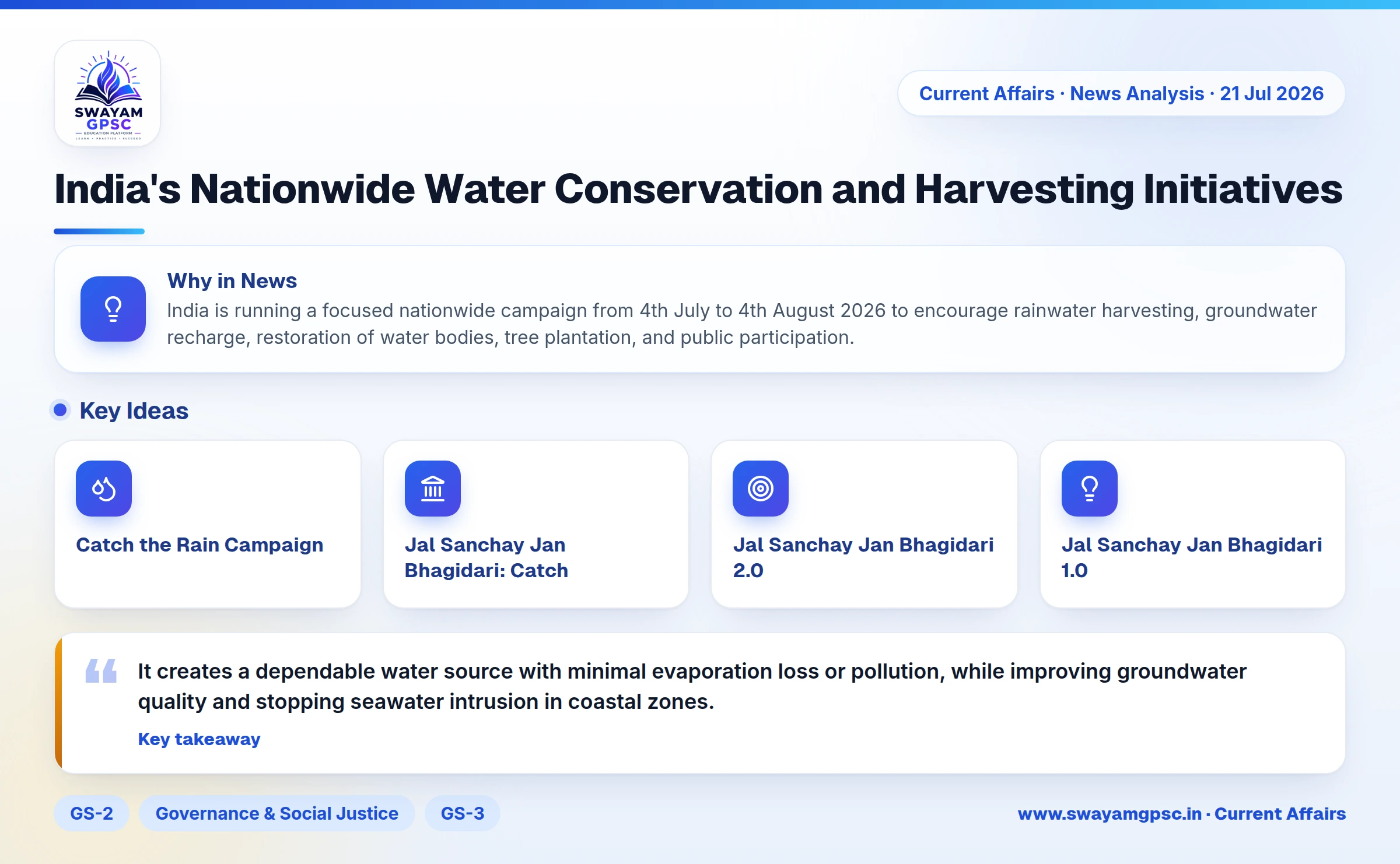
India's Nationwide Water Conservation and Harvesting Initiatives
#GS-2 #Governance & Social Justice #GS-3 #Economy #Infrastructure #Environment #Climate Change #Sustainable Development #Current Events #National #Water Conservation
Why in News
- India is running a focused nationwide campaign from 4th July to 4th August 2026 to encourage rainwater harvesting, groundwater recharge, restoration of water bodies, tree plantation, and public participation.
- This campaign responds directly to the Prime Minister's Mann Ki Baat appeal to save every drop of rain and maintain water conservation momentum across the nation.
Catch the Rain Campaign
- The National Water Mission drives the Catch the Rain campaign with the tagline "Catch the rain, where it falls, when it falls", encouraging states to build rainwater structures suitable for local conditions before monsoons arrive.
- The drive promotes check dams, harvesting pits, rooftop systems, desilting of tanks, clearing encroachments, repairing stepwells, and using abandoned borewells for groundwater recharge.
- States are establishing dedicated Rain Centres in every district at Collectorates, municipal offices, or gram panchayats to give technical guidance to citizens.
- Buildings are encouraged to set up rooftop harvesting systems to hold rainwater on their premises, which boosts soil moisture, raises groundwater levels, prevents road damage, and controls urban flooding.
- District authorities, educational institutions, public sector units, transport agencies, and security forces with large landholdings are tasked with mapping water bodies, clearing encroachments, and conserving water actively.
Jal Sanchay Jan Bhagidari: Catch the Rain (2026)
- Government authorities launched Jal Sanchay Jan Bhagidari: Catch the Rain on 1st June 2026 by expanding the original Jal Sanchay Jan Bhagidari drive and merging it with the Jal Shakti Abhiyan.
- The main goal is to promote rainwater harvesting, groundwater recharge, water storage, and community participation to turn every rain event into a water conservation opportunity.
- It integrates low-cost local solutions by combining funds from the Viksit Bharat-Guarantee for Rozgar and Ajeevika Mission-Gramin, Per Drop More Crop under PMKSY, Repair, Renovation and Restoration of Water Bodies, CAMPA, Finance Commission Grants, and state schemes.
- Panchayati Raj Institutions, Urban Local Bodies, self-help women's groups, youth groups, schools, civil society organisations, and local citizens actively participate to build sustainable water security and climate resilience.
Jal Sanchay Jan Bhagidari 2.0
- The government launched Jal Sanchay Jan Bhagidari 2.0 on 1st June 2025 to speed up groundwater recharge in over-exploited and water-critical districts through low-cost, local structures.
- Against the original target of 1 crore recharge structures by 31st May 2026, the country completed over 1.5 crore structures, while top achievers were honored at the 6th National Water Awards in November 2025.
Jal Sanchay Jan Bhagidari 1.0
- The initial phase, Jal Sanchay Jan Bhagidari 1.0, was launched on 6th September 2024 in Surat, Gujarat, to make water conservation a national public priority.
- Operating on the core principles of Community, Corporate Social Responsibility, and Cost, the initiative promoted affordable recharge structures, borewell revival, scientific solutions, and combined government-society action.
- Implemented between 1st April 2024 and 31st May 2025, the drive surpassed its target of 10 lakh groundwater structures by delivering more than 27 lakh artificial recharge structures.
Jal Shakti Abhiyan: Catch the Rain
- Authorities launched Jal Shakti Abhiyan: Catch the Rain on World Water Day in 2021 with the motto "Catch the Rain, where it falls, when it falls."
- The campaign encourages rainwater harvesting, groundwater recharge, watershed management, water body rejuvenation, and tree planting through a nationwide public movement.
- It expands on the success of Jal Shakti Abhiyan 2019, which targeted 1,592 water-stressed blocks across 256 districts, and now runs every year with new themes.
Jal Shakti Kendras
- Government authorities are setting up Jal Shakti Kendras at the district level to serve as key institutional hubs supporting local water conservation.
- These centres act as knowledge and guidance hubs that spread awareness about rainwater harvesting, groundwater recharge, and efficient water management techniques.
- Experts at these facilities provide technical guidance to local communities, district officials, and execution teams to plan and run projects properly.
- Jal Shakti Kendras strengthen community involvement by connecting citizens, institutions, and government departments with practical water-saving remedies.
Water Harvesting Systems and Types
- A water harvesting system includes techniques and structures designed to collect, store, and use rainwater or surface runoff for farming, household needs, and groundwater recharge.
- Rainwater Harvesting (RWH) collects and stores rain through rooftop systems and underground tanks to preserve water supplies.
- Groundwater Recharge Systems use tools like recharge wells to help rainwater seep deep into the earth and maintain groundwater reserves.
- Surface Water Harvesting collects rain runoff from open fields and land into ponds and reservoirs for irrigation and other practical uses.
- Urban Water Harvesting captures rain from city rooftops and paved surfaces to lower the burden on municipal networks and control stormwater flow.
Significance of Water Harvesting
- It creates a dependable water source with minimal evaporation loss or pollution, while improving groundwater quality and stopping seawater intrusion in coastal zones.
- Harvesting water lowers flood hazards and waterlogging, which shields private properties, public infrastructure, and land surfaces from soil erosion.
- Recharge structures replenish underground aquifers for dry months, reduce surface runoff, protect topsoil, and prevent silt buildup in rivers and lakes.
- Sustainable harvesting practices conserve overall water resources and reverse groundwater depletion caused by rapid urban growth.
Conclusion
- Campaigns like Catch the Rain and Jal Sanchay Jan Bhagidari have turned water conservation into a nationwide movement powered by scientific planning and public ownership.
- With growing climate risks and water demand, storing every rain drop is vital for national water security, agricultural production, and rural livelihoods.
- These drives strengthen India's progress toward Viksit Bharat by building long-lasting water infrastructure and encouraging shared responsibility across generations.