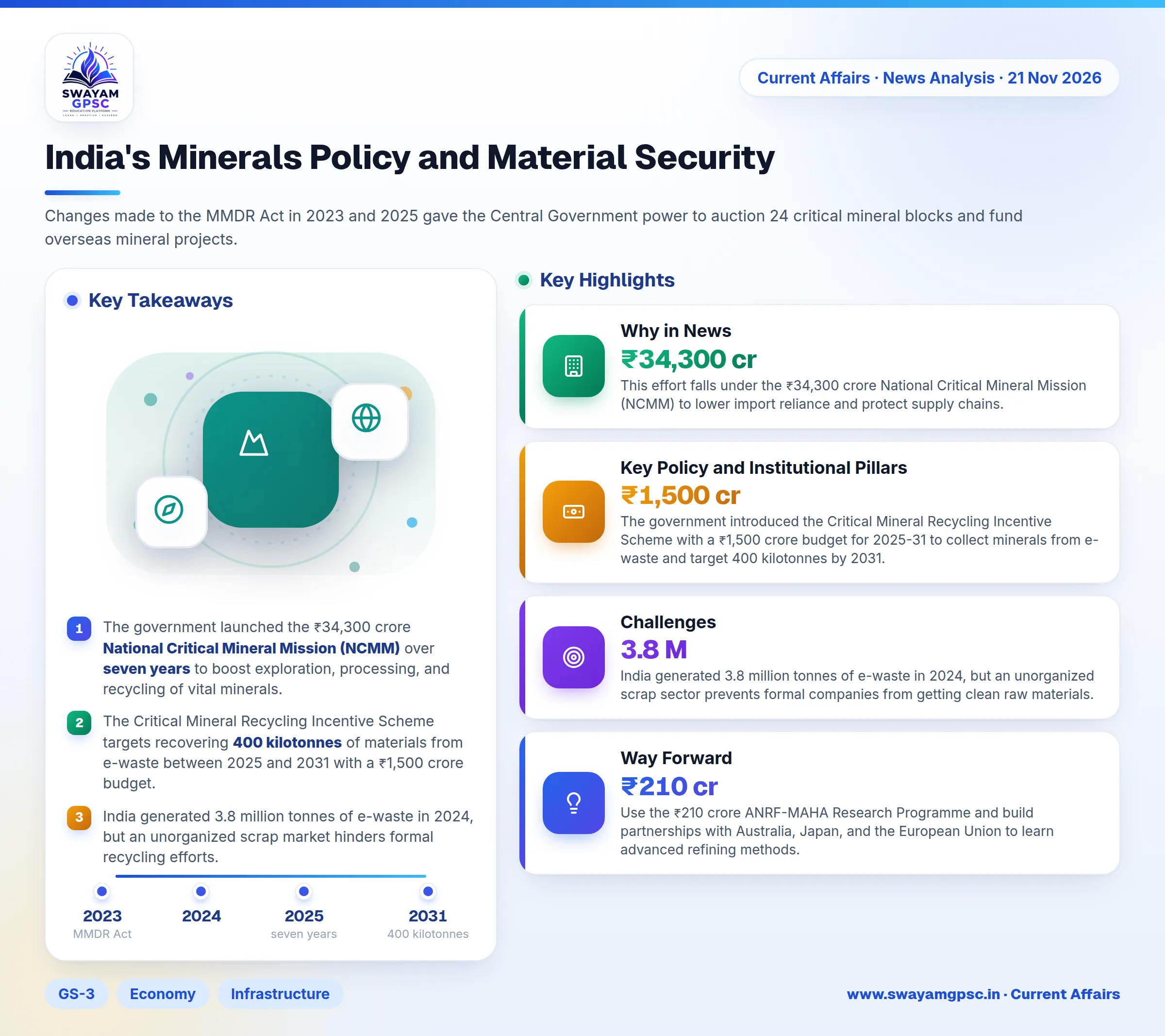
India's Minerals Policy and Material Security
#GS-3 #Economy #Infrastructure #Environment #Sustainable Development #Material Security #National Critical Mineral Mission #Critical Minerals
Key takeaways
- The government launched the ₹34,300 crore National Critical Mineral Mission (NCMM) over seven years to boost exploration, processing, and recycling of vital minerals.
- The Critical Mineral Recycling Incentive Scheme targets recovering 400 kilotonnes of materials from e-waste between 2025 and 2031 with a ₹1,500 crore budget.
- India generated 3.8 million tonnes of e-waste in 2024, but an unorganized scrap market hinders formal recycling efforts.
- The MMDR Act amendments enabled the central government to auction 24 critical mineral blocks and expand overseas acquisitions through Khanij Bidesh India Limited (KABIL).
- Experts recommend allocating resources through the ₹210 crore ANRF-MAHA Research Programme to build domestic chemical refining capacity.
Why in News
- Policy experts have urged the Indian government to boost local processing, refining, and recycling of critical minerals.
- This effort falls under the ₹34,300 crore National Critical Mineral Mission (NCMM) to lower import reliance and protect supply chains.
What is Material Security?
- Material security means having a steady and uninterrupted supply of battery-grade and refined minerals like lithium, cobalt, nickel, and rare earth elements for local factories.
- It focuses on going beyond just digging raw ore out of the ground by adding chemical refining, recycling, and maintaining emergency mineral stocks.
Key Policy and Institutional Pillars
- The National Critical Mineral Mission (NCMM) was approved in 2025 with a total budget of ₹34,300 crore over seven years to support exploration, processing, foreign acquisitions, and research.
- Changes made to the MMDR Act in 2023 and 2025 gave the Central Government power to auction 24 critical mineral blocks and fund overseas mineral projects.
- The government introduced the Critical Mineral Recycling Incentive Scheme with a ₹1,500 crore budget for 2025-31 to collect minerals from e-waste and target 400 kilotonnes by 2031.
- A joint venture company named Khanij Bidesh India Limited (KABIL) buys foreign mineral assets, including lithium blocks located in Argentina.
Why Auctions Alone Are Insufficient?
- Raw mined ore cannot go straight into battery factories without complex chemical refining, a midstream step currently dominated by China.
- Setting up new domestic mines takes years due to delays in getting environmental clearances, buying land, and building roads, leaving a sharp supply shortage for solar and electric vehicle production.
- India still buys almost all of its processed lithium, cobalt, nickel, and permanent magnets from abroad even though raw deposits exist inside the country.
Challenges
- India lacks large commercial chemical processing plants, which forces local mining companies to ship raw ore abroad for refining before buying it back at higher prices.
- Auctioned mineral blocks face multi-year delays in supplying factories because the country lacks specialized refining technology.
- India generated 3.8 million tonnes of e-waste in 2024, but an unorganized scrap sector prevents formal companies from getting clean raw materials.
- Electronics and battery makers often avoid buying recycled inputs because their quality varies and supply chains lack clear tracking.
- Fast-changing battery technology makes stockpiling raw minerals risky because shifts between Lithium Iron Phosphate (LFP) and Nickel Manganese Cobalt (NMC) chemistries quickly change mineral needs.
- Foreign trade limits and concentration of mining in a few countries make Indian factories vulnerable to sudden export bans and sudden price spikes.
Way Forward
- Build Critical Mineral Processing Parks next to mining sites so raw blocks and refining capacity can grow together.
- Connect informal scrap workers with official recycling companies using Extended Producer Responsibility (EPR) rules and Bureau of Indian Standards (BIS) quality tags.
- Create national reserves of refined, high-grade minerals instead of storing raw rocks, with clear guidelines for regular rotation and emergency use.
- Judge the success of the National Critical Mineral Mission (NCMM) by the actual tonnage of refined minerals delivered to factories rather than the number of mined blocks auctioned.
- Use the ₹210 crore ANRF-MAHA Research Programme and build partnerships with Australia, Japan, and the European Union to learn advanced refining methods.
Conclusion
- India has built a firm regulatory base for raw mineral extraction through new legislation and dedicated state missions.
- Long-term industrial stability now depends on expanding processing plants, upgrading e-waste collection, and stocking ready-to-use factory inputs to fuel domestic manufacturing.