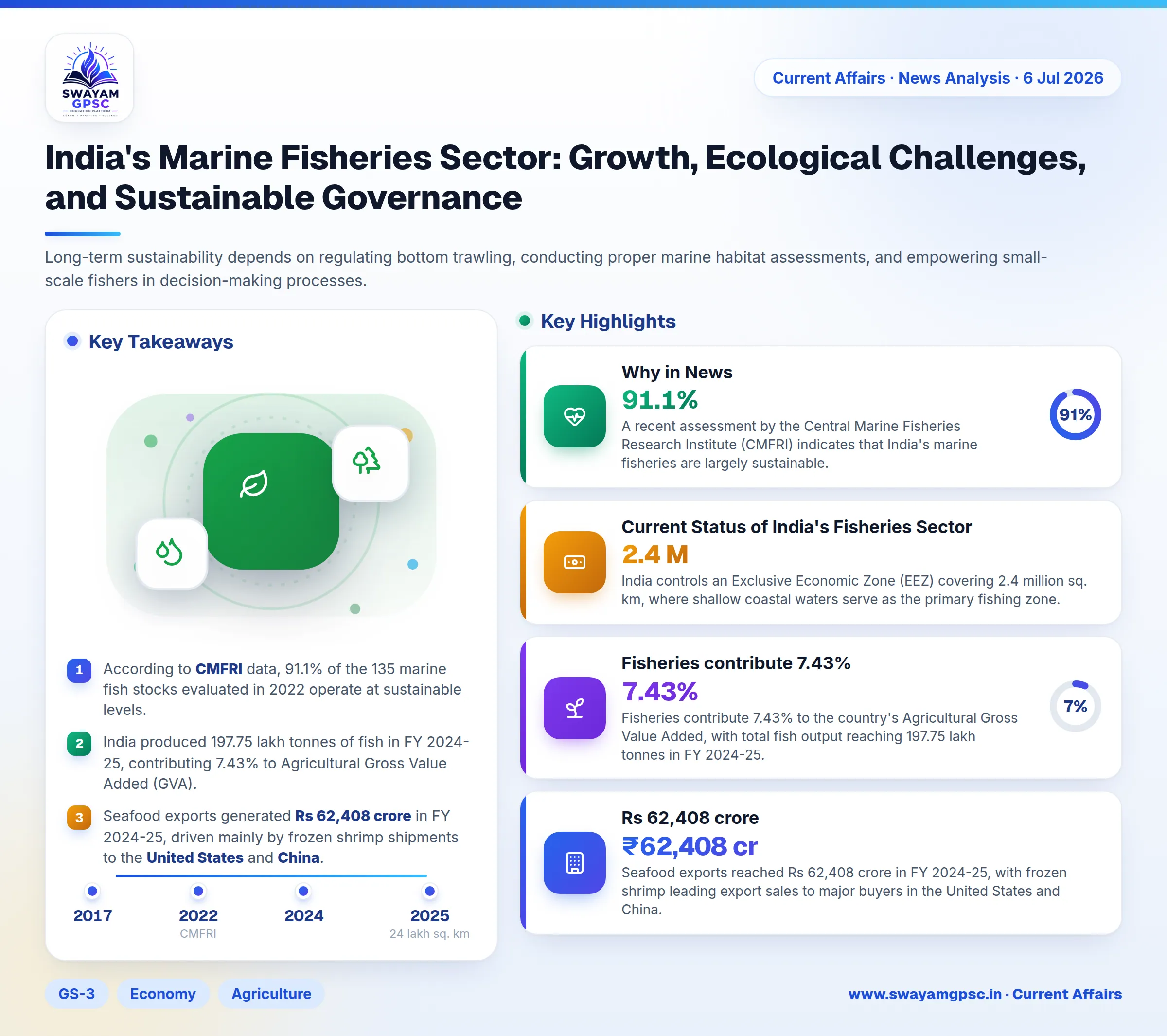
India's Marine Fisheries Sector: Growth, Ecological Challenges, and Sustainable Governance
#GS-3 #Economy #Agriculture #Infrastructure #Environment #Sustainable Development #GS-2 #Governance & Social Justice #Current Events #National #Fisheries Sector
Why in News
- A recent assessment by the **Central Marine Fisheries Research Institute (CMFRI)** indicates that India's marine fisheries are largely sustainable. The report notes that **91.1%** of assessed fish stocks remain in good health.
- On the other hand, the **Food and Agriculture Organization (FAO)** highlights growing concerns. These include stagnant catches, damage to nearshore seabed habitats, and heavy pressure from over **64,000** mechanised trawlers.
Summary of Sector Status and Ecological Stress
- India's marine fishing industry faces serious ecological and governance stress despite official claims of high stock sustainability. The **FAO** urges caution due to fully exploited resources and excess fishing capacity.
- The primary threat comes from the destruction of inshore seabed environments. Resolving this issue requires stronger coastal oversight, scientific surveys at sea, and active participation from local fishing communities.
- Long-term sustainability depends on regulating bottom trawling, conducting proper marine habitat assessments, and empowering small-scale fishers in decision-making processes.
Current Status of India's Fisheries Sector
- India controls an **Exclusive Economic Zone (EEZ)** covering **2.4 million sq. km**, where shallow coastal waters serve as the primary fishing zone.
- The **2022** assessment by **CMFRI** evaluated **135** marine fish stocks and found **91.1%** of them to be operating at sustainable levels.
- Unlike advanced fishing nations that conduct scientific surveys at sea, India estimates stock health mainly using fish landing data collected at ports.
- Fisheries contribute **7.43%** to the country's Agricultural Gross Value Added, with total fish output reaching **197.75 lakh tonnes** in FY **2024-25**.
- Seafood exports reached **Rs 62,408 crore** in FY **2024-25**, with frozen shrimp leading export sales to major buyers in the **United States** and **China**.
- The Union Budget **2026-27** allocated **Rs 2,761 crore** to the sector, allocating **Rs 2,500 crore** directly to the **Pradhan Mantri Matsya Sampada Yojana (PMMSY)**.
- Institutional credit access expanded as the government raised borrowing limits under **Kisan Credit Cards (KCC)** to **Rs 5 lakh** for fishers.
- The fleet now includes over **64,000** mechanised vessels, marking a major transformation from traditional wooden boats to powered fishing craft.
- Fish farmers are rapidly adopting modern technologies like **Recirculatory Aquaculture Systems (RAS)** and **Bio-floc technology** to boost productivity.
- The **RAS** technology uses closed-loop filtration to continuously clean and recycle water, reducing overall land and water requirements.
- The **Bio-floc technology** converts waste into beneficial microbial protein, providing both natural feed for fish and cleaner farm water.
- Launched in **2024**, the **National Fisheries Digital Platform (NFDP)** has registered over **30 lakh** stakeholders to streamline access to state subsidies.
- The **Pradhan Mantri Matsya Kisan Samridhi Sah-Yojana (PM-MKSSY)**, backed by **Rs 6,000 crore**, works to formalize unorganized fisheries supply chains.
- New regulations introduced in **2025** set rules for sustainable fishing across India's **24 lakh sq. km** **EEZ** to align with international marine standards.
Challenges Facing India's Fisheries Sector
- Relying solely on fish landing data creates blind spots. Without direct scientific measurements at sea, official sustainability figures may mask declining wild fish populations.
- Inshore marine environments face severe damage from mangrove removal, industrial pollution, reduced river water flow behind dams, and habitat degradation.
- Uncontrolled growth in the fleet of **64,000** mechanised trawlers causes continuous seabed scraping, which destroys bottom marine life and sparks conflict with traditional fishers.
- Weak enforcement of seasonal fishing bans and coastal zoning rules allows non-compliant fishing, largely due to shortages of patrol boats and staff in coastal states.
- Excess trawler capacity creates intense competition over dwindling catch, pushing small-scale fishing families into economic distress.
- Government plans urging fishers to shift into deep-sea waters face criticism from **FAO** experts, who note that deep ocean areas yield limited fish production while increasing fuel costs.
India's Initiatives for Sustainable Fishing
- The **National Policy on Marine Fisheries (NPMF, 2017)** establishes environmental conservation as the guiding principle for managing marine resources.
- The government enforces a strict **61-day** uniform fishing ban during the annual monsoon season across the **EEZ** to support stock recovery.
- Central regulations prohibit harmful practices like pair trawling, bull trawling, and using high-intensity **LED lights** to attract fish.
- Authorities actively promote eco-friendly measures, including sea ranching, deploying **Artificial Reefs**, and supporting seaweed mariculture.
- Coastal state governments enforce rules on minimum mesh sizes, engine horsepower limits, minimum legal catch sizes, and restricted fishing zones.
Way Forward
- Authorities must strengthen coastal patrol systems using electronic vessel tracking, community watch groups, and strict penalties for illegal entry.
- Research bodies like **CMFRI** should shift toward direct ocean research surveys to evaluate living fish stocks and benthic ecosystem health.
- State governments need to restrict destructive bottom trawling while enforcing strict seasonal closures to protect vulnerable coastal breeding grounds.
- Promoting combined aquaponics systems can help fish farmers lower water consumption while producing additional crops on limited land.
- Investing in cold chains, cold storage hubs, and refrigerated trucks will drastically reduce post-harvest fish spoilage and keep fish fresh for market.
- Fishers require training and low-cost credit to enter value-added markets, such as processed seafood meals, fish oil supplements, and marine collagen products.
Conclusion
- India's marine sector must strike a careful balance between economic output and marine conservation. Sustainable growth requires immediate action to protect fragile coastal waters.
- Protecting marine ecosystems while securing the livelihoods of local fishing families will ensure India maintains a resilient and globally competitive seafood industry.
Frequently Asked Questions
- Degradation of nearshore breeding grounds remains the primary threat, driven by industrial pollution, habitat loss, and illegal trawling.
- Mechanised trawling uses powered vessels to drag weighted nets along the ocean floor, which can destroy bottom ecosystems if done without proper controls.
- Shallow coastal waters act as vital nurseries and feeding grounds for young marine species, while supporting millions of small-scale artisanal fishers.
- The **PMMSY** scheme provides safety nets during ban periods, funds group insurance, builds artificial reefs, and develops climate-resilient fishing villages.
- Key reforms include ocean-based stock assessments, stricter nearshore vessel monitoring, co-management by local fishers, and mangrove restoration.